When your QA team reviews only 3% of calls, the other 97% is a blind spot. Compliance gaps go unnoticed. Coaching opportunities are missed. Revenue leaks from high-intent calls that never convert.
Call center quality monitoring should do more than score agent performance. It should connect call quality to conversion rates, campaign ROI, and customer lifetime value.
This guide shows you how. You'll learn to build scorecards that catch compliance issues early, set quality standards across all channels, and use AI to score 100% of calls without adding headcount.
Main Takeaways
- Call center quality monitoring reviews voice, chat, and email contacts. It helps boost agent results, maintain compliance, and protect revenue.
- A QA scorecard should weight compliance at 25%–30% in regulated fields, and focus on resolution accuracy in sales settings.
- AI-powered analytics platforms score 100% of calls against custom criteria. No need for manual review or data science skills.
- When call outcomes link to the campaigns that drove them, quality monitoring becomes a revenue function.
What Call Center Quality Monitoring Is and Why It Drives Revenue
Call center quality monitoring is the process of recording, scoring, and reviewing customer contacts across voice, chat, and email. The goal is to strengthen agent results, maintain compliance, and protect revenue.
This process serves agents who need clear benchmarks, QA managers who own scoring consistency, and customer experience (CX) leaders who depend on solid data to set strategy.
Four Business Impacts Quality Monitoring Drives
- Targeted coaching lifts agent results where it matters most. When you know which behaviors drive conversions, coaching becomes a revenue lever instead of a training exercise.
- Steady service standards raise customer satisfaction and reduce churn. Consistent quality builds trust and repeat business.
- Structured compliance monitoring protects you in HIPAA, PCI DSS, and GDPR settings. Automated compliance checks catch violations before they become legal exposure.
- Regular checks catch process failures before they spread across teams or sites. Early detection prevents small issues from becoming systemic problems.
The KPIs That Connect Quality to Revenue
Four metrics link call quality to business results:
- Customer Satisfaction Score (CSAT): Captures post-call satisfaction and links directly with retention and lifetime value.
- First Call Resolution (FCR): Measures whether the issue was resolved without callbacks or transfers. This cuts cost per contact and lifts conversion rates on sales calls.
- Average Handle Time (AHT): Tracks call length and works as an efficiency signal when paired with quality scores.
- Net Promoter Score (NPS): Reflects willingness to recommend and serves as a lagging marker of total quality results.
- Call Abandonment Rate: Measures the percentage of customers who hang up before reaching an agent, mostly due to long hold times. A rate over 10% signals problems with call handling.
- Customer Effort Score (CES): Measures how easy it is for customers to resolve issues. CES helps identify friction points like dropped calls, long hold times, or too many transfers when used alongside call analytics.
The table below shows target ranges for these metrics:
With inbound voice making up over 53% of contact center volume, according to Call Centre Helper, call quality monitoring remains the anchor of any omnichannel QA program.
Measured across a large enough share of contacts, these metrics reveal which agent behaviors drive conversion and retention, not just whether callers left happy.
The Hidden Cost of Only Reviewing a Sampling of Calls
Most contact center quality monitoring only assesses 30% or fewer calls, according to MaxContact. Traditional QA programs aim for 1–4% call coverage, or roughly 4–8 calls per agent per month.
That gap hides real risk:
- Compliance lapses that create legal exposure
- Coaching signals from mid-tier agents who would improve with feedback
- Escalation patterns that point to broken processes
- Revenue leakage from poor close rates on high-intent calls
Staffing pressure makes the problem worse. Contact center turnover was 31.2% in 2024, according to Metrigy. Skilled reviewers leave faster than new agents can be trained and coached. The window between finding an issue and applying a fix keeps widening.
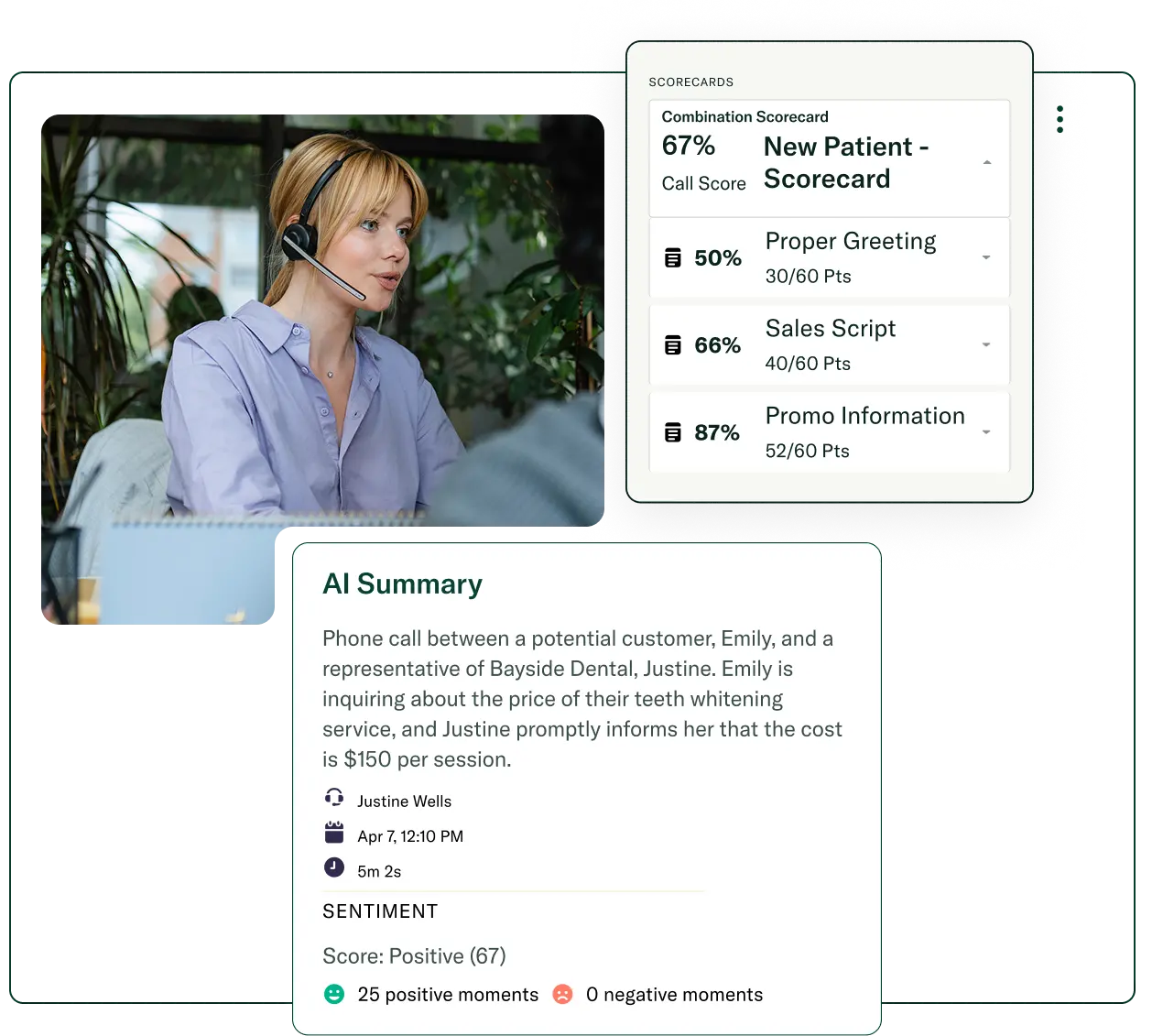
AI-powered analytics platforms close this gap by scoring every call against custom business outcomes. Invoca Signal AI applies steady criteria across 100% of contacts. Full-call coverage shifts from a staffing problem to a setup choice.
The table below shows how AI-powered quality monitoring compares to traditional manual approaches:
How to Build and Run a Call Quality Monitoring Program
QA programs need defined standards, a weighted scorecard, coverage across every channel, and a direct line from each review to an agent coaching action. Here's how to build one that drives results.
1. Document Quality Standards Before Scoring Anything
Spell out what a strong contact looks like for voice, chat, and email. This enables reviewers to judge against shared criteria, not gut instinct. It cuts scoring gaps and shortens calibration cycles.
Include standards for:
- Opening protocols (proper ID, professional tone, rapport-building)
- Compliance disclosures (required legal language, consent statements)
- Active listening markers (acknowledging concerns before offering solutions)
- Resolution accuracy (correct answers on the first attempt)
- Closing procedures (clear next steps, confirmation of understanding)
2. Build a Weighted QA Scorecard
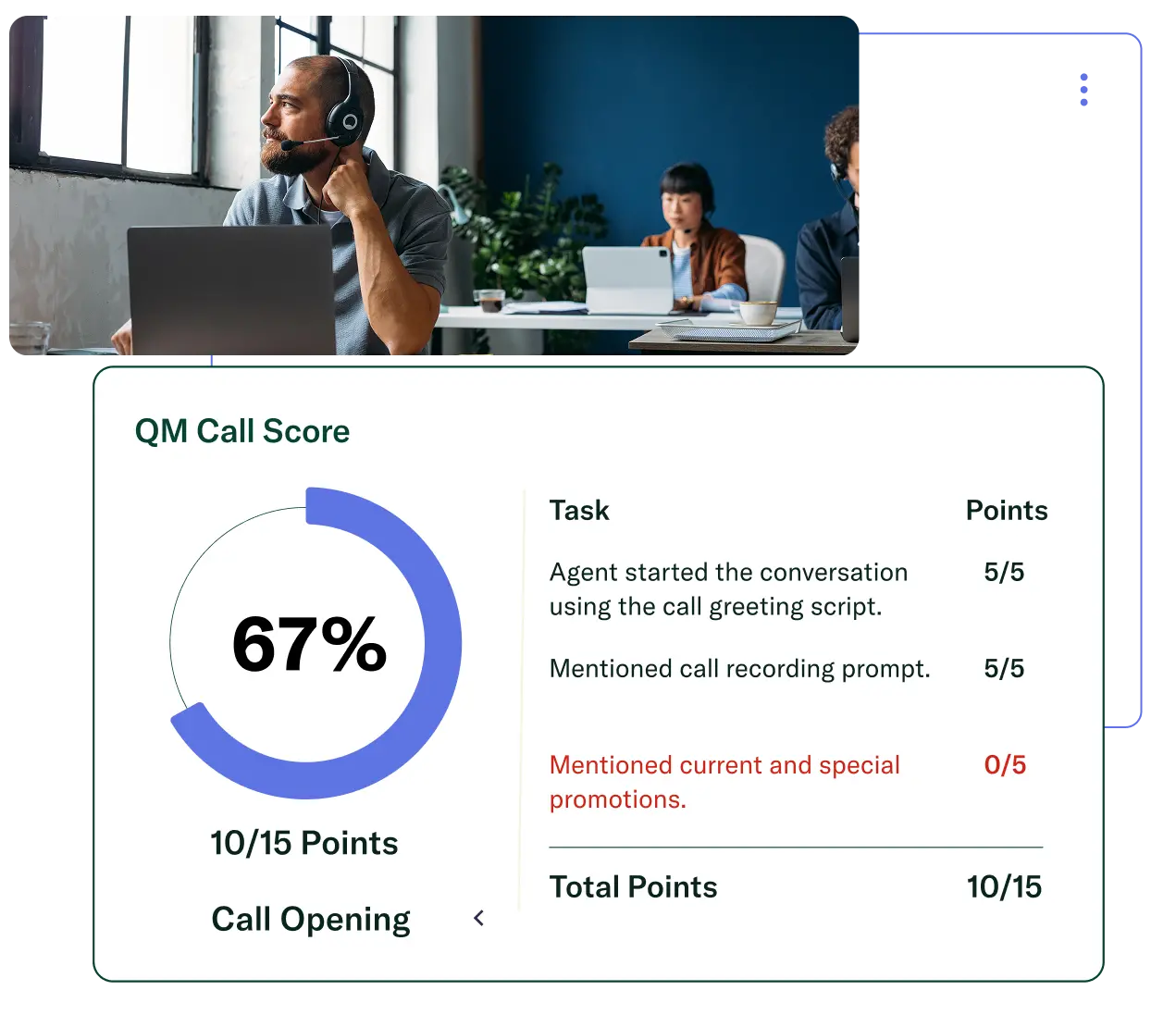
A QA scorecard should cover five areas:
- Greeting and opening: Proper ID, a professional tone, and rapport-building
- Compliance disclosures: Required legal language, consent statements, and regulatory notices
- Active listening and empathy: Whether the agent addressed the caller's concern before moving to a fix
- Issue resolution accuracy: Whether the correct answer was delivered on the first attempt
- Closing and next steps: Proof that the agent set clear hopes for what happens after the call
Weight each area based on business risk. In regulated fields like healthcare and finance, compliance disclosures should carry 25%–30% of the total score. Sales-focused settings shift that weight toward resolution accuracy and closing strength.
Calibrate scores across reviewers monthly. Have several people score the same set of calls on their own, then compare results. Any gap above 5% on key areas warrants a reset session. Steady scoring is what makes QA data trusted enough to drive coaching choices and reporting.
3. Sample Strategically Across Agent Tiers
Pulling from top, middle, and bottom agents surfaces coaching chances that complaint-driven or random sampling miss. Review calls from different times of day, campaign sources, and customer segments to capture the full range of interactions.
4. Use Real-Time Monitoring Methods
Quality monitoring includes multiple observation methods:
- Call recording: Captures interactions for review, training, and compliance audits
- Speech analytics: Identifies keywords, sentiment, and topic trends across calls
- Live monitoring: Supervisors listen to calls in progress to provide immediate support
- Whisper and barge: Managers can coach agents during live calls (whisper mode) or join the conversation when immediate intervention is needed (barge mode)
Real-time monitoring catches issues before they affect outcomes and accelerates new agent ramp time.
5. Connect Every Review to a Coaching Action
Monitoring calls for quality without a feedback loop creates data, not growth. Each scored contact should trigger a specific, time-bound coaching session.
Share both strong and weak examples. When agents see what good looks like and understand why it matters to conversion rates or customer retention, coaching becomes more effective.
6. Adapt Criteria by Channel Without Creating Silos
Call center email quality monitoring demands accuracy and brand voice. Chat requires speed and grammar standards. Voice requires tone, empathy, and compliance scoring. Unified quality standards should govern all three, with channel-specific criteria added where needed.
7. Spread Ownership Across the Team
Shared ownership keeps QA from becoming an isolated audit function:
- QA managers own program design and calibration
- Team leads own coaching delivery
- Agents own self-review and improvement
When everyone owns a piece of quality, results improve faster.
Common Implementation Challenges and How to Solve Them
Even well-designed QA programs face obstacles. Here's how to address the most common ones:
- Data overload: Too many metrics creates paralysis. Focus on the 3–4 KPIs that tie directly to revenue or compliance risk. AI-powered platforms like Invoca surface what matters and filter out noise.
- QA staffing constraints: Finding skilled quality analysts is difficult, especially with high turnover. Automated scoring reduces the need for manual review while maintaining consistency.
- Privacy and compliance complexity: Recording and analyzing calls requires careful data handling. Look for platforms with built-in compliance controls, role-based permissions, and secure storage that meet HIPAA, GDPR, and PCI DSS requirements.
- System integration friction: Legacy tools don't always connect easily. Choose platforms with pre-built integrations to your CRM, CCaaS, and marketing tools to avoid custom development work.
When quality monitoring connects to the systems that drive revenue decisions, these challenges become solvable with the right platform choice.
Quality Monitoring Software for Call Centers
The right platform unifies call recording, speech analytics, and automated QA into a single workflow. That workflow also feeds compliance controls and revenue attribution.

Quality monitoring software for call centers typically involves CCaaS platforms with five key tools. A 2024 Metrigy report found that 36% of contact center teams run CCaaS as their primary platform. The table below maps each tool type to its main use case and key feature so you can spot gaps in your current contact center quality management stack.
Quality monitoring data also reveals which campaigns drive high-intent callers. Marketing gets a feedback loop that digital analytics alone can't provide. That link turns contact center quality management into a revenue function.
Quality monitoring software pays for itself by:
- Reducing compliance risk
- Providing coaching workflows that lift agent results and reduce turnover
- Connecting call outcomes to marketing spend for revenue attribution insights
Turn Quality Monitoring Into Revenue Execution With Invoca
Invoca connects call quality data to the marketing campaigns and digital journeys that created each conversation. This closes the loop between agent results and revenue attribution.
Full-call coverage surfaces compliance lapses and coaching signals before they compound. Campaign-level close rate data shows marketing exactly which sources drive high-converting calls and which waste budget. Want to see it in action? Book a demo today.

FAQs about Call Center Quality Monitoring
How do I decide which quality monitoring software to implement if I'm already using a CCaaS platform?
Start by checking your CCaaS platform's native QA module. See if it supports 100% call scoring, automated compliance redaction for HIPAA and PCI DSS, and links to your CRM and attribution tools. Add a standalone tool only if you need campaign-level attribution or custom outcome scoring your CCaaS can't deliver.
What's the minimum number of calls I need to review manually if I'm using AI-powered scoring for the rest?
Review 5%–10% of AI-scored calls each month as a calibration sample. This checks scoring accuracy and flags edge cases the model misses. Focus manual review on high-stakes calls like sales conversions, escalation events, and compliance-flagged contacts. Add a random sample across tiers to catch model drift. Use calibration sessions to adjust AI thresholds and keep human reviewers aligned within 5%.
How do I weigh my QA scorecard categories if my contact center handles both sales and service calls?
Build two scorecards with shared core areas (compliance, empathy, resolution), but different weights. For sales calls, weight closing strength and needs discovery at 30%–40% of the total score. For service calls, weight issue resolution and empathy higher. Tag calls by type in your QA platform so the right scorecard applies on its own. Report conversion rates and CSAT for each type.