

.svg)


AI has moved from the experimentation phase to an expectation of results in B2C marketing. Boards are pressing AI readiness and demanding proof of ROI. Leadership teams expect AI-driven efficiency. All the while, marketers are incredibly motivated to show results quickly.
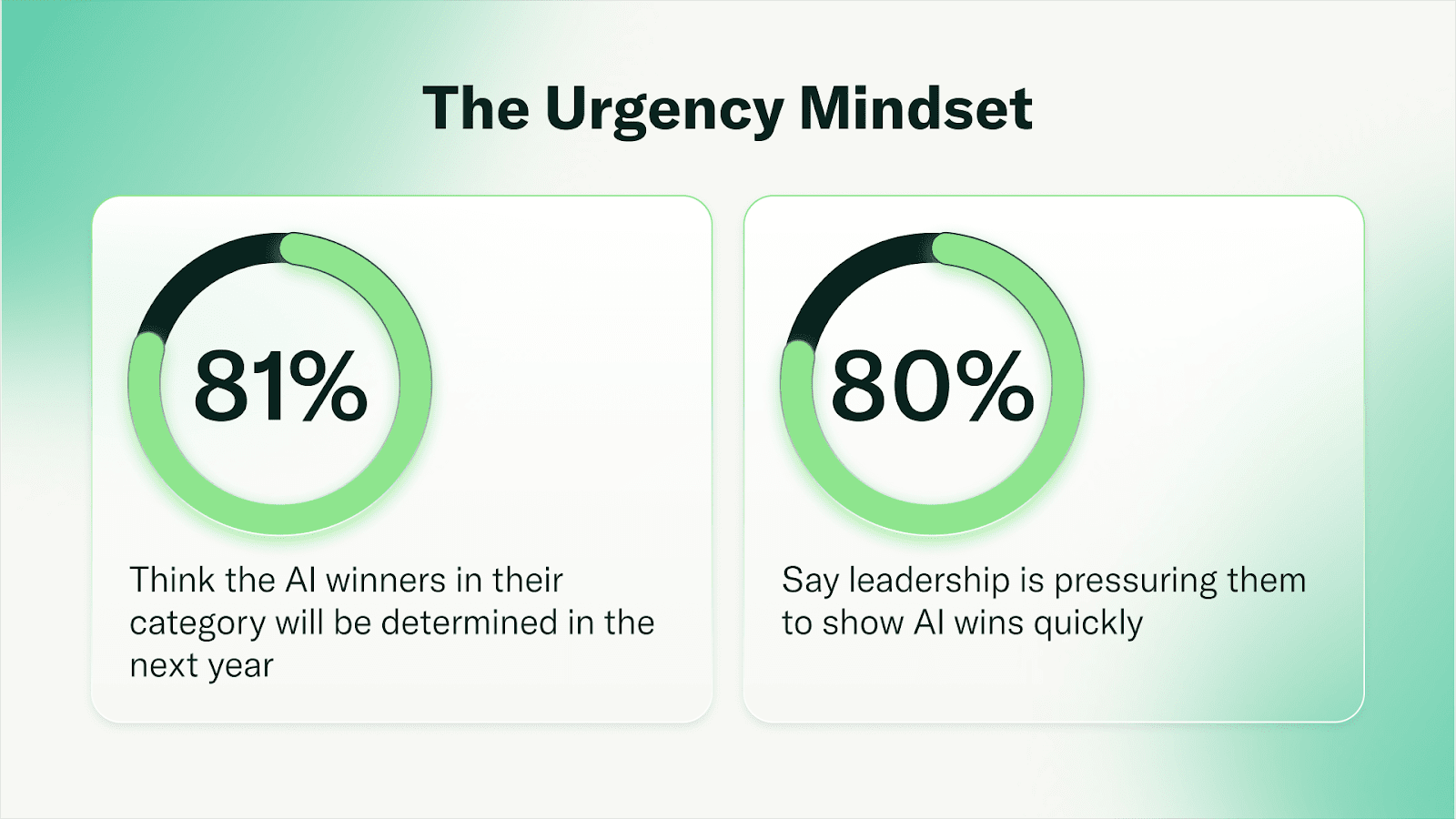
That urgency is real and justified. According to Invoca’s B2C Marketing AI Impact Report, 81% of B2C marketers believe AI leadership in their category will be determined within the next 12 months. This is a defining moment.
At the same time, the data reveals a growing risk. Organizational confidence in AI maturity is outpacing actual capability. That gap has consequences for revenue, customer experience, and long-term competitiveness.
The Illusion of Being “Ahead of the Competition”
Most marketing leaders believe their organizations are moving faster than their peers. In fact, 82% say they are adopting AI faster than competitors.
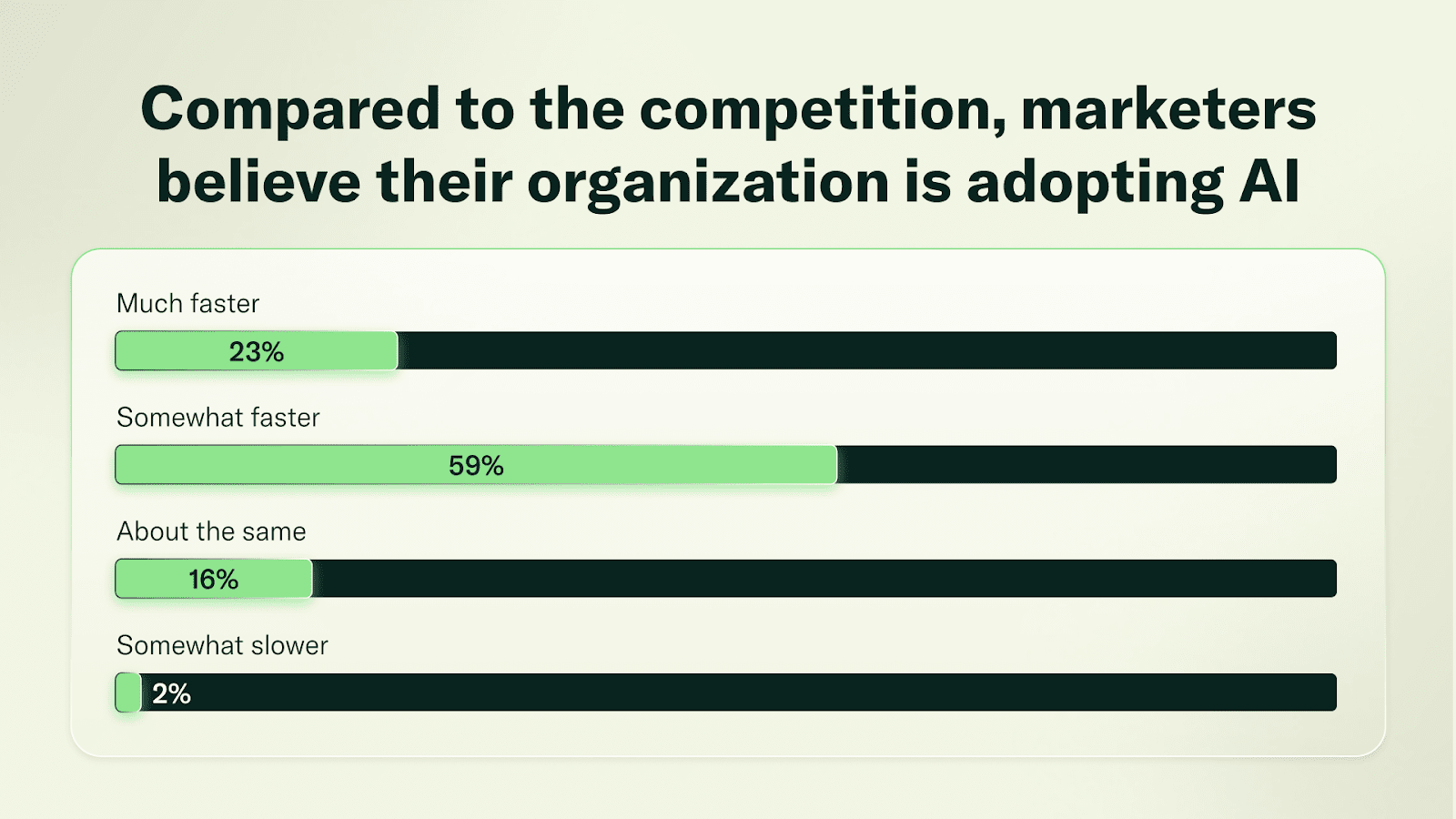
Someone has to be behind, so this is a statistical impossibility that signals a widespread perception problem rather than a performance advantage.
In practice, many organizations equate AI progress with visible activity: new tools, pilot programs, or automated workflows. Those efforts matter, but they do not define maturity. AI maturity shows up in outcomes like improved conversion rates, better demand quality, faster decision-making, and measurable revenue impact.
Analyst research supports this view. Forrester consistently finds that most enterprises remain in early or transitional phases of AI adoption, with limited ability to operationalize insights across the full customer lifecycle. Execution gaps, data fragmentation, and slow activation prevent AI from delivering compounding value at scale.
Confidence alone does not close those gaps.
Overconfidence vs. Actual Capability
When asked to assess their real AI capabilities, marketers offer a more measured response. Only 23% classify their organization as “leading,” while the majority place themselves in advanced or intermediate tiers.
This gap between perceived pace and actual capability matters because AI initiatives often underperform quietly. Campaigns continue to run, and dashboards continue to populate while results plateau rather than fail outright.
Without a clear connection between AI decisions and revenue outcomes, organizations struggle to explain why investment levels keep rising while impact remains uneven. Over time, this erodes trust — internally and externally.
Leadership teams play a critical role here. AI maturity requires more than enthusiasm or experimentation. It requires operational discipline and system-level thinking.
The Top 3 AI Maturity Gaps
Across Invoca research and customer data, three gaps consistently limit AI effectiveness in B2C marketing organizations.
1. Insight latency
Many teams operate with delayed intelligence. Conversion data, conversation insights, and performance signals arrive too late to influence active campaigns. Optimization decisions reflect yesterday’s demand, not current buyer behavior.
2. Incomplete first-party data integration
AI systems frequently operate without access to the full buyer journey. Digital engagement data, conversation data, and transaction outcomes remain disconnected. As a result, AI lacks the context required to understand intent, prioritize opportunities, or optimize toward real business results.
3. Dependence on point solutions
Point tools address isolated problems. They do not create shared intelligence. When AI is deployed in silos, learning remains local and value creation stays incremental. This structure prevents AI from improving performance across demand generation, conversion, and revenue as a unified motion.
These gaps help explain why AI activity often outpaces AI impact.
How Executives Can Immediately Audit AI Maturity
AI maturity becomes clearer when leaders focus on execution rather than aspiration. The following four audits provide a reliable starting point.
Data readiness
Can AI access digital interactions, conversations, and outcomes in a single system? If not, decisioning and optimization remain incomplete.
Actionability timelines
How long does it take to act on new insights? When activation takes days, AI loses its advantage.
Customer experience risk
The AI Impact Report shows a significant perception gap: 86% of marketers believe AI improves the buying experience, while only 35% of consumers agree. This disconnect creates brand risk when AI is deployed without sufficient context or oversight.
Attribution systems
AI investments require outcome-grade measurement. When AI actions cannot be tied to revenue, confidence eventually breaks down.
A Roadmap for Real AI Readiness
AI maturity advances through alignment rather than acceleration. Effective programs pair prompts with context. They rely on connected buyer journey data rather than isolated signals. They prioritize outcomes like demand quality, conversion efficiency, and revenue over haphazard AI tool adoption.
The key to success is assuring that the buyer journey is run as a system. AI delivers value when it is grounded in first-party data, informed by real interactions, and accountable to measurable business results.
Organizations that make this shift gain faster insight activation, stronger conversion performance, and greater confidence in AI-driven decisions.
Create AI Systems, Not Just AI Activity
Most B2C brands are investing aggressively in AI. Fewer are operating with true AI maturity.
The difference lies in systems, not speed. Leaders who connect digital, conversational, and transaction data into a single operating model create the foundation AI needs to perform reliably. Those who do not will continue to see uneven results despite increasing investment.
AI is becoming the control layer for growth. Maturity is defined by whether it can consistently improve revenue outcomes while protecting customer experience.
That is the standard executive teams should use — and the gap many organizations still need to close.
Get the Invoca B2C AI Impact Report to learn more.
.svg)
.svg)