.svg)


Do you know who your core customers are and why they choose you over competitors? If not, customer segmentation can help.
Customer segmentation—the process of grouping customers by shared characteristics, behaviors, or needs—is one of the most reliable ways to understand what drives your audience. According to a recent guide from Hanover Research, companies that use customer segmentation are 130% more likely to know their customers’ motivations and 60% more likely to understand their concerns and challenges.
However, traditional segmentation can be time-consuming to set up and difficult to maintain. Teams often spend weeks wrangling spreadsheets, updating static segments, and trying to keep pace with ever-changing customer behavior.
AI changes the game. With AI customer segmentation, machine learning can analyze far more data, update segments dynamically, and surface patterns humans might miss. And by using AI for customer segmentation, marketers can move faster, target more precisely, and adapt campaigns in real time.
Invoca takes this a step further. By using AI to analyze real customer conversations, Invoca uncovers high-intent audiences, reveals what motivates them to call, and helps marketers refine targeting strategies to create more of those core customers.
In this post, we’ll explore how AI customer segmentation works, how to put it into practice, and the business benefits of adopting an AI-enabled approach.
Main Takeaways
- AI customer segmentation uses advanced algorithms to quickly analyze large datasets and uncover valuable, previously hidden customer patterns.
- Using AI for customer segmentation enables marketers to create dynamic, behavior-based segments that evolve in near real time.
- Core AI methods that support modern customer segmentation include clustering, classification, and predictive modeling.
- AI customer segmentation makes it easier to deliver timely, relevant engagement and personalized experiences that lift conversions and ROI.
- Invoca’s AI insights help marketers segment by intent and conversation context to deliver more effective campaigns that drive revenue.
What Is AI Customer Segmentation?
AI customer segmentation uses machine learning to analyze customer data and automatically sort people into meaningful groups based on behaviors, expressed needs, intent signals, and other shared characteristics. The result is segmentation that’s far more precise—and far easier for marketers to act on.
Unlike traditional segmentation, which relies heavily on demographics and manual updates, AI can process massive amounts of data in seconds. Instead of grouping customers by broad traits like age or location, AI can analyze thousands of real customer conversations to identify highly specific segments such as “high-intent callers interested in the Ford Focus.”
That level of depth gives marketers a richer, more actionable target audience than any static demographic segment ever could. Not surprisingly, customer segmentation and targeting is one of the top applications of AI in marketing today.
4 Types of Customer Segmentation
When you’re building an AI-powered segmentation strategy, it helps to start with the four foundational types of customer segmentation:
- Demographic: Divides audiences by age, gender, income, or occupation.
- Geographic: Categorizes customers by location, region, or climate.
- Psychographic: Groups customers based on lifestyle, values, and interests.
- Behavioral: Focuses on actions, usage, purchase frequency, and engagement levels.
Benefits and Applications of AI Customer Segmentation
AI can make customer segmentation quicker and far less labor-intensive than traditional methods. Here are some of the key benefits and applications of AI for customer segmentation.
1. Uncover Hidden Customer Patterns
AI can reveal subtle patterns in customer behavior that manual analysis often misses, including purchase drivers buried deep in a customer’s digital or conversational journey.
For example, a dental patient might not explicitly search for “teeth whitening,” but their behavior—engaging with email offers, redeeming whitening-related promotions, or asking questions during a call—can reveal high intent. That insight allows marketers to personalize outreach and enhance the overall experience.
2. Create More Personalized Campaigns
Getting customer segmentation right opens the door to far more personalized marketing. Brands can deliver highly targeted content, relevant offers, and timely nudges that boost engagement and conversion rates.
AI-driven segmentation supports high-impact personalization, such as:
- Renewal reminders for insurance policies, warranties, or subscriptions that are about to expire
- Birthday-based promotions for customers and their friends or family members
- Alerts when a desired product—like a new smartphone or a specific car model—is back in stock
- Notifications when a product a customer has researched or shown interest in is included in a special deal or limited-time promotion
- A tailored discount code or incentive that is sent to the customer after they start a purchase but abandon the checkout process
These well-timed touches help strengthen customer loyalty and reduce churn. The data is clear on the importance of personalization: According to McKinsey, 71% of consumers expect brands to tailor their outreach, and 76% feel frustrated when it doesn’t happen.
3. Enhance the Customer Experience
AI segmentation creates a more accurate and up-to-date view of customer needs. Traditional segmentation is static and quickly becomes outdated. AI, on the other hand, can continuously process data, update segments in real time, and adapt to shifting behaviors.
This agility pays off. When Baker Tilly helped a Fortune 500 insurance client build an analytics-driven segmentation model, the client increased customer lifetime value (CLV) and generated $3 million in additional annual sales. With AI customer segmentation, companies can improve experiences across the entire customer journey—from discovery and consideration to purchase and retention.
Table: Segmentation Use Cases by Industry
The insurance industry is just one user of AI customer segmentation. Here’s how six other major industries use the process and what outcomes they can achieve.
| Industry | How AI Segmentation Is Used | Outcome |
|---|---|---|
| E-commerce | Personalizes product recommendations and promotions based on browsing, purchase history, and behavioral signals. | Higher conversion rates and more repeat purchases. |
| Finance | Tailors loan, insurance, and investment offers by analyzing customer intent, transaction patterns, and financial behavior. | Improved customer retention and reduced portfolio risk. |
| Healthcare | Segments patients to deliver personalized communication, appointment reminders, and individualized care plan recommendations. | Better patient engagement and improved care outcomes. |
| Media and Entertainment | Recommends content and ad experiences based on viewing history, preferences, and consumption patterns. | Increased viewer engagement and subscription renewals. |
| Automotive | Identifies in-market shoppers and segments them by purchase stage (e.g., research vs. ready-to-buy). | More efficient ad spend and higher conversion rates for calls or leads. |
| Telecom | Segments customers by lifetime value, plan usage, and churn risk to personalize retention offers. | Reduced churn and higher customer satisfaction. |
How AI Customer Segmentation Works
How does it work? Here’s a step-by-step look at AI for customer segmentation in practice.
1. Data Collection and Analysis
High-quality data is the foundation of effective AI customer segmentation. Machine learning models can analyze both structured data—such as customer relationship management (CRM) system records, transaction history, and web analytics—and unstructured data like chat logs, recorded phone conversations, emails, and social media posts. Bringing these sources together into a clean, unified dataset is essential for generating accurate, meaningful segments.
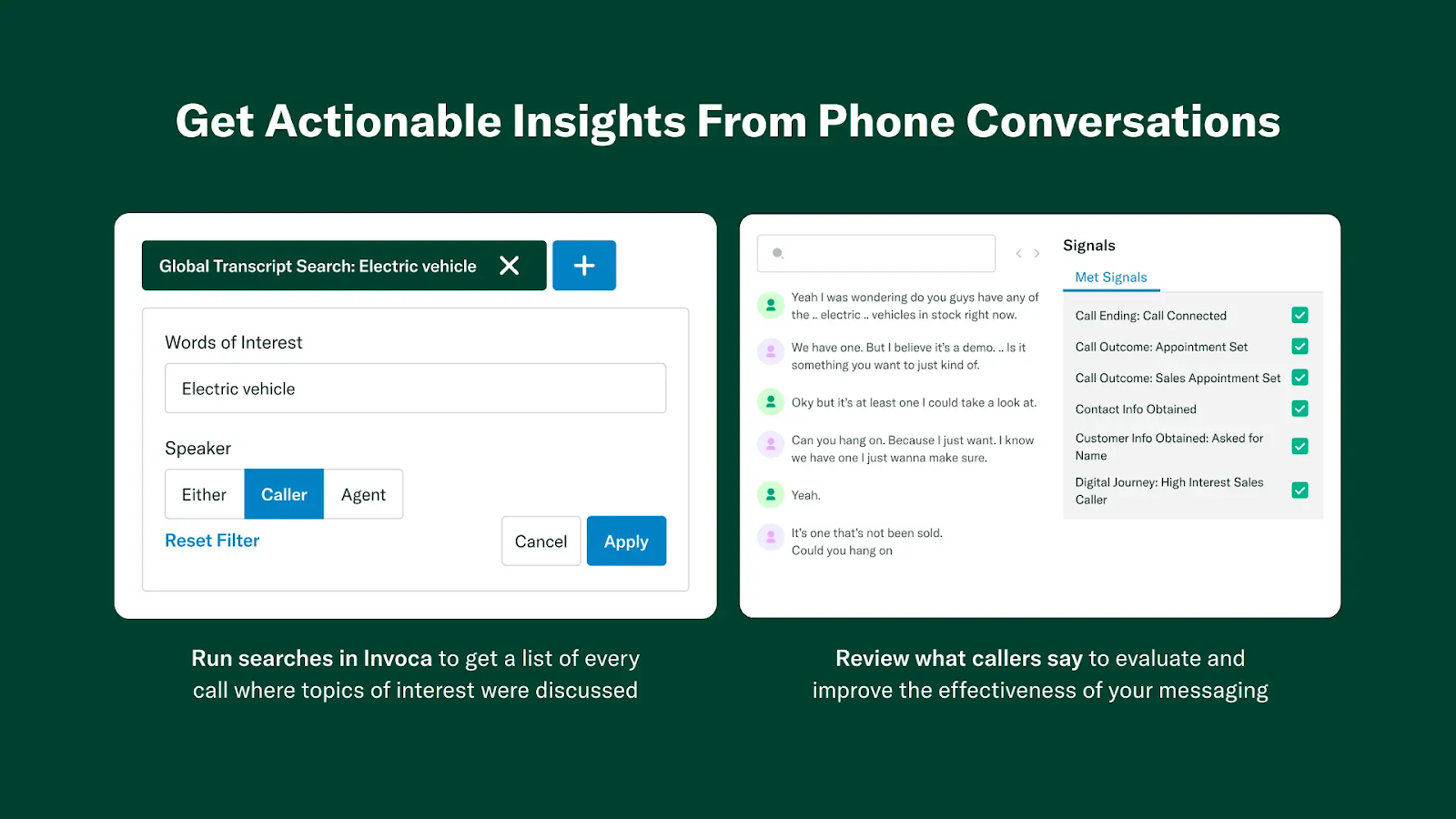
Phone conversations are an especially powerful source of first-party data, yet they are often overlooked. Calls contain rich signals about sentiment, product interest, objections, and outcomes. A conversation analytics platform like Invoca integrates easily with your martech stack and CRM, making it simple to capture and activate high-value voice data that can strengthen your segmentation models.
2. Pattern Recognition and Behavioral Insights
AI excels at uncovering relationships, correlations, and behavioral patterns that are nearly impossible for humans to spot at scale. For example, machine learning can identify customers who consistently call after clicking a certain ad or visiting specific product pages, automatically grouping them into a segment for timely follow-up communication.
AI can also pick up on subtle emotional cues within conversations. If a caller’s tone signals hesitation, enthusiasm, or urgency, AI can classify that sentiment and help marketers build precise micro-segments designed to receive tailored offers, reminders, or coupons.
3. Predictive Modeling and Forecasting
AI can also predict how your segmented customers are likely to behave next. Machine learning models can anticipate a customer’s likelihood to purchase, respond to an upsell, renew a policy or subscription, or even churn.
Using AI for predictive segmentation enables marketers to forecast which segment a customer will enter next. For example, if a caller at an auto dealership expresses strong enthusiasm for a particular make and model, AI can detect that sentiment and automatically move them into a high-intent segment for targeted follow-up and faster conversion.
4. Dynamic and Continuous Segmentation
AI models continuously learn from new data, making AI customer segmentation dynamic rather than static. As fresh signals come in, segments are updated quickly and automatically, allowing marketers to respond to shifts in customer behavior almost in real time.
Say that AI detects a sharp decline in customer sentiment after a change in eligibility for health insurance coverage. Marketing teams at health insurance firms can immediately adjust messaging or reach out to affected policyholders with alternative plans that offer similar coverage or clearer policies before dissatisfaction leads to churn.
5. Data Integration and Tech Stack Alignment
Lastly, AI segmentation tools should integrate seamlessly with your existing tech stack, including CRM platforms such as Salesforce and HubSpot, customer data platforms (CDPs) like Oracle and Microsoft, web analytics tools such as Google Analytics and Adobe Experience Cloud, and call-tracking and conversation intelligence software such as Invoca.
Invoca’s ability to connect voice and digital data creates a centralized segmentation ecosystem. When customer segmentation data is integrated with the rest of your customer data, it helps eliminate silos, improve marketing accuracy, and enhance activation across channels.
7 Best Practices for Implementing AI Customer Segmentation
How do you make the most of AI for customer segmentation? These seven best practices will help you launch and scale a successful program.
1. Collect and Integrate the Right Data
Successful AI customer segmentation starts with the right inputs. Identify and integrate the key data sources that will inform your segments, including:
- CRM or CDP data
- Web and campaign analytics
- Sales and transaction history
- Call and contact center data
Tools like Invoca help you connect online and offline interactions by turning data-rich phone conversations into structured signals about intent, sentiment, and outcomes. That gives your segmentation models a fuller, more accurate view of each customer.
2. Define Clear Business Objectives
Be explicit about what you want segmentation to achieve and how it supports your broader business goals. Are you trying to improve conversion rates, reduce churn, increase upselling opportunities, or refine customer experience marketing strategies?
Tie your segmentation strategy to measurable key performance indicators (KPIs), such as conversion rate, retention, CLV, or cost per acquisition (CPA). Tracking movement in these metrics will show whether your AI customer segmentation efforts are working.
3. Select Scalable AI Tools
Choose tech tools and platforms that can handle large, dynamic datasets and integrate seamlessly with your existing tech stack. They should also be scalable so your segmentation program can grow with your business.
Because segmentation must evolve as quickly as customer behavior and sentiment shift, an AI-powered system that delivers up-to-the-minute customer insights—like Invoca’s conversational data—is essential for staying relevant and responsive.
4. Foster Collaboration Between Teams
Accurate segmentation benefits more than just marketing. Use your AI initiative as a catalyst to align marketing, customer experience, sales, and even operations around shared customer definitions and KPIs.
Cross-functional dashboards, regular reviews of segment performance, and shared feedback loops can help teams refine audience definitions together. When everyone is working from the same AI customer segmentation “source of truth,” campaigns, conversations, and experiences become more consistent and effective.
5. Manage Data Quality and Compliance
Even the best AI models can’t fix bad data. Make data quality and compliance non-negotiable by focusing on these best practices:
- Establish strong data hygiene processes, including cleansing, deduplicating, and enriching records.
- Address all relevant privacy and security regulations, such as the General Data Protection Regulation (GDPR) for EU customers, the California Consumer Privacy Act (CCPA) for California residents, and the Health Insurance Portability and Accountability Act (HIPAA) when working with protected health information (PHI).
- Apply data minimization, anonymization, and other privacy-preserving techniques to reduce risk and safeguard sensitive information.
Clean, compliant data doesn’t just protect your business; it also makes your AI customer segmentation more accurate, reliable, and effective.
6. Continuously Refine and Optimize Segments
AI customer segmentation isn’t a one-and-done project. Be sure to review and refine your models and segments regularly as behavior, products, and market conditions change.
Retrain models on fresh data, monitor performance drift, and use techniques like A/B testing across segments to see which audiences respond best to which types of offers. Track conversion, engagement, and retention by segment so you can double down on what works and confidently let go of what doesn’t.
7. Use AI to Power Behavioral Segmentation
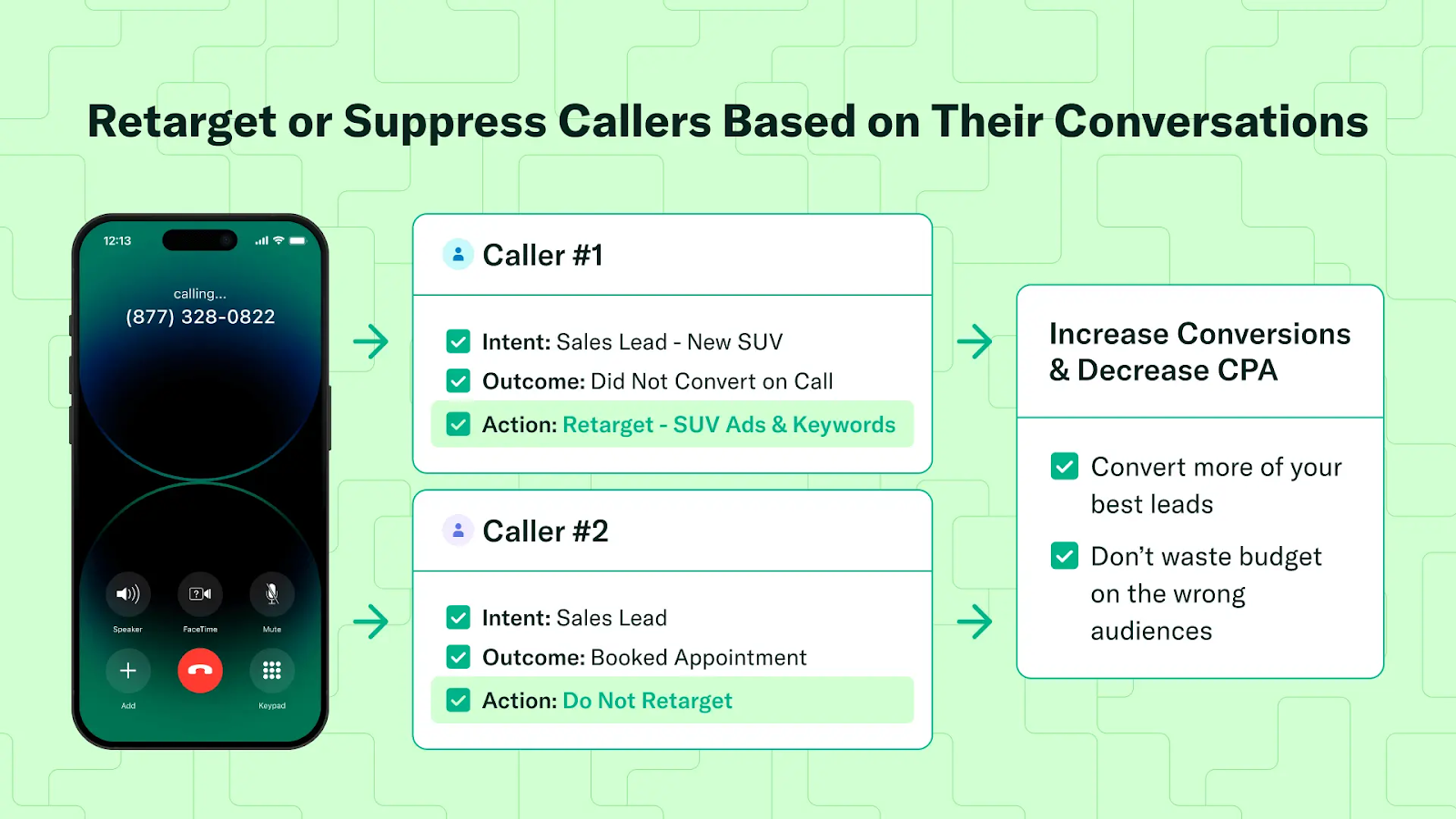
Behavioral segmentation groups customers based on what they actually do—their actions, intent, and engagement signals—rather than just who they are on paper. That level of depth is hard to achieve with traditional methods, but this is exactly where AI excels.
AI can detect deep behavioral drivers, such as why a customer is calling, how close they are to a purchase decision, or whether their tone signals frustration or enthusiasm. Platforms like Invoca automatically capture these signals from real conversations, making it easier for you to build high-intent, behavior-based segments that can supercharge your targeting and customer experience strategies.
Segment Smarter with Invoca
AI in customer segmentation is still in its early stages, and we’ve only begun to tap its full potential. As AI technologies advance, the precision, speed, and value they deliver will continue to grow. Even today, AI customer segmentation is already transforming how marketers define audiences, refine segments, and improve customer experience strategies.
Invoca’s AI-powered conversation analytics platform brings these capabilities to life. By capturing data-rich phone conversations and turning them into structured insights about customer behavior, sentiment, and intent, Invoca helps you build more precise, enriched customer segments. It also strengthens related efforts—like competitive intelligence—by giving you direct, unfiltered access to the true voice of the customer.
With Invoca, you can build more actionable segments, improve campaign performance, and convert more high-intent customers to help drive revenue.
Additional Reading
To learn more about how Invoca’s AI-driven quality intelligence tools can help you take your customer experience analytics to another level, see these additional resources:
- How to Build Stronger Customer Profiles with AI
- Why Understanding Your Buyer Persona Is Essential for Successful Marketing
- How to Use First-Party Caller Data to Improve Audience Targeting Without Cookies
You can also book a free demo with our team to learn how Invoca’s AI customer segmentation tools can help your business improve marketing and drive revenue.

.svg)
.svg)