

.svg)


Healthcare organizations are operating in one of the most unforgiving economic environments in decades. Payer reimbursement pressure is intensifying as operating costs continue to rise. Marketing leaders are not exempt from the resulting pressures, and they’re seeing unprecedented scrutiny from CFOs and CEOs to prove ROI.
In this environment, sustained growth requires eliminating waste, converting more of the demand you already pay for, and proving exactly what’s working across the full patient journey.
That’s where many healthcare organizations are stuck. Digital marketing performance is still judged primarily by clicks, impressions, and form fills. But patients don’t make decisions in a single online session. They use AI to do their research, compare providers, and find reviews. They’ll probably visit your website, too, but most ultimately call when it’s time to ask a few more questions and set an appointment.
The problem is that while calls are arguably the most important part of the patient journey, they remain disconnected from the rest of the healthcare marketing and revenue system.
Healthcare Still Relies on Phone Calls for Conversions
Despite years of investment in digital experiences, phone calls remain the dominant conversion touchpoint for healthcare. The decisions patients are making are complex and personal, and they overwhelmingly want to speak to a human.
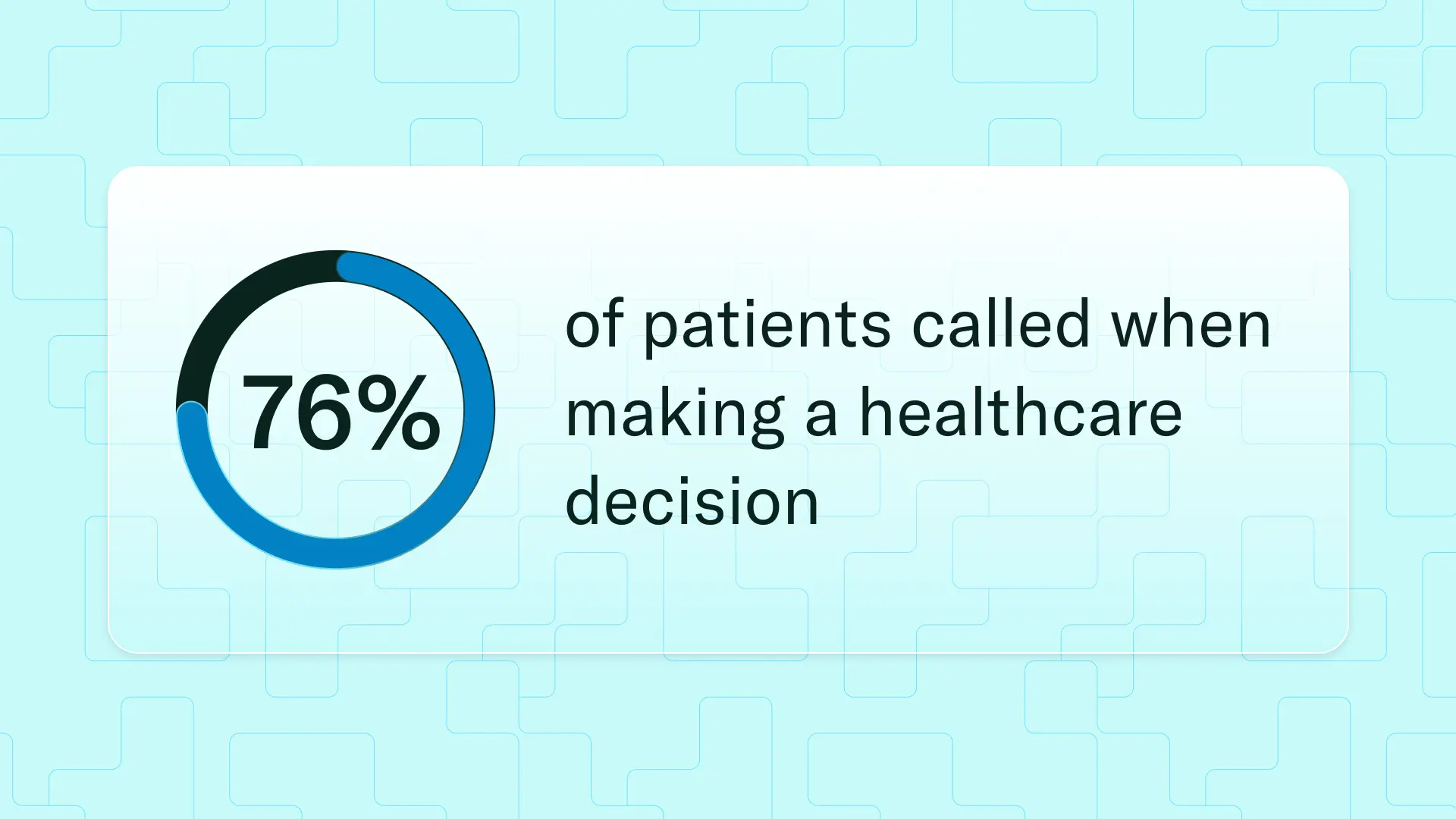
Invoca’s recent Healthcare Consumer Experience Report found that 76% of consumers reported calling when making a high-stakes healthcare decision, a proportion similar to that reported three years ago. It is telling that the preference for calling has remained strong over the last three years, despite expanded digital experiences and the advent of generative AI.
For healthcare marketers, this creates a dangerous blind spot.
Most digital measurement systems stop at the click or form submission. The moment a patient picks up the phone — the moment when revenue is actually created — attribution breaks. Marketing loses visibility, operations loses context, and executives lose confidence in reported ROI.
The Attribution Gap Is Now a Financial Liability
In a cost-cutting era, incomplete attribution isn’t just a reporting problem. It’s a financial one.
Healthcare CMOs are being asked to defend budgets with the same rigor as capital investments. “Trust me” no longer works. Leadership wants to know:
- Which campaigns actually drove booked appointments?
- Which channels generate high-intent patients versus low-value inquiries?
- Where are we losing demand after the click?
Without visibility into calls and conversations, those questions are impossible to answer. And if you are answering them without all the data in hand, you’re underreporting conversions and selling yourself short.
Invoca’s 2026 Healthcare AI Impact Report shows that while most organizations invest heavily in AI-driven marketing optimization, only 47% actively analyze call recordings and transcripts with AI. The good news is, that’s over 10 points higher than the average across all industries we surveyed. The bad news is that healthcare marketers share a similar inability to take action on conversation data in a timely manner.
This "insight-to-action" gap is a major leak in the marketing funnel. The AI Impact Report data reveals a costly delay between when an insight is discovered and when it can be acted upon. We found that only 18% of healthcare organizations can feed call conversion data to ad platforms in near real-time, which is essential for agile optimization.
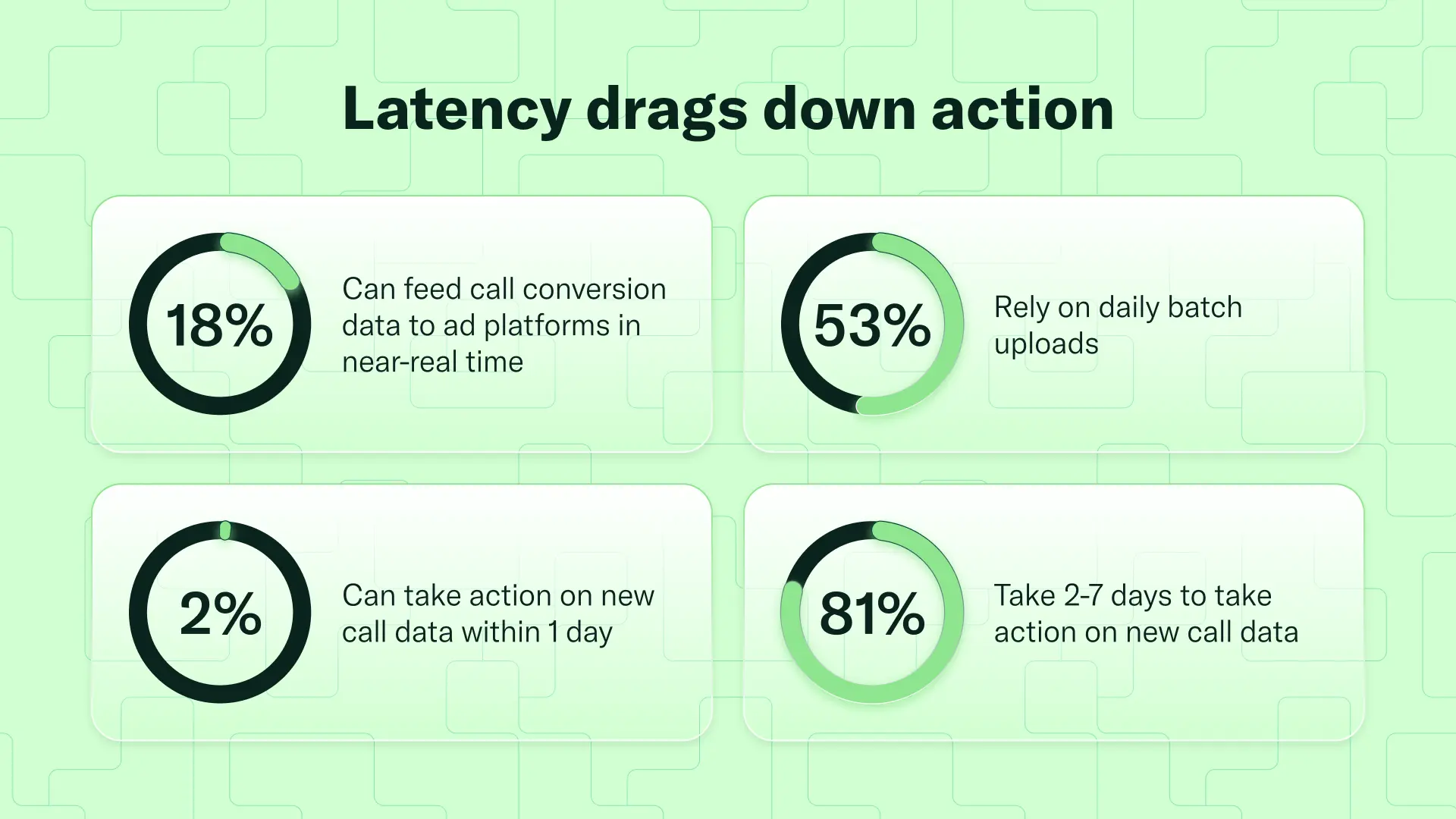
A majority (53%) still rely on slower daily batch uploads. Worse yet, a mere 2% of healthcare marketers can turn a new insight from a source like a phone conversation into a live campaign change on the same day. The vast majority — 81% — take between two and seven days, which severely blunts the competitive advantage AI is meant to provide. When optimization signals are delayed, your budget is spent on yesterday's picture of demand.
As one Forrester analyst noted that when organizations fail to connect digital signals to offline outcomes, optimization efforts inevitably drift away from business reality. In healthcare, that drift translates directly into wasted acquisition spend.
Marketing and Operations Can No Longer Be Separate Systems
Another structural challenge healthcare organizations face is more organizational than technical. Marketing is success measured by demand generation and patient acquisition. Operations and contact centers are measured on efficiency and patient experience. Revenue happens in the handoff, but the data doesn’t get shared.
A campaign may generate thousands of calls, but without understanding what happened in those conversations—whether appointments were booked, insurance was accepted, or callers abandoned after long hold times—marketing optimization is guesswork.
Closing this gap takes more than dashboards. It requires a shared system of record that connects digital demand, conversations, and outcomes into one operational view.
Why Invoca is Essential Healthcare Revenue Infrastructure
Invoca was built for this exact moment. Not as a point solution, but as an AI-native infrastructure that runs the complete patient journey as a system. Invoca connects digital touchpoints, phone calls, messaging, and downstream outcomes into a single, trusted foundation.
For healthcare organizations, that means:
- Proving what marketing actually works. Every call is attributed back to the campaign, keyword, ad, and channel that drove it. Outcomes like booked appointments or qualified leads close the loop, giving CFO-grade attribution that stands up to scrutiny.
- Optimizing at every touchpoint. Invoca AI doesn’t just report on calls—it uses conversation and outcome data to improve media bidding, call routing, and patient engagement in near real time.
- Reducing acquisition costs without cutting growth. By identifying which campaigns drive high-intent calls and which leak demand, organizations can reallocate spend rather than reduce it.
This is why Invoca functions as both a system of record and a system of action. Better first-party data powers better AI — and better revenue outcomes.
Why AI Must Be Grounded in Real Patient Conversations
Healthcare leaders are understandably cautious about AI. Compliance, trust, and patient experience are non-negotiable. But the biggest AI risk today is optimizing on the wrong signals.
Invoca changes that by grounding AI in first-party journey data—what patients clicked, what they said, what happened next. That context powers:
- Smarter media optimization based on real appointment outcomes
- Better call routing and prioritization for high-value patients
- AI agents and human agents equipped with context from the full patient journey
As industry analysts have consistently emphasized, AI systems only perform as well as the data they’re trained on. In healthcare, conversation data is the missing layer that turns experimentation into enterprise-grade performance.
Under pressure from payers and budget constraints, healthcare marketing is being forced to evolve. The organizations that win won’t be the ones with the flashiest digital experiences or the most experimental AI pilots. They’ll be the ones that treat the patient journey as a connected system from first click to phone call to booked appointment, and invest in infrastructure that proves and improves performance at every step.
When calls are the dominant conversion path, the system that connects them to outcomes is essential.
.svg)
.svg)