.svg)


Don't have time to read? No problem, listen to the audio blog summary below!
Marketing has always been a blend of creativity, data, automation, and complexity. Today's teams stitch together analytics, bidding systems, CRM signals, attribution models, call data, and campaign platforms—manually orchestrated with meetings and spreadsheets.
Agentic AI changes that operating model entirely.
Instead of marketers pushing buttons across disconnected tools, agentic systems become autonomous operators that perceive what's happening across channels, decide what needs adjustment, and act.
Here's how this shift plays out in modern marketing organizations.
AI Autonomously Handles the Execution Layer
Marketing execution involves countless tedious tasks that consume valuable time: bid adjustments, frequency capping, segmentation updates, audience cleanup, and budget reallocation across platforms.
These are necessary functions, but they pull marketing teams away from strategic thinking and creative work. According to research, marketing automation currently saves companies an average of six hours per week on routine tasks, and 75% of marketers are already using AI tools to reduce time spent on manual optimization work.
The problem is that traditional automation isn't truly autonomous—it still requires constant human oversight and adjustment. Marketers are checking dashboards, pulling reports, and making manual adjustments, hoping their decisions will remain effective until the next review cycle. This reactive approach means that opportunities are missed and budgets are wasted during the gaps between human interventions.
Agentic AI fundamentally changes this dynamic by autonomously handling the entire execution layer.
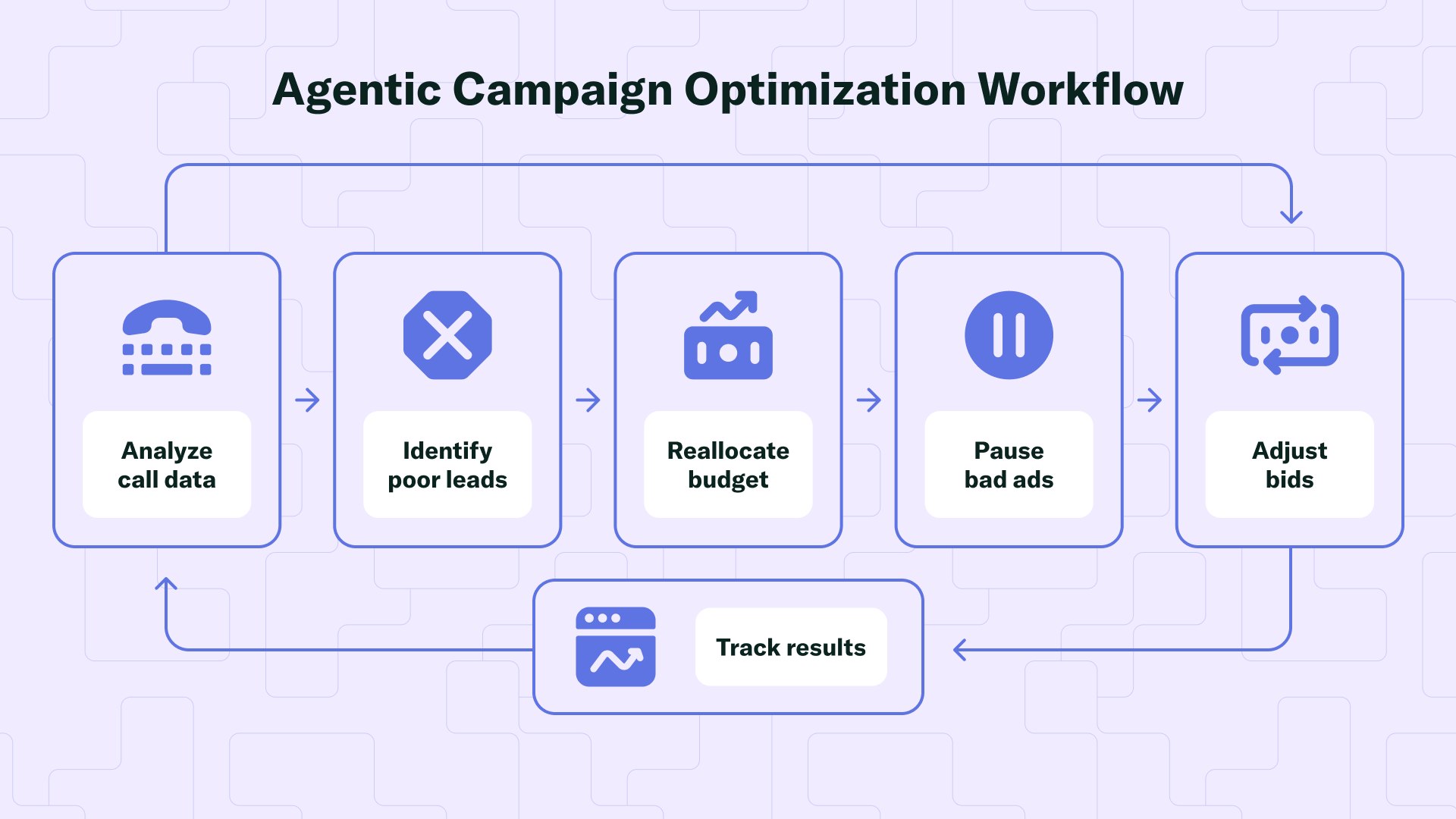
Example of an agentic AI campaign optimization workflow
Your business goal: "Reduce wasted advertising spend while improving lead quality."
Rather than setting this as an objective for your team to manually optimize toward, you configure an autonomous agent with this directive. The agent then continuously:
- Analyzes call data and downstream conversion patterns to understand which campaigns generate qualified leads.
- Detects subtle patterns that degrade lead quality.
- Reallocates spend across campaigns in real-time based on performance signals, shifting budget from underperforming segments to high-converting ones.
- Automatically pauses ad groups or audiences that consistently waste budget.
- Pushes bid changes to advertising platforms throughout the day.
- Monitors the downstream impact of every adjustment to ensure changes improve the metrics that matter.
This represents a fundamental shift in the marketer's role. You're no longer the person executing these optimizations—you're setting the strategic direction and guardrails, then letting the agent handle the mechanical execution. The agent operates continuously, making micro-adjustments based on real-time performance data, a feat that no human team could sustainably achieve.
Gartner research predicts that by 2028, at least 15% of day-to-day work decisions will be made autonomously through agentic AI, up from essentially 0% in 2024. For marketing teams drowning in operational tasks, this shift can't come soon enough. The marketer sets the direction—the agent handles the grind.
Adaptability: Continuous Learning Instead of Weekly Review
Traditional marketing optimization operates in batch cycles. Teams run campaigns, wait for data to accumulate, schedule weekly or monthly review meetings, analyze performance, make decisions, implement changes, and repeat the cycle. This approach is increasingly inadequate in an environment where consumer behavior shifts rapidly, and competition is fierce.
Each cycle introduces lag time between when performance shifts and when you respond to it. A campaign could be hemorrhaging budget for days before anyone notices and takes action.
Agentic AI collapses these optimization cycles into continuous, near-real-time adaptation. Rather than waiting for the weekly meeting to discuss whether morning or evening ads perform better, an agent identifies these patterns as they emerge and adjusts accordingly.
Even as agentic AI removes the need for routine performance check-ins, the strategic reviews that do remain still benefit from an accurate record — a meeting note taker ensures the decisions made in those less-frequent sessions don't get lost between one review and the next.
Example of real-time agentic AI campaign optimization
A call-intent agent is monitoring your lead generation campaigns. It begins to identify that weekday mornings between 8:00 and 10:00 AM produce phone calls that convert to sales at significantly higher rates than afternoon or evening calls. The revenue per lead is 40% higher, and the customer lifetime value is notably better.
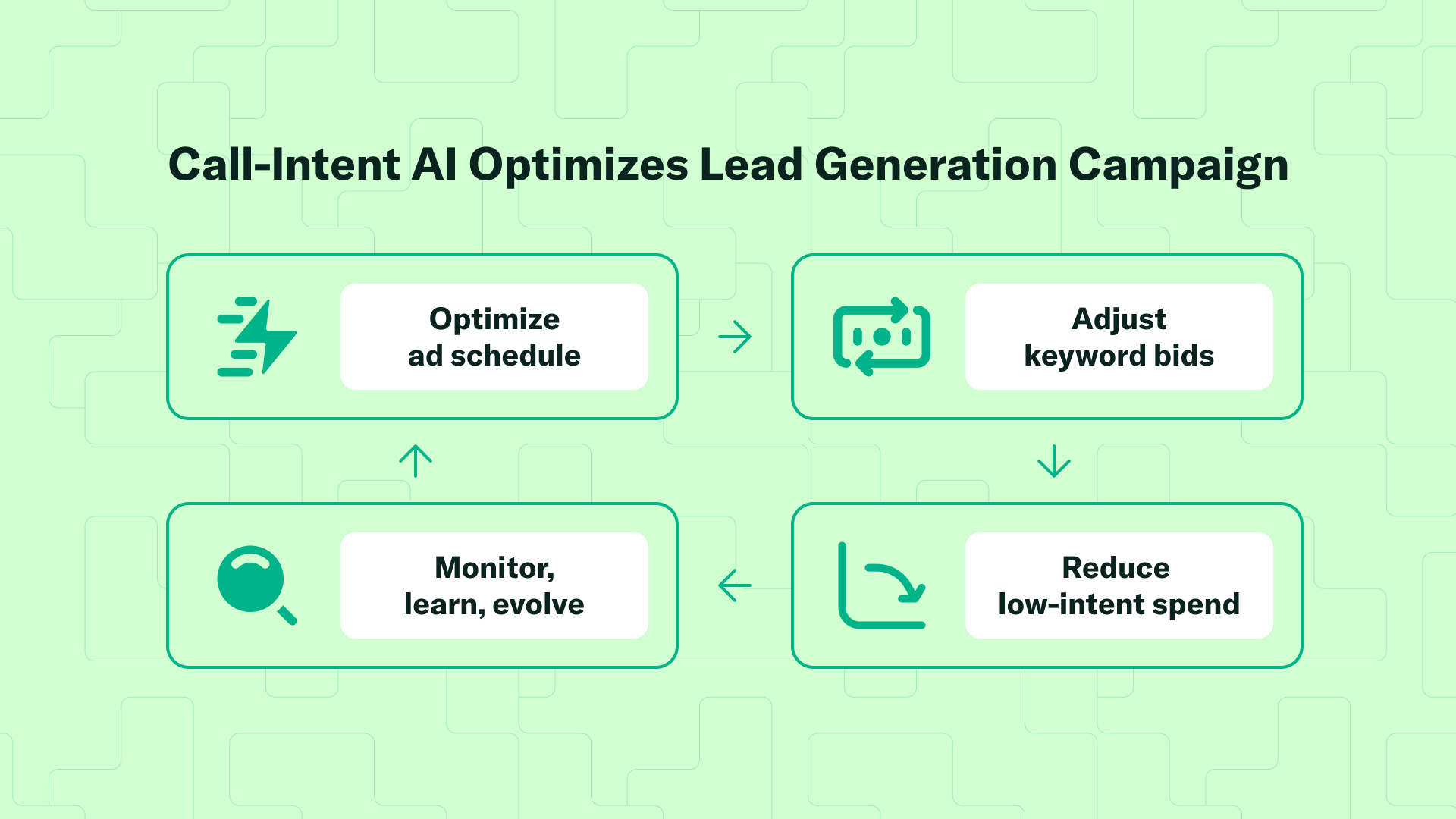
Rather than flagging this for the next team meeting, the agent immediately begins adapting the campaign:
- It adjusts ad scheduling to concentrate more impressions during those high-value morning windows.
- Increases bids on your highest-performing keywords, specifically during morning hours.
- Reduces spend during low-intent windows.
- Continues monitoring throughout the following weeks to see if this pattern holds. as seasonality shifts, holidays approach, or market dynamics change.
Importantly, this isn't "set and forget" automation where you configure rules once and hope they stay relevant. It's a living system that continuously learns and evolves as behavior patterns shift.
This continuous learning capability matters because marketing isn't static. Consumer behavior evolves, competitive landscapes shift, economic conditions change, and product offerings develop. Agentic systems can track these changes at a granular level and adjust tactics accordingly, something that's simply impossible with human-led weekly reviews.
The result is that your campaigns are always operating near their optimal configuration, rather than oscillating between periods of strong performance and gradual degradation.
Align Goals to Optimize for the Metric That Matters—Revenue
Here's a fundamental problem with most marketing technology: it optimizes for what's easy to measure rather than what actually drives business value. Ad platforms optimize for clicks, impressions, cost-per-click, and click-through rates because these metrics are clean, immediate, and platform-specific. But businesses don't exist to generate clicks—they exist to generate revenue, profit, and customer lifetime value.
This misalignment creates a persistent tension in marketing organizations. You're managing campaigns that the platform says are performing well, but the sales team is frustrated because lead quality is poor. Finance is questioning why marketing spend continues to increase while revenue growth stagnates. And you're stuck in the middle, trying to bridge the gap between vanity metrics and business outcomes.
The disconnect happens because most marketing tools can't see the full customer journey. They can track what happens within their silo—clicks on ads, email opens, form submissions—but they don't have visibility into downstream outcomes. Did that lead become a customer? What was the deal size? How long did they stay? What's their lifetime value? These questions are often answered (if at all) through complex attribution modeling, manual analysis, and reports that come weeks after campaigns have run.
Agentic AI can fundamentally realign optimization with actual business outcomes by anchoring directly to the metrics that matter.
How agentic AI can align marketing optimization with business outcomes
Your business goal: "Increase qualified phone leads by 20% while maintaining cost efficiency."
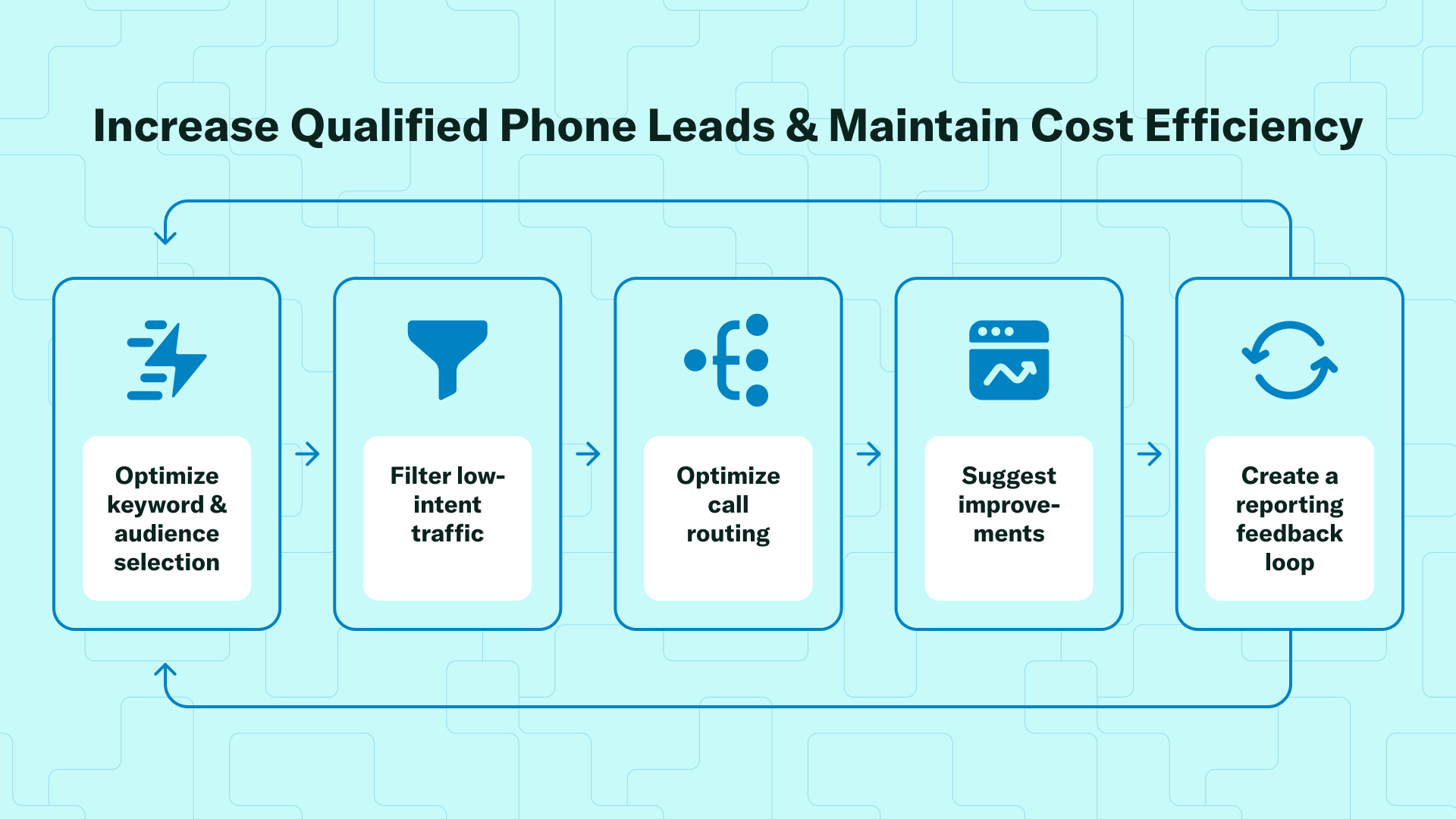
An agentic system interprets this objective and begins working toward it holistically:
- It enhances keyword and audience selection by analyzing which terms and segments historically produce leads that convert.
- It actively filters low-intent traffic. Smarter filtering at the top of the funnel dramatically improves efficiency.
- Then optimizes caller routing to ensure high-intent leads reach the most effective sales representatives or response processes.
- The agent doesn't just optimize in isolation—it suggests messaging. improvements based on what it observes in actual customer interactions.
- Finally, and perhaps most importantly, the agent feeds actionable insights to both marketing and sales teams. It creates a feedback loop where downstream conversion data informs upstream marketing decisions.
The agent's north star throughout all of this is the actual business KPI—qualified leads that convert to revenue—not vanity metrics like impression share or click volume. Forrester research shows that organizations can achieve 210% ROI over three years with properly implemented autonomous systems, with payback periods under six months. This kind of return is only possible when the optimization target aligns with genuine business value.
Agents Must Explain Their Decisions Transparently
Here's the challenge with autonomous systems: the more sophisticated and autonomous they become, the more they can feel like black boxes. Marketers need to trust and understand what these systems are doing, especially when they're making consequential decisions about budget allocation, audience targeting, and message delivery.
This isn't just about comfort level—it's about learning and improving. When a human marketer makes an optimization decision, they can explain their reasoning: "I shifted budget from Search Campaign A to Campaign B because the conversion rate was 40% lower and CPA was trending upward." Other team members can learn from this reasoning, challenge assumptions, and build institutional knowledge. If the autonomous system can't articulate similar logic, it becomes impossible to learn from its decisions or troubleshoot when things go wrong.
Transparency also matters for organizational trust and adoption. CMOs and CFOs are understandably skeptical when you tell them an AI agent is now controlling significant portions of marketing spend. They need assurance that the system is operating rationally, following business logic, and producing defensible decisions—not just making random adjustments based on inscrutable patterns.
According to Gartner research, over 40% of agentic AI projects are at risk of cancellation by 2027 due to unclear business value or inadequate risk controls. Transparency isn't just a nice-to-have feature—it's essential for long-term success and adoption of these systems.
Safety & Compliance Guardrails to Keep Agents From Going Off-Script
Marketing operates in a complex environment marked by numerous constraints, including brand guidelines, regulatory requirements, budget limitations, competitive sensitivities, and reputational risks. Autonomy in this context doesn't mean freedom to do anything—it means operating effectively within carefully defined boundaries.
This distinction is critical because one of the biggest fears around agentic AI is loss of control. What if the agent makes a decision that violates regulations? What if it publishes messaging that contradicts brand positioning? These aren't theoretical concerns—they're legitimate risks that could result in regulatory penalties, brand damage, and business disruption.
The solution isn't to limit agent autonomy so severely that they become glorified suggestion engines. It's to implement robust guardrails that define the operating zone within which agents can act freely.
Think of it like giving a talented employee increasing levels of responsibility. A new hire might need approval for every decision. A senior leader has broad autonomy within their domain but still operates within company policies, legal requirements, and strategic boundaries. Agentic AI should operate similarly—maximum autonomy within clearly defined constraints.
Example agentic AI guardrails that make autonomy safe
Content and messaging controls: Ad-copy agents cannot publish directly without human approval, especially for heavily regulated industries.
Budget management boundaries: Budget agents operate within set ranges—they can reallocate spend across campaigns and adjust bids, but they can't exceed daily or monthly caps without escalation.
Industry-specific compliance: Messaging agents must adhere to regulations governing healthcare (HIPAA), financial services (SEC, FINRA), and insurance sectors.
Privacy and data protection: No agent can access or disclose personally identifiable information (PII) in a manner that violates privacy regulations or company policies. This includes ensuring that personalization doesn't cross into invasive territory.
Brand consistency: No action can conflict with established brand guidelines around voice, tone, visual identity, value propositions, or positioning.
Competitive and strategic boundaries: Agents should understand competitive sensitivities—for example, not bidding on competitor brand terms if that violates company policy, or avoiding messaging that makes claims that can't be substantiated.
These guardrails aren't limitations that reduce the value of agentic AI—they're enablers that make autonomous operation practical and safe at scale. With proper boundaries in place, marketing leaders can feel confident allowing agents to operate independently across a wide range of decisions.
Agentic AI Creates a New Marketing Operating Model
What emerges from all of this is a fundamentally different marketing operating model—not just incremental improvement, but a genuine transformation in how marketing teams function and deliver value.
The traditional model is characterized by marketers spending a considerable amount of time on execution and operational tasks. Optimization is slow, and decisions are made based on incomplete or delayed data. Persistent misalignment between platform metrics and business outcomes wastes budget and time, slowing growth.
The agentic model transforms this with a human-led strategy and AI-led execution, enabling continuous optimization, tactical iteration, and real-time adaptation based on comprehensive data about actual business outcomes. It also creates tight alignment between optimization targets and revenue quality, enabling marketing teams to focus on the work that genuinely requires human judgment.
When marketers control the vision and agents control the execution, the entire revenue engine accelerates. Teams can run more campaigns, optimize more aggressively, respond more quickly to opportunities, and drive better outcomes—all while working more sustainably and focusing on the strategic and creative work that drew most of us to marketing in the first place.
Get The B2C AI Marketing Impact Report to learn how marketers plan on using AI in 2026.
.svg)
.svg)