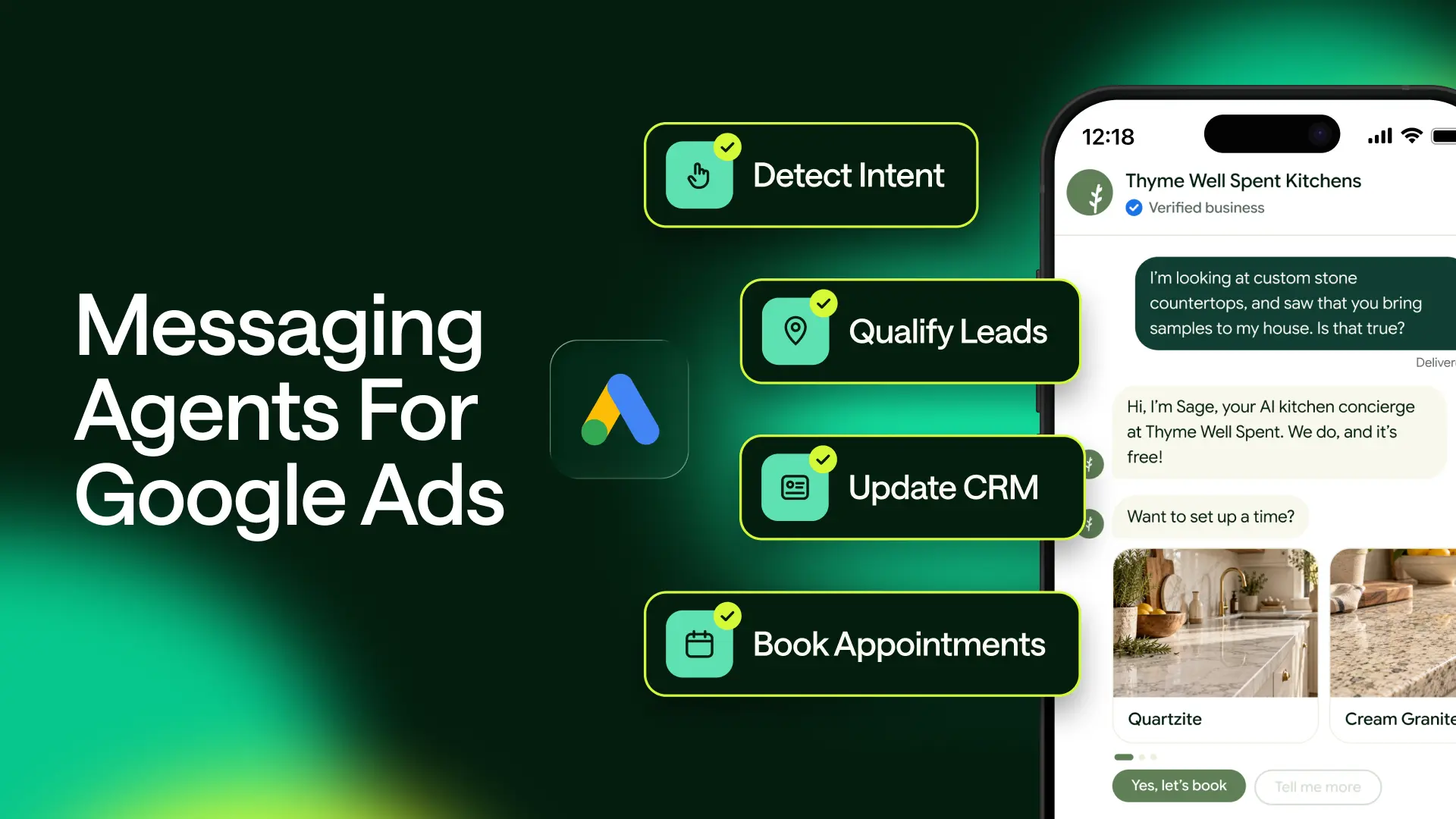
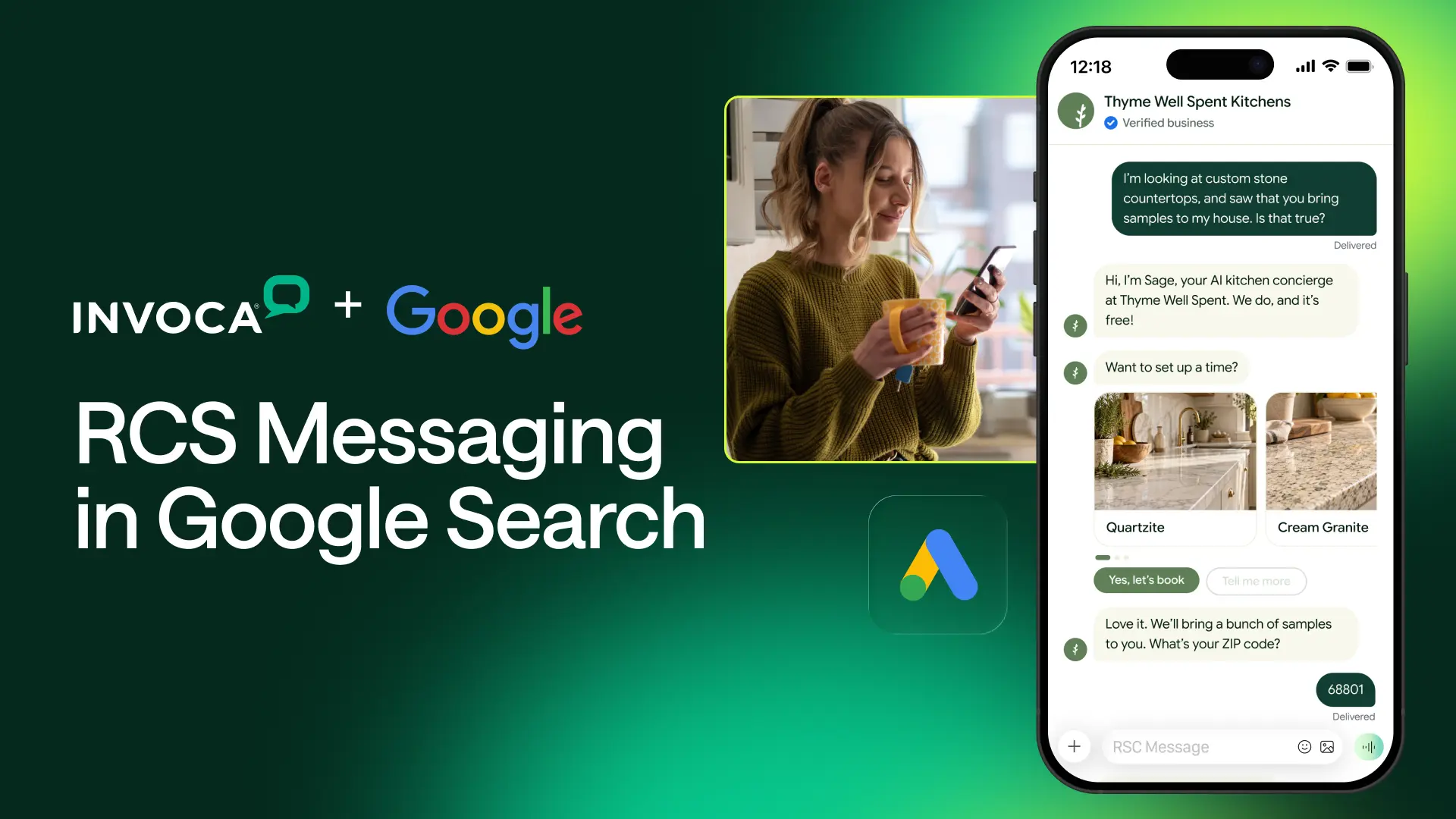
RCS messaging is now available in Google Ads and search results, creating an immediate opportunity to start a conversation and convert leads without them ever leaving the search results page. Invoca's Messaging Agents for Google Ads take it a step further by giving brands full control over those conversations with an AI agent trained on their data and messaging.
Most paid search clicks still land on a page and go cold. For brands in considered-purchase categories such as home services, financial services, insurance, telecom, and travel, conversational ads via RCS messaging offer a new, faster channel to convert more leads.
But most marketing teams still treat messaging as a single channel called "text," and that's the knowledge gap this guide closes. Read on to learn what RCS messaging is, how it differs from the SMS programs you already run, why it matters for B2C marketers, how messaging in Google Search works, and how to get the most out of this new channel with Invoca's Messaging Agents for Google Ads.
What Is RCS Messaging?
RCS, or Rich Communication Services, is the messaging standard built to replace SMS. It runs inside the default messaging app on both Android and iPhone, so the consumer has nothing to download and nothing to learn. SMS can only carry plain text. RCS turns the consumer's messaging inbox into an app-like experience with images, video, interactive cards, tappable buttons, read receipts, and typing indicators.
RCS has been the default on Android for years, but the channel became useful for B2C marketers only once Apple added RCS support to the iPhone with iOS 18 in late 2024.
Since then, adoption has moved quickly: Google says more than a billion RCS messages are now sent every day in the U.S. alone across Android and iOS. In practice, most of your customers can already receive RCS messages from you.
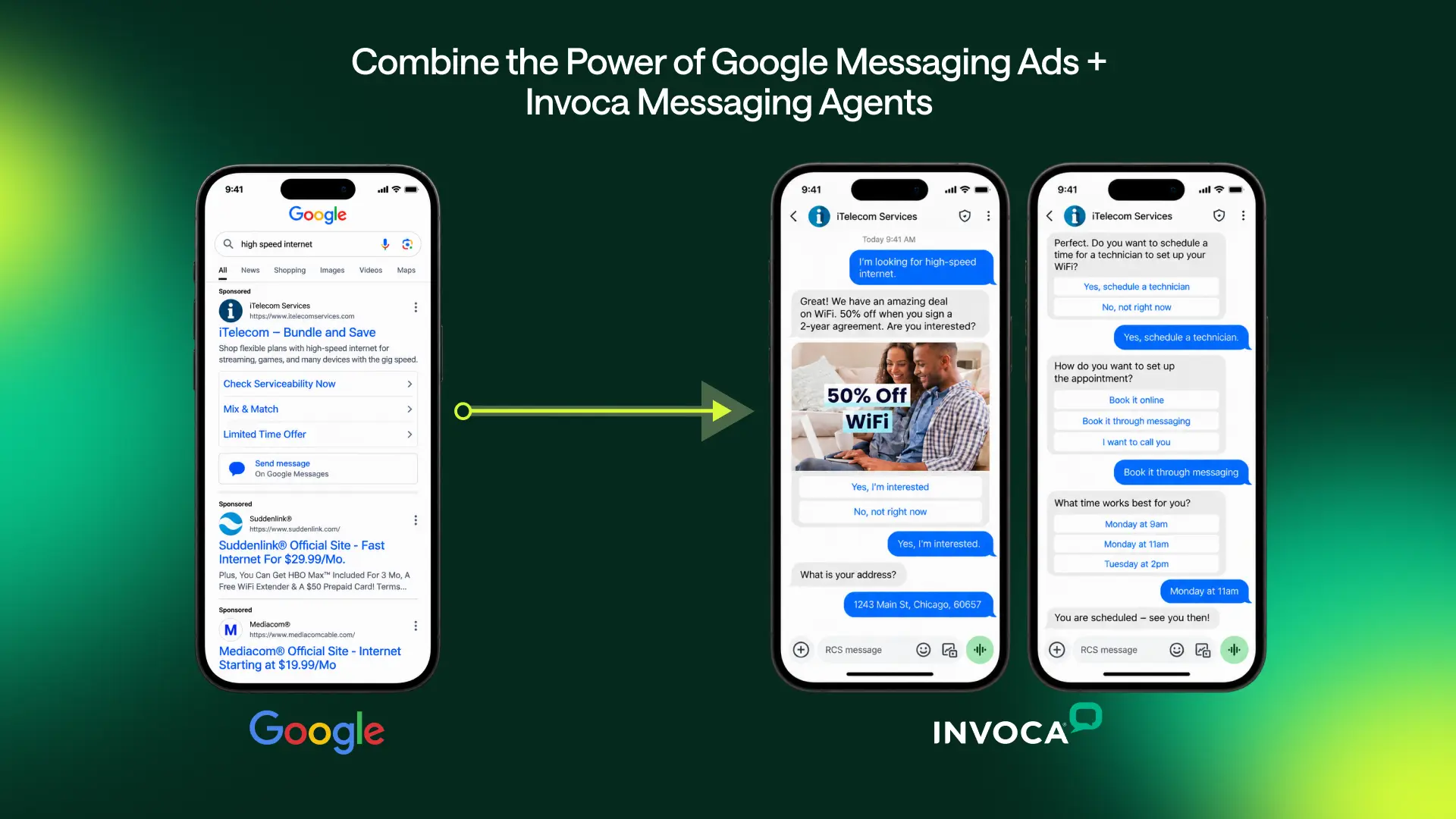
For brands, Google's business-facing product is RCS for Business, which it also uses to power the messaging buttons in search results and ads. A few capabilities matter most for the conversations your business has with sales leads:
- Verified branding: The thread shows the company name, logo, and brand colors with a verification mark, so the consumer knows they're talking to the business and not a spoofed number.
- Rich cards and suggested actions: A single message can include an image, text, and tappable replies or actions (book now, call now, see itineraries), keeping the consumer moving toward conversion.
- In-thread workflows: Appointment booking, order tracking, and web views can run inside the conversation without sending the consumer back to a browser.
- Reliable delivery: If a message can't be delivered over RCS, it falls back to SMS/MMS, so no lead is lost to an older phone or a carrier gap.
The most valuable use case for messaging in Google Search is the inbound conversation a consumer starts straight from the search results, where intent is highest, and the window to convert is shortest.
RCS vs. SMS: The Differences Marketers Need to Know
The difference is easiest to see side by side. SMS is a 160-character text pipe that was never designed for selling. RCS is a conversation surface that happens to live in the same inbox.
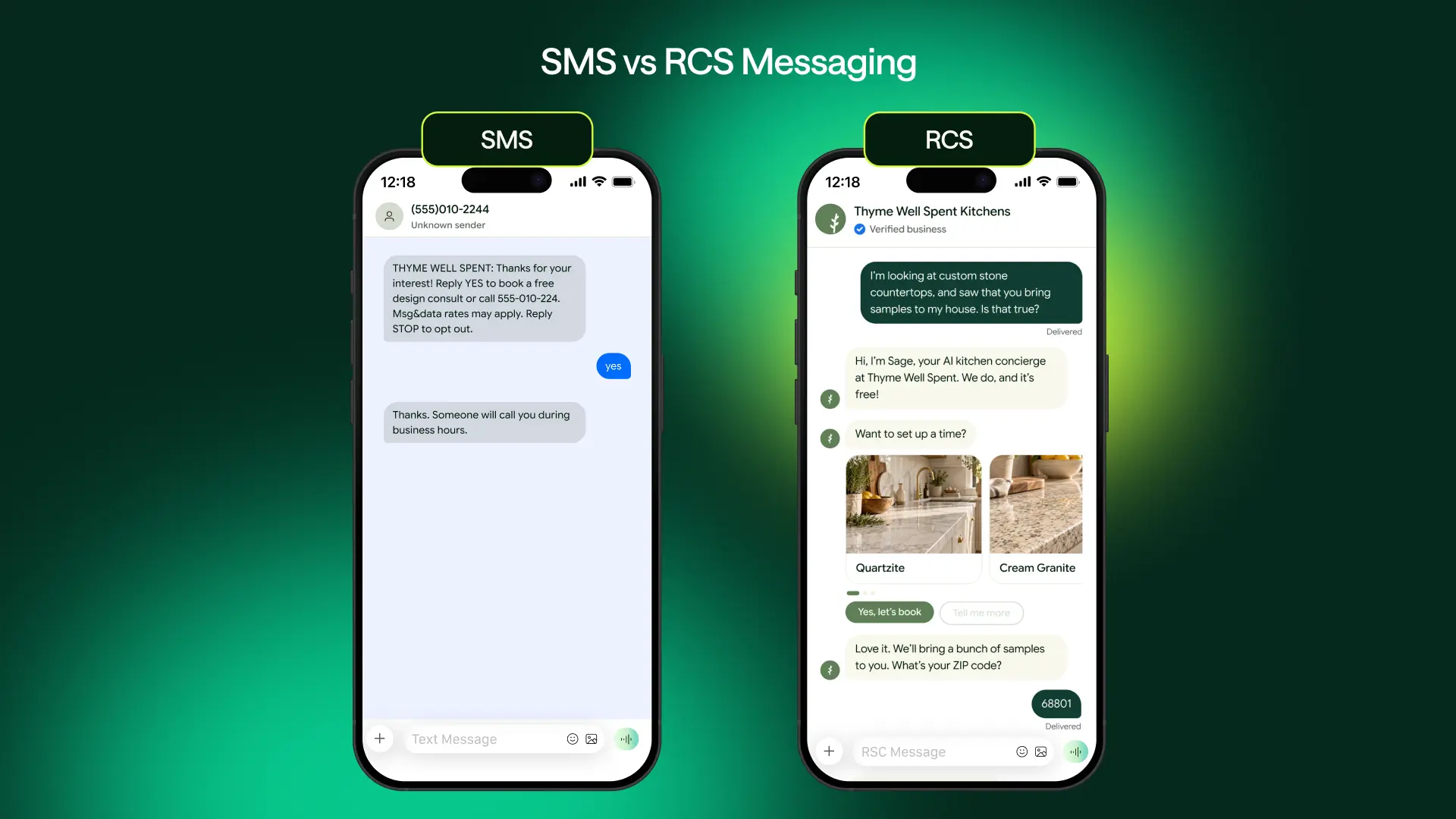
Verified identities and suggested actions are most important from a marketing perspective. Verified identity solves the trust problem that hobbles SMS response rates. A consumer who sees your logo and a checkmark in the thread treats it like a brand touchpoint, whereas unbranded SMS messages are treated with suspicion. Suggested actions and in-thread workflows keep leads engaged and prevent them from wandering off when they are redirected to a browser.
What RCS does not change is consent rules, opt-in and opt-out requirements, and carrier compliance. These apply to RCS just as they do to SMS.
Why B2C Marketers Should Use RCS
The case for RCS comes down to where it sits in the buyer journey. Email and SMS are outbound channels you push into. RCS, as Google has deployed it in Search, is an inbound channel a motivated buyer opens on their own, at the moment they're deciding. That changes what messaging is for.
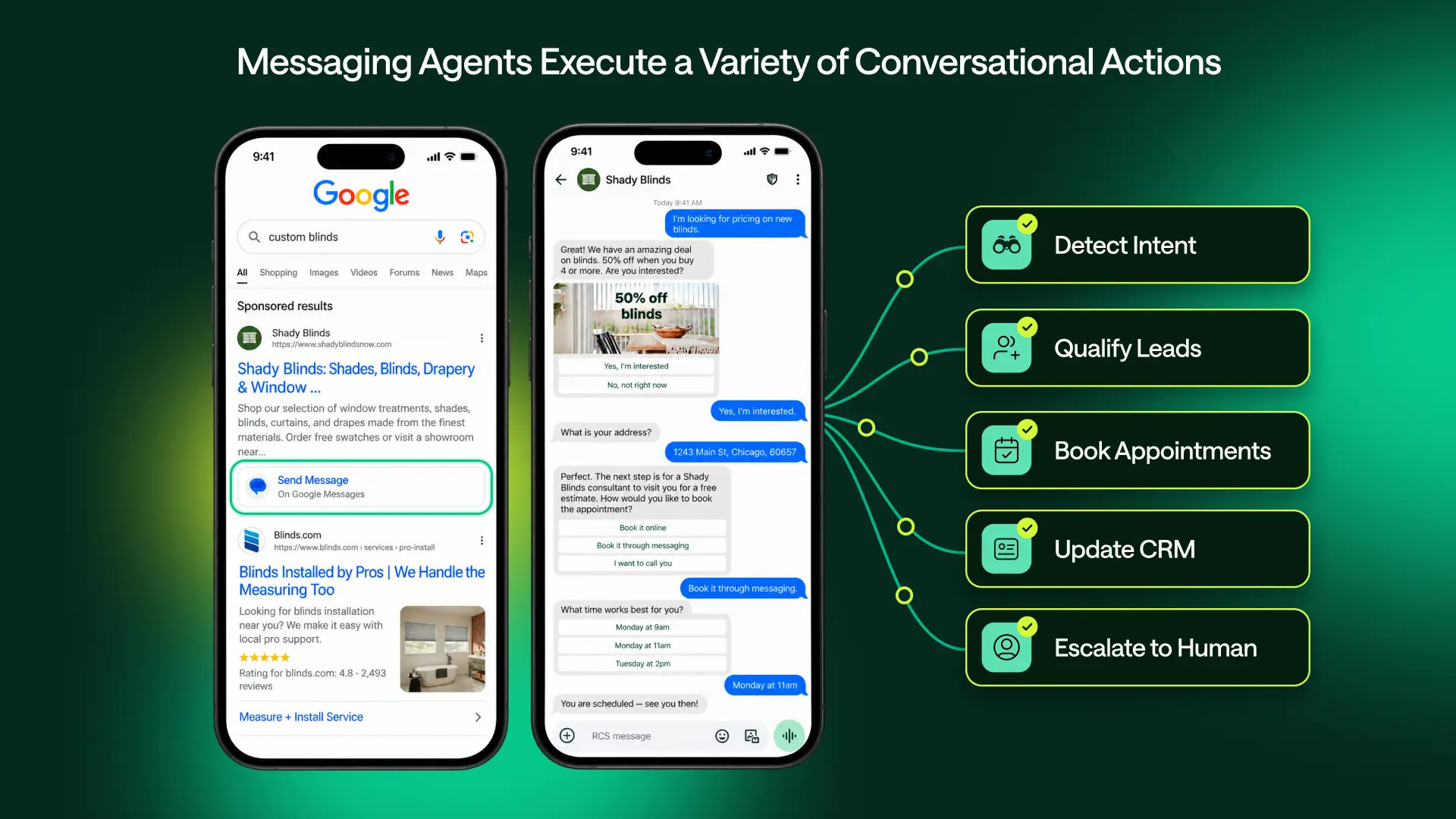
RCS messaging turns search intent into a conversation without a landing page in between
A consumer researching a water heater replacement, a mortgage rate, or an insurance quote has questions a landing page can't answer about their situation. RCS lets them ask, and lets you answer, before they bounce to a competitor's website.
It meets the standard AI has set for buyer experiences
Buyers now research using ChatGPT, Gemini, and AI Overviews, and they expect to ask a question and get an answer tailored to their own circumstances. A form-and-callback flow feels a decade old next to that. RCS gives brands a native way to deliver that back-and-forth in the inbox the buyer already uses.
It converts leads in the thread
Booking an appointment, confirming service availability, or completing a multi-step quote can all happen without leaving the conversation. Fewer handoffs mean fewer places for a lead to go cold.
It establishes trust before the first reply
The verified brand badge does something no SMS short code can: it tells the consumer who they're talking to. In high-stakes categories where fraud fears run high, that matters at least as much as the rich media.
It produces first-party data you can act on
Every RCS conversation is a record of what the buyer asked, what they were quoted, what objection came up, and what happened next. Connected to your CRM and ad platforms, that becomes conversion data for Google Ads and buyer intelligence for the rest of the team.
The one caveat is that RCS is only as good as your ability to respond. An RCS thread that waits until the next business day for a human reply loses most of its advantage over a form, so responses need to be automated using AI agents to scale.
How RCS Messaging Works in Google Search
Google surfaces a message option wherever a consumer can already find your brand in Search. Rather than a single ad format, you get a "message" button attached to your brand across paid and organic placements, so it works at every stage of the search journey:
From the consumer's side, the experience is as simple as it gets. They tap the message button in the search results, a verified RCS conversation opens in their default messaging app, and the messaging agent takes over.
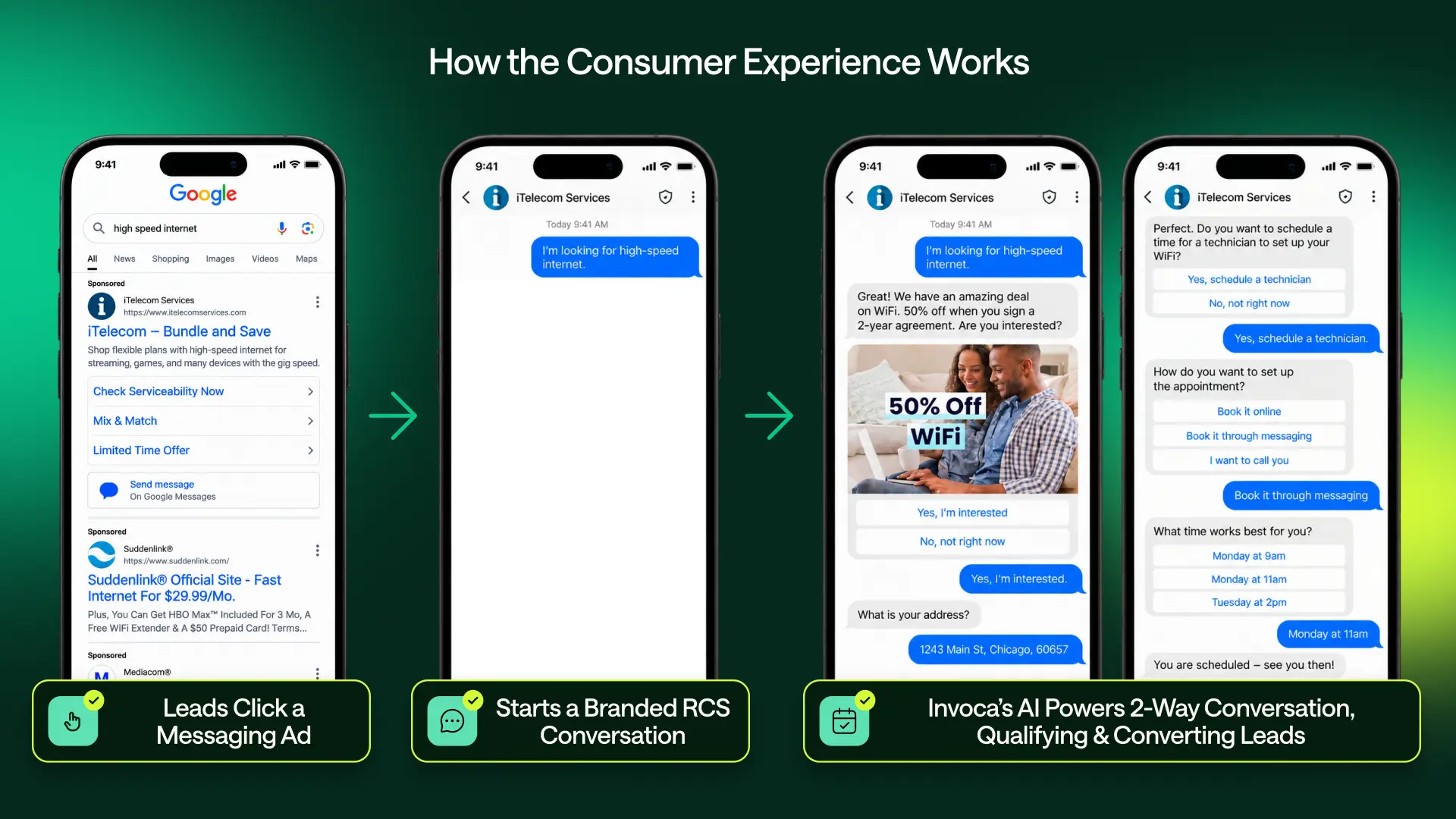
The consumer then converts on their preferred path: booking in the messaging thread, through a booking link, or by speaking with a live agent, who has the full context from the messaging conversation to complete the sale.
The mechanics on the brand's side are simpler than they sound. Invoca provisions the messaging agent, activates the entry points you choose in Google, trains the AI agent on your historic customer interactions, and connects it to your CRM and other systems of record. You decide which entry points to turn on and what counts as a qualified lead.
How Invoca's Messaging Agents for Google Ads Turn RCS Message Leads into Revenue
Invoca's Messaging Agents for Google Ads enable you to reliably automate conversations from Google RCS message leads. The agent answers every message instantly, 24/7, using AI trained on your first-party data. Every conversation runs on Invoca's platform, so it's connected to the rest of the buyer journey from the first tap. Specifically, brands can:
- Reach consumers where they search on Google. Consumers can message brands from Google ads as well as organic touchpoints such as web results, sitelinks, and featured snippets, so you capture demand you're already paying for and demand you've already earned.
- Respond instantly, at any hour, with personalized assistance. AI agents answer questions and move the buying conversation forward, late at night or over the weekend when stores and contact centers are closed.
- Move consumers to a decision faster. Consumers can check service availability, book appointments, and get pricing from their phone, with no app to download, using the RCS rich cards and suggested actions described above.
- Build trust from the first message. Messaging Agents are verified and badged, so the consumer sees your brand, not a number, from the first reply.
- Answer with the context and systems that power your customer experience. Messaging Agents use AI trained on your business's first-party data and knowledge to answer questions and offer advice, with access to company systems for consumer profiles, service availability, geographic coverage, appointment booking, and more.
When a phone call is the better path, the agent offers it, and the call is routed with the conversation history attached, so the buyer never has to repeat themselves.
Connect RCS conversations to conversions and revenue
The measurement gap with most conversational ad formats is that the conversation stays inside the platform, and so does the context. Because Messaging Agents run on Invoca, each conversation is tied to the campaign, ad group, and keyword that surfaced it. The context and outcomes of the conversation are also recorded, so it can be matched to the customer in your CRM, so you have complete revenue data.
Importantly, the conversion and revenue data from these conversations are also sent back to your ad platforms to inform Performance Max, Smart Bidding, and other AI-driven optimization, improving your ROAS.
Drive Better ROAS and More Revenue with Invoca Messaging Agents for Google Ads
RCS gives B2C marketers something SMS never could: a verified, interactive conversation that starts at the moment of highest intent and finishes in the thread.
Invoca Messaging Agents for Google Ads are now available in beta. Click here to schedule a demo.
FAQs About RCS Messaging for Google Search
What does RCS stand for?
RCS stands for Rich Communication Services. It is an advanced telecommunications protocol designed to replace SMS and MMS. RCS enables interactive, app-like experiences inside native mobile messaging apps—including high-resolution media, read receipts, interactive buttons, carousels, and verified business sender profiles.
Is RCS the same as iMessage?
No, RCS is not the same as iMessage. iMessage is Apple’s proprietary messaging service that works exclusively between Apple devices. RCS is an open global telecommunications standard supported across carriers, Android devices, and iPhones (beginning with iOS 18). While both provide rich features like typing indicators and high-res media, RCS enables these capabilities across different operating systems.
Is RCS free, and does it use cellular data?
For consumers, RCS messaging uses mobile data or Wi-Fi rather than standard cellular text allowances. It does not incur per-message SMS charges, though data usage counts against a user’s mobile plan. For businesses, RCS for Business is typically billed by telecom aggregators and platforms on a per-delivered-message or per-active-conversation model.
Can you send RCS messages inside Google Ads?
Yes. Google Ads supports messaging assets that trigger RCS conversations directly from Search ads and organic search listings. When a high-intent searcher taps "Send message," their default messaging app opens directly into a verified two-way RCS thread with your brand, bypassing landing page friction entirely.
Can an AI agent respond to RCS messages automatically?
Yes. Brands can deploy conversational AI messaging agents to manage inbound RCS threads 24/7. Modern AI agents, such as Invoca Messaging Agents for Google Ads, are trained on your company's knowledge base and product catalog to qualify leads, answer complex questions, check inventory, and book appointments in real time without human intervention.
Do businesses need opt-in consent to message customers via RCS?
Yes. RCS messaging is governed by the same regulatory compliance frameworks as SMS, including TCPA, CTIA guidelines, and GDPR. For outbound promotional campaigns, businesses must secure explicit consent and provide standard opt-out commands (like "STOP"). However, when a consumer initiates a conversation via an inbound Google Search message asset, their click represents inbound intent to chat.
Is RCS messaging secure and encrypted?
Yes. RCS provides enterprise-grade security and fraud protection through verified sender verification, preventing brand spoofing and phishing. In addition, person-to-person (P2P) RCS natively supports end-to-end encryption (E2EE), while business messaging (A2P) uses encrypted transport protocols (TLS/HTTPS) between consumer devices, carriers, and enterprise platforms.