.svg)

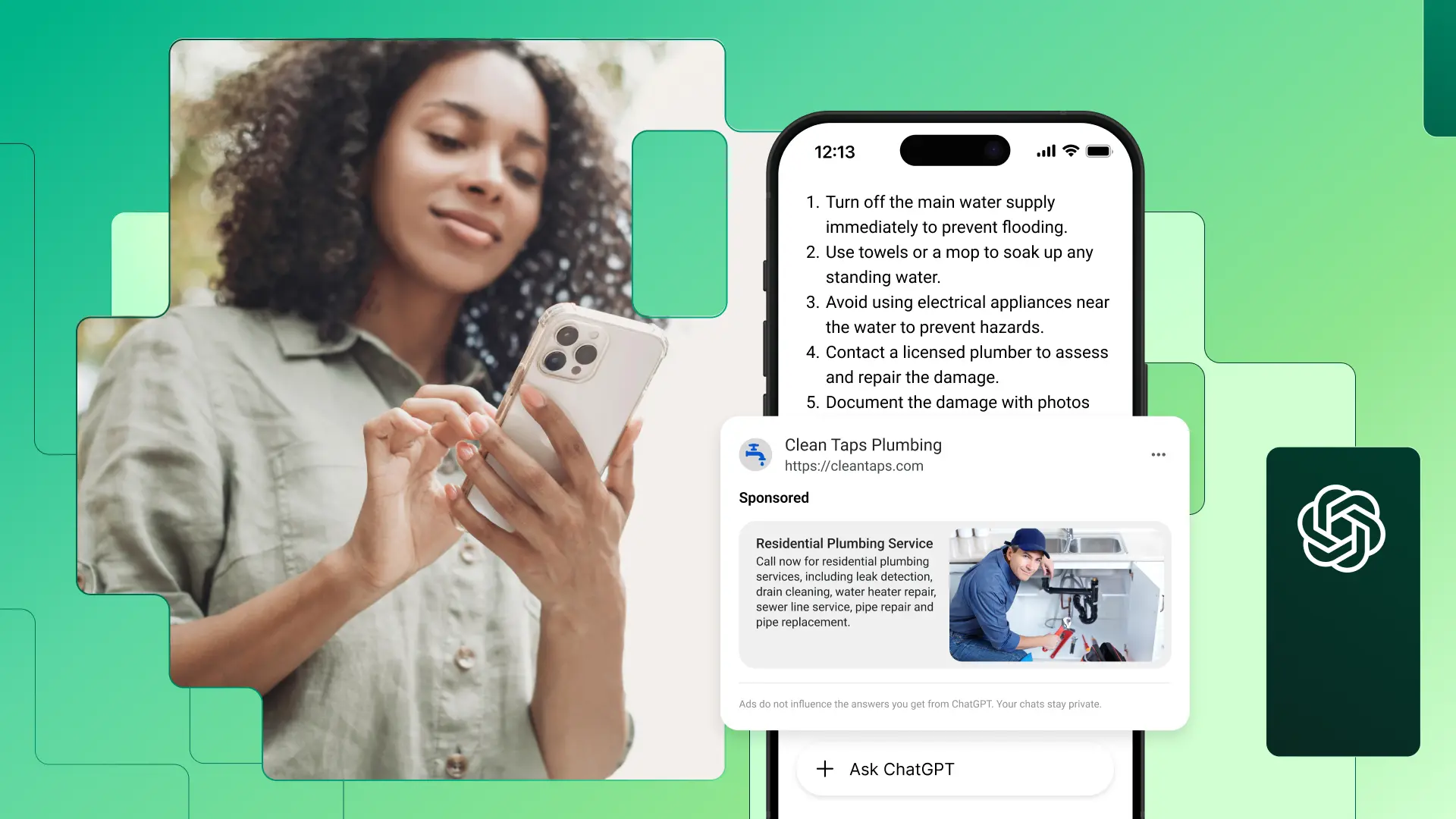
ChatGPT Ads added eight new features on July 24, and the one that should change how marketers treat the channel is conversion-optimized bidding. Advertisers can now choose a conversion objective and let ChatGPT push delivery toward clicks more likely to convert, while still paying on a click basis.
Alongside that come average daily budgets, automatic spend pacing, geographic exclusions, improved conversion matching, AppsFlyer and Adjust integrations for app measurement, bulk API support, and refreshed product cards. These new features close some big gaps between ChatGPT Ads and the ad platforms your team already runs.
It also arrives at a moment when new Invoca data shows ChatGPT is producing the highest-quality phone leads of any marketing channel we measure.
This is big news for B2C brands, as The Invoca Lead Conversion Benchmarks Report 2026 found that ChatGPT now generates higher-quality leads than any other channel. The report found that 49% of answered calls from ChatGPT were qualified leads—about 10 points above the all-channel average and 6 points higher than the next-best performer. Conversion rates on those calls landed at 40%, right around average.
This makes sense because someone who has researched a purchase with generative AI is likely better informed and therefore better prepared to buy.
Total call volume attributable to generative AI is still low, which is exactly what makes this the perfect moment to test the channel while auction prices are lower and competition is thin.
ChatGPT Ads now has the bidding controls to buy outcomes, and the audience quality to make those outcomes worth buying. Like any other platform, though, conversion bidding only works when it can see all of your conversions. In industries where sales close over the phone, most advertisers are missing a large share of their conversions.
What OpenAI Just Added to ChatGPT Ads (Updated 8/27/26)
Exclusion targeting (in testing)
OpenAI confirmed to Adweek that it's testing negative targeting guidance—new controls that let advertisers specify contexts where they don't want their ads to appear. Details are still thin, and there's no public timeline, but it appears this will give advertisers a way to opt out of placements.
This came about following independent research from SE Ranking, which analyzed over 50,000 commercial prompts and found ChatGPT served ads on nearly 26% of them. However, 14.35% of those ads had no connection to the conversation they ran alongside. The mismatch problem wasn't evenly spread, either: it ranged from 2.6% in pets to more than 50% in relationships, news, and politics, some of which are categories that advertisers don’t want near their brand. Ad buyers have also flagged limited visibility into where their ads actually ran, and in at least one case, ChatGPT gave an advertiser an explanation for its own ad placement that OpenAI later confirmed to be wrong.
Exclusion targeting won't fix relevance on its own. But it's a meaningful admission that the platform's targeting is still catching up to what advertisers expect from mature channels. This is worth watching alongside the conversion-bidding rollout below, since neither feature does much good if you can't first control where your budget shows up.
Here's what each of the eight updates reported by Search Engine Land changes for advertisers.
Conversion-optimized campaigns (oCPC)
Advertisers can now select a conversions objective and let ChatGPT Ads push delivery toward clicks more likely to produce a conversion event. Billing still happens on a valid-click basis. This addition moves the platform from selling traffic to selling outcomes.
Automatic advanced matching
Website conversion measurement now uses hashed customer data to improve attribution accuracy. You'll find it under Tools > Conversions > Data Source.
Average daily budgets and automatic pacing
Daily budgets shifted from fixed caps to a rolling seven-day average, so spend can flex day to day while staying inside overall limits. Spend is also paced across the day rather than front-loading in the morning. The change took effect July 27.
Geographic exclusions
You can now remove specific locations from campaign delivery, which is important for any multi-location business with uneven service coverage or franchise-territory rules.
Mobile measurement with AppsFlyer and Adjust
App advertisers can finally attribute installs and in-app events to ChatGPT Ads campaigns. Until now, there was no supported way to prove a click produced a download.
Bulk API updates
The Ads API supports asynchronous bulk creation and updates across campaigns, ad groups, and ads, which lowers the operational cost of running the channel at scale.
Refreshed product feed cards
Product feed campaigns are getting updated cards that display pricing and star ratings.
Granted, all of these are catch-up features compared to legacy digital ad platforms, but it could lower the barrier to entry for many advertisers.
Conversion Bidding Is Only as Good as the Conversions You Report
Here's the part that should give marketers in high-consideration industries pause.
An algorithm optimizing toward conversions will optimize toward whatever you tell it a conversion is. Feed it form fills, and it will find people who fill out forms. Feed it click-to-call taps, and it will find people who tap buttons. Neither of those is actually a conversion.
In automotive, healthcare, home services, insurance, financial services, telecom, and travel, the most valuable conversions often occur over the phone. Consumers call to book appointments, get quotes, and get those final big questions answered before making a big purchase. However, many businesses still don’t track these valuable conversions. If your conversion signal only captures digital actions, oCPC will spend your budget chasing a sliver of your best customers.
How Invoca Connects ChatGPT Ads to Offline Revenue
Invoca launched a no-code integration with the Conversions API for ChatGPT Ads in May, and the new oCPC objective is precisely the use case it was built for. The integration does three things.
It maps offline conversions back to ChatGPT ad engagement
Besides attributing digital leads like form fills, online appointments, and ecommerce orders back to ChatGPT ads, Invoca also works for calls and texts. When someone clicks a ChatGPT ad and later converts on a phone call or SMS conversation, Invoca attributes that conversion to the originating ad, then uses AI to analyze the conversation for intent and outcome. Not just that a call happened, but whether it produced a lead, an appointment, or a sale.
It measures revenue instead of activity
Appointments booked, quotes generated, sales closed, and dollars attached to each attributed conversation. Marketing teams see which ChatGPT campaigns are generating qualified demand rather than just engagement.
It feeds those outcomes back for continuous optimization
Conversion data flows to OpenAI via the Conversions API, giving ChatGPT's models real business results to optimize against. With oCPC now live, that loop is no longer just a reporting benefit. It directly shapes who sees your ads.
This is the same closed-loop approach that Invoca customers already run on ad platforms like Google Ads, Meta, TikTok, and Reddit, applied to a channel that most of your competitors aren’t yet measuring.
This Window of Opportunity Will Soon Close
Consumer behavior is moving faster than advertiser behavior, and that gap is the opportunity.
The B2C Buyer Experience Report 2026 found that 58% of US consumers used generative AI to research a high-stakes purchase, up from 41% a year earlier. That's a 17-point jump in twelve months. Among Boomers, use climbed from 11% to 34%, a group that also told us, at 85%, that they still prefer a human representative when they're ready to decide. Research in AI, close on the phone. That pattern describes the exact journey the Invoca integration measures.
Once ChatGPT Ads matures to the point where every performance team is running oCPC campaigns against it, auction prices will reflect that. The advertisers who have already trained the algorithm on their actual revenue outcomes will start from a better position than those showing up with a form-fill pixel.
What to Do With ChatGPT Ads This Quarter
Start a small ChatGPT Ads test in your highest-value category and properly instrument it before scaling. Make sure your conversion events include offline outcomes, not just website actions, so oCPC has something worth optimizing toward. Then judge the channel on lead quality and revenue per conversion rather than cost per click, because the benchmark data suggests that's where ChatGPT's advantage actually shows up.
The channel is small. The signal is strong. The measurement problem is solvable now.
.svg)
.svg)