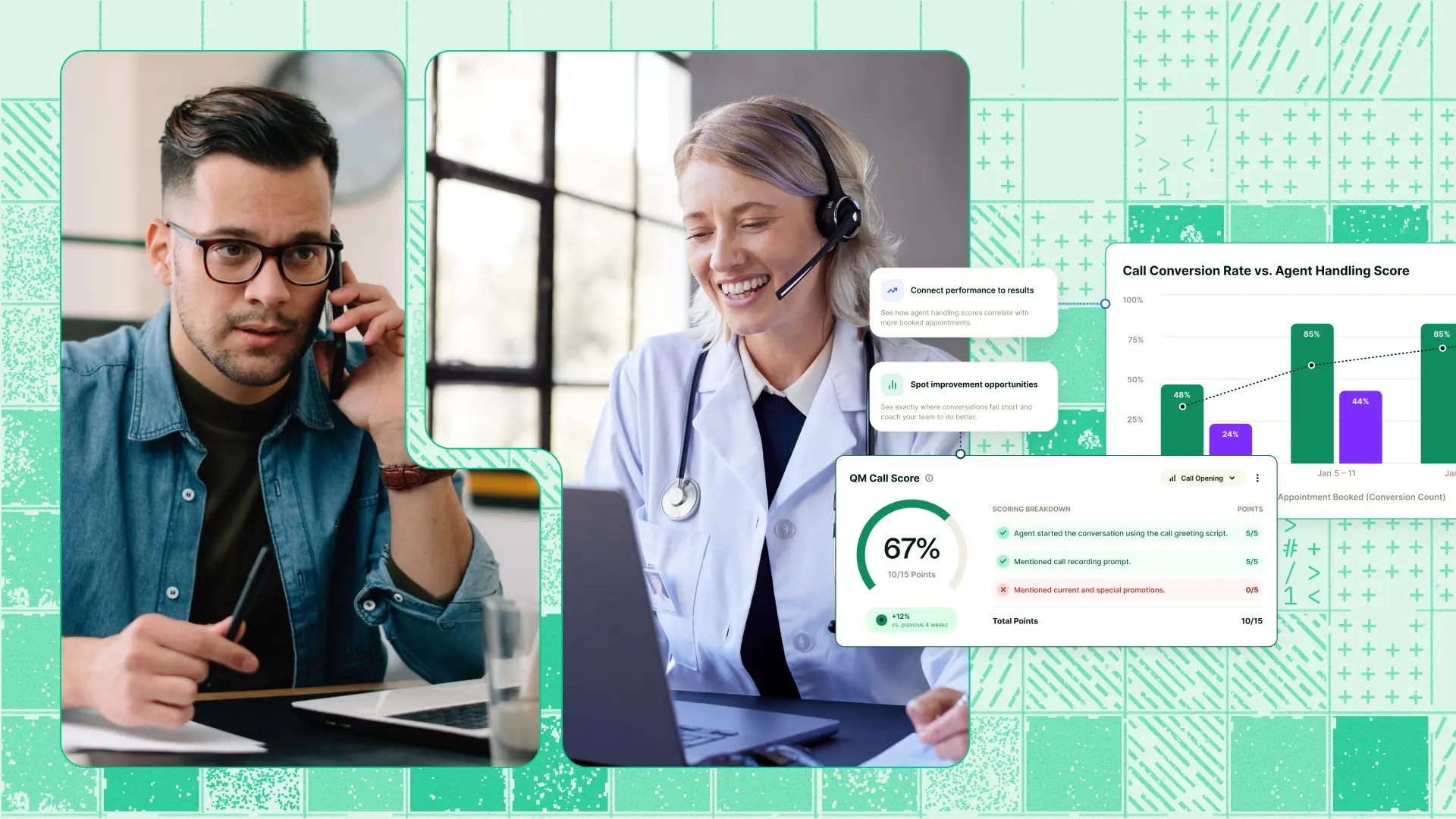
We've all interacted with an AI receptionist that claims to "understand your concern," while proving it does not, in fact, understand anything. You ask a simple question, like "How much will this procedure cost with my deductible?" and it responds with something deeply unhelpful, like "No problem, I can help you pay your bill!" You try again. It gets more cheerful. You get more annoyed. Eventually, you give up and dial the patient access center, where you wait on hold.
The most frustrating part is that it often feels like we don't have a choice. According to our recent survey, 65% of consumers say they feel forced to use a company's AI. Organizations are funneling us into AI interactions whether we want them or not, burying phone numbers, hiding "speak to a person" buttons, and making us jump through hoops before we can talk to a human.
In healthcare, the stakes of that bad experience are higher. A patient who abandons a chat window isn't abandoning a sweater in a cart—instead, they may be abandoning the search for care altogether, or taking it to the health system across town.
Here's the good news: AI agents don't have to be this way. When deployed thoughtfully, they significantly improve the patient experience. The difference comes down to a few key principles: knowing when AI should step in versus step aside, giving patients real agency to choose their preferred channel, and using conversation data to make AI smarter rather than just more persistent.
This article breaks down the expert tips you need to deploy HIPAA-compliant AI receptionists and SMS messaging agents that patients will actually find helpful.
1. Train Your AI Agents on Your Best Patient Access Calls
The reason many AI receptionists don't deliver is that they're not trained correctly. Your AI is only as good as the data you feed it—put garbage in, and you get garbage out. However, when training AI, most health systems overlook the richest data source at their disposal: the thousands of conversations happening every day in the patient access center.
That's why Invoca's AI receptionist and SMS messaging agents are pre-trained on your best calls, so they speak the way your top-performing schedulers do, using your language, tone, and approach to handling questions. There's no months-long training period or awkward learning curve where patients suffer through robotic responses while the system figures things out. You launch with an AI that already knows how to represent your system across every market and service line.
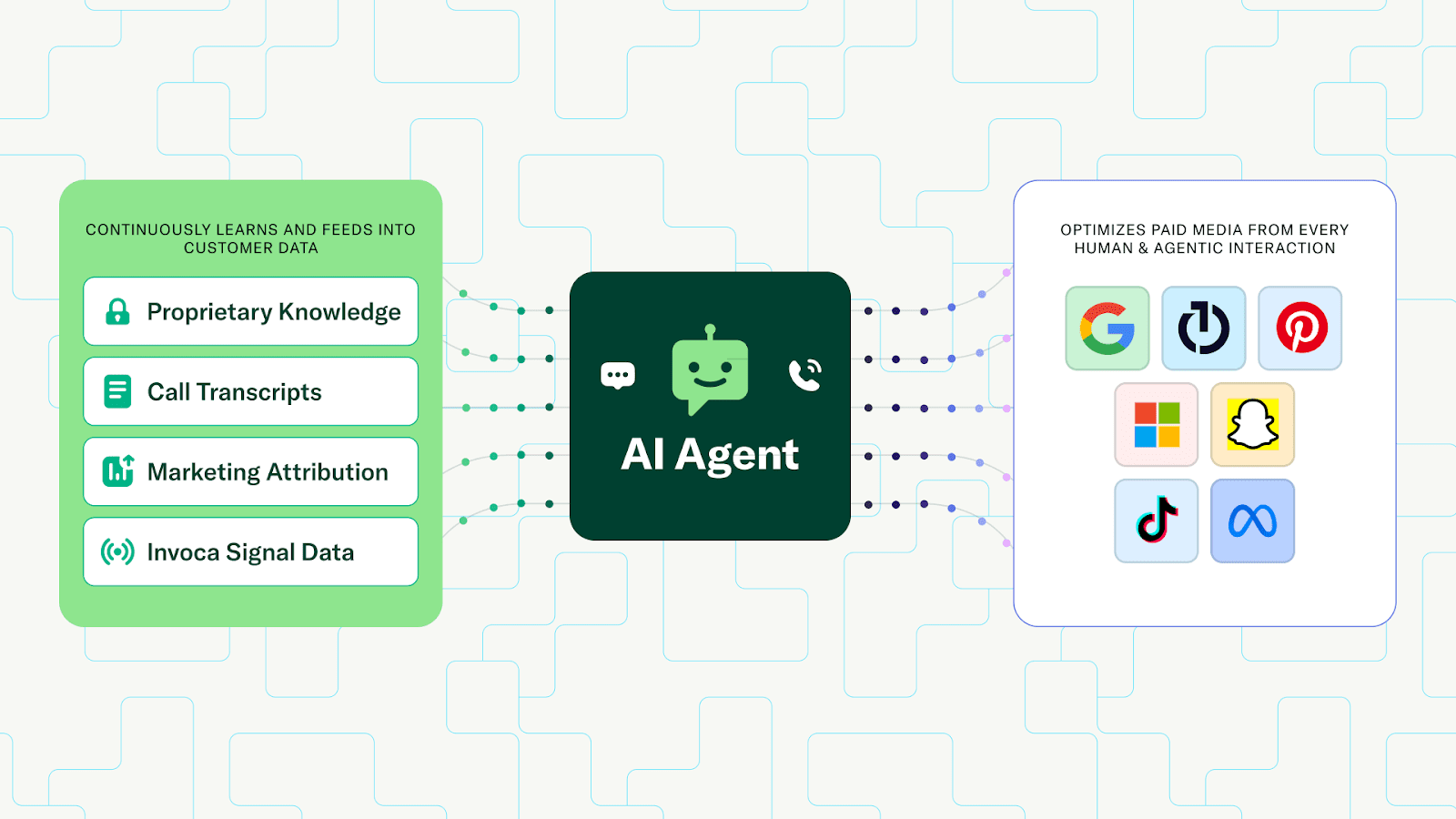
Invoca's AI agents also aren’t static. They continuously learn and adapt from every conversation, call transcript, attribution signal, and campaign outcome. This means they get smarter over time, just like a strong scheduler improves by learning on the job. Service lines expand, providers join and leave the network, payer mixes shift, and the AI keeps pace.
Of course, training on real patient conversations only works if PHI stays where it belongs. Invoca's AI agents never store sensitive data shared during a conversation, and our redaction technology automatically strips 24+ types of PII and PHI from call recordings and transcripts. The platform is HIPAA-compliant and BAA-backed, so you get the operational value of your call data without creating a new compliance exposure.
2. Connect Your Agents to the Entire Patient Journey
One of the most frustrating aspects of AI agents is that they often have no idea what you've already done. You clicked an ad for joint replacement, read three pages about the orthopedic program, looked up two surgeons, maybe even started an appointment request form, and then you texted or called the system with a question. The AI responds as if you're a complete stranger starting from scratch. You have to give it context by repeating all the information you already provided.
Invoca's AI agents eliminate this friction by connecting the entire patient journey. They don’t operate in a silo—they’re built as an integrated part of Invoca's platform, which means they already know what ads were clicked, what pages were visited, what service lines were viewed, and what actions were taken before texting. When the AI fields a lead, the conversation picks up where the journey left off, not from square one. The lead doesn't have to re-explain themselves because the AI already has the context it needs to help them.
This seamless connection does more than just improve the patient experience—it ties every SMS interaction, callback, and conversion back to the original marketing source. That means health systems can finally prove ROI across the full patient journey and use those insights to optimize smarter. This fills a critical attribution gap, as tracking conversions across a sprawling integrated delivery network can be extremely challenging.
3. Answer Overflow and After-Hours Demand Instead of Losing It
When patients call your access center, they want immediate help and are usually trying to book an appointment. That's what makes unanswered calls so damaging—they not only delay the conversation but can also stall care and leave high-intent patients in limbo.
While answering the phone may seem like a no-brainer, it's not always that simple. Even well-run access centers get hit by unexpected volume spikes, staffing shortages, and campaigns that drive demand straight into peak congestion. Our 2026 industry benchmark data shows that only 47% of callers to health systems never reached a human agent.
Then there's the after-hours leak. Patients often research care at night and on weekends, when the access center is closed, and voicemail is the only option.
Missed calls are inevitable, but the real question is how quickly you can recover before that patient moves on to another provider. That's where Invoca's AI Agents make all the difference. Here’s how they can help:
Answer the call with an AI receptionist
When peak volume exceeds staffing, Invoca's AI Voice Agent picks up 24/7, qualifies intent, books routine and known appointment types, and warm-transfers anything complex to a live scheduler with context attached. Because it absorbs overflow rather than sitting in front of every call, it protects service levels without disturbing your live-agent queue. After hours, it turns voicemails into booked appointments.
Recover leads that still slip through with SMS
The moment a call is abandoned, hits voicemail, or arrives outside business hours, Invoca's AI Messaging Agent can follow up by text with a secure self-scheduling link tied to live availability in systems like Epic Cadence, along with answers to basic questions. Because the AI pulls context from across the journey, the message references the service line the patient was actually looking at instead of a generic "sorry we missed you."
From there, the AI can book appointments, schedule callbacks, answer program questions, capture consent, and gather details, all over text. Recovering that demand also lightens the load on schedulers who would otherwise be working a callback list.
4. Progress Stalled Leads and Send Appointment Reminders
As a patient, there's nothing more frustrating than hitting a wall in an appointment request form. Just as you're about to submit, an unexpected roadblock stops you cold—a question about your referral you can't answer, a plan name that isn't in the dropdown, a required field you don't understand. Without help at that moment, abandoning the form feels like the easiest option. Or you go find a provider that makes it simpler.
This is where messaging does the work that voice can't. Nobody wants a surprise phone call because they hesitated on a form field, but a text arriving in the same minute feels like help. Instead of a generic "you didn't finish your request" email hours later, the agent initiates a personalized SMS conversation that answers the question, removes the friction, and keeps the patient moving toward a booked appointment.
If someone drops off a provider search or an appointment request form, the AI agent can meet them with a text right where the frustration occurred, resolve the question that stopped them, and finish the scheduling in the text thread. If the patient would rather talk it through, the agent can schedule a callback at a time of their choosing.
In addition, you can use AI agents to send appointment reminders, which can help reduce your no-show rate. You can also automate follow-ups via SMS so they receive important information post-visit and can schedule any additional appointments they may need.
5. Provide an Easy Exit Hatch to a Human
In our recent survey, 60% of respondents said quicker access to a human would improve their experience with AI. Most patients aren't rejecting AI outright—they simply want to reach a human faster when the moment calls for it. Only a small minority (8%) say they never want to interact with AI during a high-stakes purchase. What patients are really asking for is control: the ability to self-serve when it's easy, and to reach a person instantly when it's not.
Healthcare raises the stakes on that judgment call. A patient asking for clinic hours or a scheduling link is well served by AI. A patient describing chest pain needs a nurse line immediately, and an agent that tries to handle it is a patient safety problem. Recognizing that moment and getting out of the way is the single most important thing an AI receptionist does.
That's where AI can play an unexpectedly positive role. Used correctly, AI doesn't block access to humans, but rather it clears the path. Between them, the AI receptionists and SMS agents can absorb the routine volume that floods access centers, including billing and statement questions, records requests, MyChart and portal help, prescription refills, and rescheduling. Deflecting or resolving those calls automatically frees schedulers to work the ones that drive patient acquisition. When a situation requires a person, the agent recognizes it and routes the patient to the right department or clinical triage. Instead of a gatekeeper, AI becomes a facilitator.
The experience gets even better when the AI hands off context, including digital journey data, prior interactions, and captured intent, so the live agent can jump straight into a fast, personalized conversation.
Additional Reading
Want to learn more about how Invoca's AI agents can help you improve the patient experience and drive more revenue? Request a demo or check out these resources: