.svg)


It’s ten at night, and a prospective patient notices a strange mole on the back of her neck. “Has this always been there?” she wonders, studying it in the mirror. She Googles her symptoms and, of course, immediately finds herself reading about skin cancer. She then runs a panicked search for dermatologists in her area to set up a screening. The fact that it’s after normal hours doesn’t matter to her—she wants help with her urgent issue now.
Two practices send her straight to voicemail, but the third answers. Within seconds, she's in a conversation: a few questions about her symptoms, insurance, and a time window that works for her. She hangs up with an appointment booked. Throughout the whole exchange, she never spoke to a human. An AI voice agent handled everything.
This kind of patient journey is becoming more common as leading dermatology practices and multi-site groups scale AI across their organizations. The goal isn't to replace human interaction, but to supplement it, providing instant answers and faster access to care, whether that care is a skin cancer screening or a Botox consult.
This guide is for the operations leaders and marketing teams evaluating AI voice agents for dermatology. It covers what these agents can do, where the line between administrative help and clinical risk sits, how to evaluate a vendor demo without getting distracted by the razzle-dazzle, and how to continually improve your deployment after go-live.
What Are AI Voice Agents?
"AI voice agent" has become a loose label in healthcare technology. It gets applied to everything from a simple appointment-reminder bot to a fully conversational system that can hold a real exchange with a patient. For the purposes of this guide, here's the working definition:
An AI voice agent is a conversational system that understands spoken natural language over the phone, draws on context about who's calling and why (the number they dialed, the ad they clicked, the service they searched for), asks qualifying questions, takes action like booking an appointment or a callback, and hands off to a human with full context when it needs to. It doesn't route callers through a phone tree menu of pre-recorded prompts. It holds an actual conversation.
Why Dermatology Practices Are Under Pressure to Automate Calls Right Now
Dermatology is really two businesses operating under one roof. Medical dermatology—skin checks, biopsies, chronic conditions like eczema or psoriasis—runs on steady, insurance-governed, lower-margin volume. Meanwhile, cosmetic and aesthetic treatment—Botox, fillers, laser, acne programs—is cash-pay or financed, higher-margin, and driven by a completely different research-and-consultation journey. That split creates pressure that most other specialties don't deal with in quite the same way.
Here are a few factors leading dermatology providers to turn to AI voice agents:
The service-line blind spot is costing practices real margin
A routine skin check lead and a $2,000 cosmetic laser lead arrive through the same phone line and the same web form. Without conversation data tying ad spend to the service a caller actually requested, practices tend to over-invest in low-value medical inquiries while starving the cosmetic campaigns that drive the most profit.
Aggregators are reselling your demand
Prospective patients frequently leak to booking aggregators that resell the same demand to competing practices, inflating acquisition costs. The practices with the tightest grip on their own phone and web conversations are the ones that keep that demand for themselves.
The after-hours black hole is bigger than most practices realize
A large percentage of appointment requests arrive after hours, between 5 p.m. and 9 a.m., when offices are closed, and unattended leads go cold by the next morning.
Front desks are stretched across two very different jobs at once
Reception staff are juggling checked-in patients, copay collection, and physician requests while the phone rings with a mix of routine medical calls and high-value cosmetic inquiries that need a different kind of attention. That mix results in high abandonment rates and long holds, turning valuable new patient calls into lost revenue.
Consolidation is raising the stakes
Dermatology is moving further into market consolidation, with cosmetic and aesthetic revenue often exceeding 30% of deal value. In this environment, the practices that can prove which channels and service lines actually drive booked appointments have a real advantage at the negotiating table and in day-to-day budget decisions.
What AI Voice Agents Automate: A Use Case Breakdown
The most useful way to think about these agents isn't as a flat list of features. Instead, visualize a set of checkpoints along the patient acquisition and access journey, from first contact through handoff to staff.
Instant Engagement for New Patient Inquiries (Speed to Lead)
This is why most dermatology practices start looking at this category of tools in the first place. Most voice agents can engage patients the moment they reach out by phone. But only the best agents can use context like which ad was clicked, which page was viewed, or which service was searched to personalize the conversation from the first word.
Cosmetic vs. medical lead qualification
Once engaged, the agent has to quickly determine whether it's looking at a routine procedure or a $2,000 cosmetic consult, since the two require entirely different qualifying questions, pricing conversations, and routing. Using the caller's digital journey alongside the live conversation, a good agent identifies intent in real time and qualifies or routes the caller accordingly, rather than treating every inbound call as the same generic inquiry.
Scheduling, confirmations, and callback booking
Beyond qualifying, the agent can book directly: scheduling an appointment, confirming the details, or arranging a callback window when a live conversation is genuinely needed. This matters most during the gaps in coverage—after hours, over lunch, or during a call surge—when interest would otherwise sit unanswered until someone is free. Capturing that interest at its highest point, rather than losing it to a voicemail, a competitor, or an aggregator, is where most of the measurable ROI in this category comes from.
Handing off to staff with full context
Even well-designed AI voice agents often need to hand conversations off to a human. Patients often have complex or clinical questions that fall outside an AI agent's capabilities, such as Mohs surgery coordination or a biopsy result. The quality of that handoff is one of the most underrated differentiators between platforms. A good handoff passes along the caller's intent, the qualification details already gathered, and the full conversation history, so the staff member picking it up doesn't have to ask the patient to repeat everything they just said.
What AI Voice Agents Should (and Shouldn't) Handle
AI voice agents belong in the administrative domain of scheduling, hours, insurance questions, reminders, and intake logistics for both medical and cosmetic inquiries. That's the territory these tools are built for, and where they hold up well. The moment a conversation touches symptoms, a clinical judgment call, or a health or safety emergency, it's crossed into clinical/crisis territory. That shift needs to trigger an immediate, hard-coded handoff to a human. This has to be designed into the system as a firm rule, so the handoff happens the same way every time, regardless of how the rest of the conversation is configured.
Dermatology has a few unique boundary lines that are especially important to get right. For example, prescribing Isotretinoin (Accutane) falls under the FDA's iPLEDGE program, which requires strict scheduling and monitoring. An AI agent working with these patients needs to respect those windows rather than book around them. Mohs surgery and other surgical requests typically require routing to a coordinator rather than a standard booking flow. And because dermatology marketing often involves searches tied to specific conditions, practices have to be careful about passing identifiable health information to ad networks.
In addition, roughly a dozen states require all-party consent before a call can be recorded, so a voice agent vendor needs to handle that disclosure by default rather than as something a practice has to remember to configure. None of this is legal advice, and the specifics shift often enough that it's worth confirming current requirements with counsel before finalizing any configuration.
How to Evaluate a Vendor: 7 Considerations for Demos
Most vendor demos are built to show off what the agent does well. The questions below are built to surface what happens when things go sideways and expose the parts of a platform that are easy to gloss over in a sales conversation.
1. Conversation quality and training data
Ask to hear (or read) unedited examples of the agent handling an ambiguous request, an interruption, or a caller who changes the subject mid-conversation—not just the clean, scripted demo flow. Also inquire about the agent's ability to identify and handle crisis, emergency, or potential self-harm. You’ll want to see if the voice agent can understand different dialects and accents as well.
In addition, ask how the agent is trained. For example, does the vendor train it on generic web data or real first-party data from your best patient conversations?
2. Context awareness
Ask what information the agent actually has access to at the start of a conversation—the ad clicked, the page viewed, the phone number's call history with the practice—and how much of that is used to shape the interaction.
Also, if a patient leaves and returns, does the agent have to start at the beginning? Or can it pick up where the conversation left off?
3. Compliance and consent handling
Ask directly how the platform handles TCPA consent capture, 10DLC registration, and call recording disclosure by state, and ask to see documentation rather than taking a verbal assurance. Ask who's responsible for compliance if something goes wrong, and get that answer in writing. Also, ask if the solution is HIPAA compliant, and if the vendor is willing to sign your BAA.
4. Escalation and the clinical/crisis boundary
Ask for the specific list of triggers that force a handoff to a human, and what an audit trail of escalations looks like. A vendor that can't answer this precisely hasn't built it precisely or at all.
5. Pricing transparency
Ask for the full pricing structure, including what happens during a call volume spike, what counts as a "conversation" for billing purposes, and what's included versus billed separately.
6. Integration and handoff quality
Ask how the agent hands a conversation to staff: does the person picking up the call or text see a summary of what's already happened, or are they starting cold? Ask how the platform integrates with the practice's existing phone system, scheduling software, or EHR, and what breaks if one of those systems changes.
7. Conversation quality monitoring
When evaluating AI voice agents, don’t stop at “How many conversations did the agent handle?” You need reporting that shows whether those conversations actually delivered business results. Vendors should provide clear visibility into containment and escalation rates, conversion rates, human handoffs, and conversation outcomes.
In addition, ask whether the agent supports marketing attribution. The best agents can trace each AI-booked appointment back to the specific webpage or marketing channel that drove it. This gives marketing teams a clear line of sight into which campaigns are actually converting, so they can allocate their budgets accordingly.
After Go-Live: How to Continually Optimize Your AI Voice Agent
Launching an AI voice agent is just the beginning. The real value comes from measuring performance and continuously optimizing it.
Start by defining success metrics before go-live. Track containment rate, appointment booking or callback conversion rate, escalation accuracy, and patient satisfaction. Just as importantly, measure conversion attribution: which conversations, campaigns, and AI interactions actually lead to booked appointments and revenue. With solutions like Invoca, organizations can connect AI-driven voice and messaging interactions to downstream conversions, giving marketing and operations teams clear visibility into ROI by service line and location.
Don't rely on aggregate metrics alone. Regularly review a sample of conversations to identify missed opportunities, incorrect cosmetic-versus-medical routing, or booking errors that dashboards can miss. A weekly spot check combined with a more comprehensive monthly audit is often enough to catch issues early.
Finally, watch for signs of performance drift, such as rising escalation rates, declining booking conversions, longer conversations, or the AI handling requests outside its intended scope. These are signals that your AI agent needs refinement.
Why Leading Dermatology Providers Use Invoca's AI Voice and Messaging Agents
Invoca's AI voice agents are HIPAA-compliant with BAA support, so practices can deploy them without treating compliance as a bolt-on afterthought. Our agents redact sensitive information the moment it's provided, so it's never stored. In addition, attribution is built to keep identifiable health information out of ad-network reporting, addressing the PHI-to-ad-network exposure that's a live concern for dermatology marketers.
The agents also start with a real advantage most competitors can't offer: they're trained on your highest-converting calls, so instead of a generic script, the agent learns how your staff actually qualify leads and guide callers to a booked appointment. This means it performs at a high level from day one rather than requiring months of tuning.
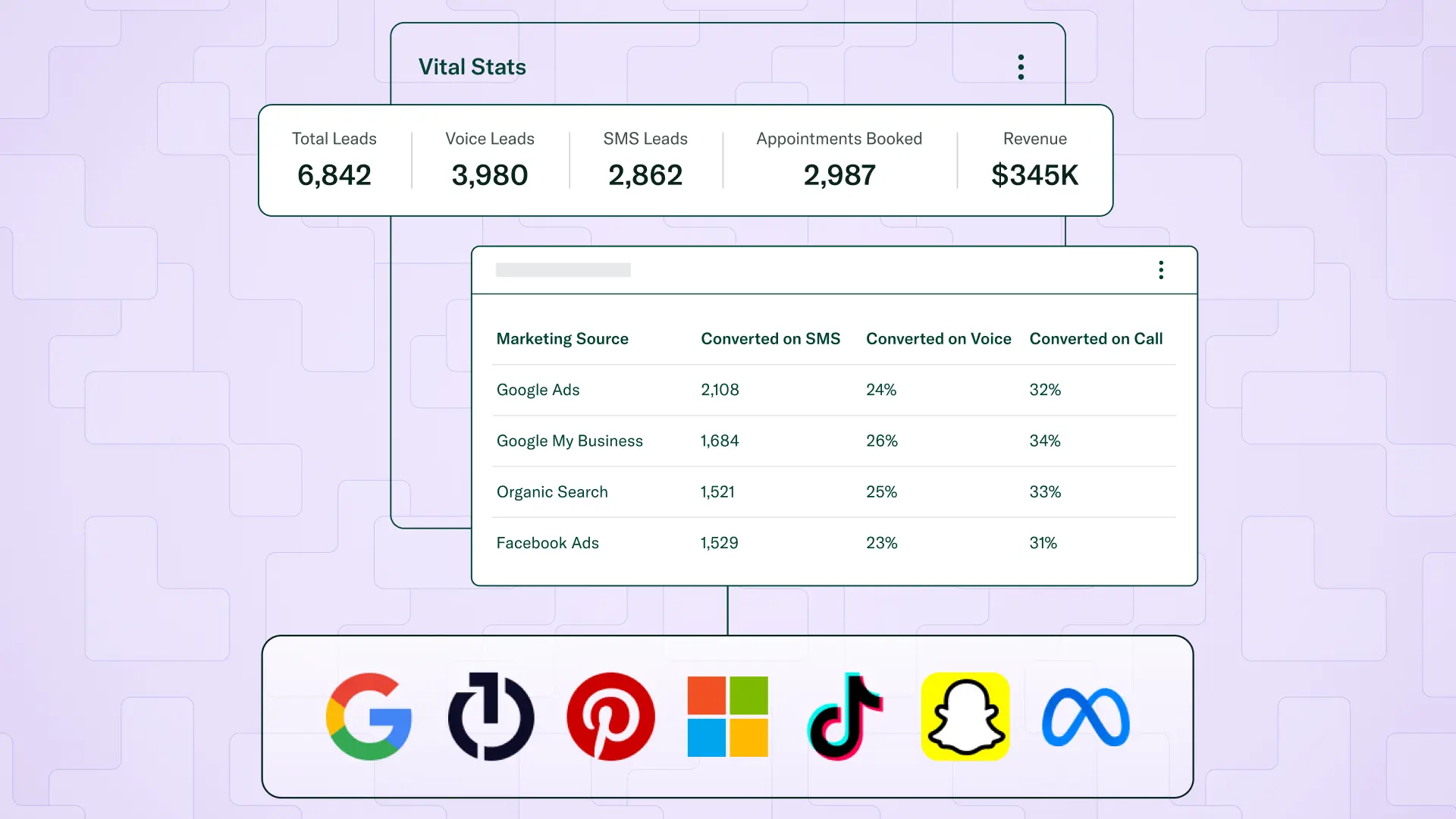
In addition, Invoca AI agents use digital journey data—like ad clicks, web activity, and content viewed—to personalize conversations. By meeting patients with relevant context and personalized messaging, agents can create better experiences that drive more bookings.
Finally, because conversion tracking is native to the platform, every booking, callback, or escalation the agent handles ties back to the marketing campaign, ad, or keyword that drove it, giving practices the same closed-loop visibility into AI-handled conversations that they'd expect from any other part of their funnel.
Additional Reading
Want to learn more about Invoca's AI voice agents for dermatology providers? Check out these resources:
.svg)
.svg)