

.svg)


Google Marketing Live 2026 made one thing clear: we've crossed a threshold in marketing AI. The era of bolt-on AI features is over, and we're now in an Agentic era that’s defined by technology that doesn't just process information, but takes autonomous action to drive revenue.
Philipp Schindler, Google's Chief Business Officer, set the stage by noting that the industry has compressed a decade of innovation into the last twelve months, and that velocity is the new baseline. "AI has moved from chat to act,” said Schindler. “It is an active partner that can plan, execute, and optimize complex workflows under your supervision. We are now firmly in our Agentic Gemini era."
Here's the throughline beneath every announcement at GML 2026: agents are only as good as the data and systems that support them. For revenue marketing leaders, the new imperative is to strengthen your data foundation, measurement, and execution stack, and ensure they’re well connected so AI agents can act reliably on your behalf.
Here are the big takeaways for marketing leaders from the Google Marketing Live 2026 keynote.
1. The Modern Measurement Playbook: First-Party Data as Ground Truth
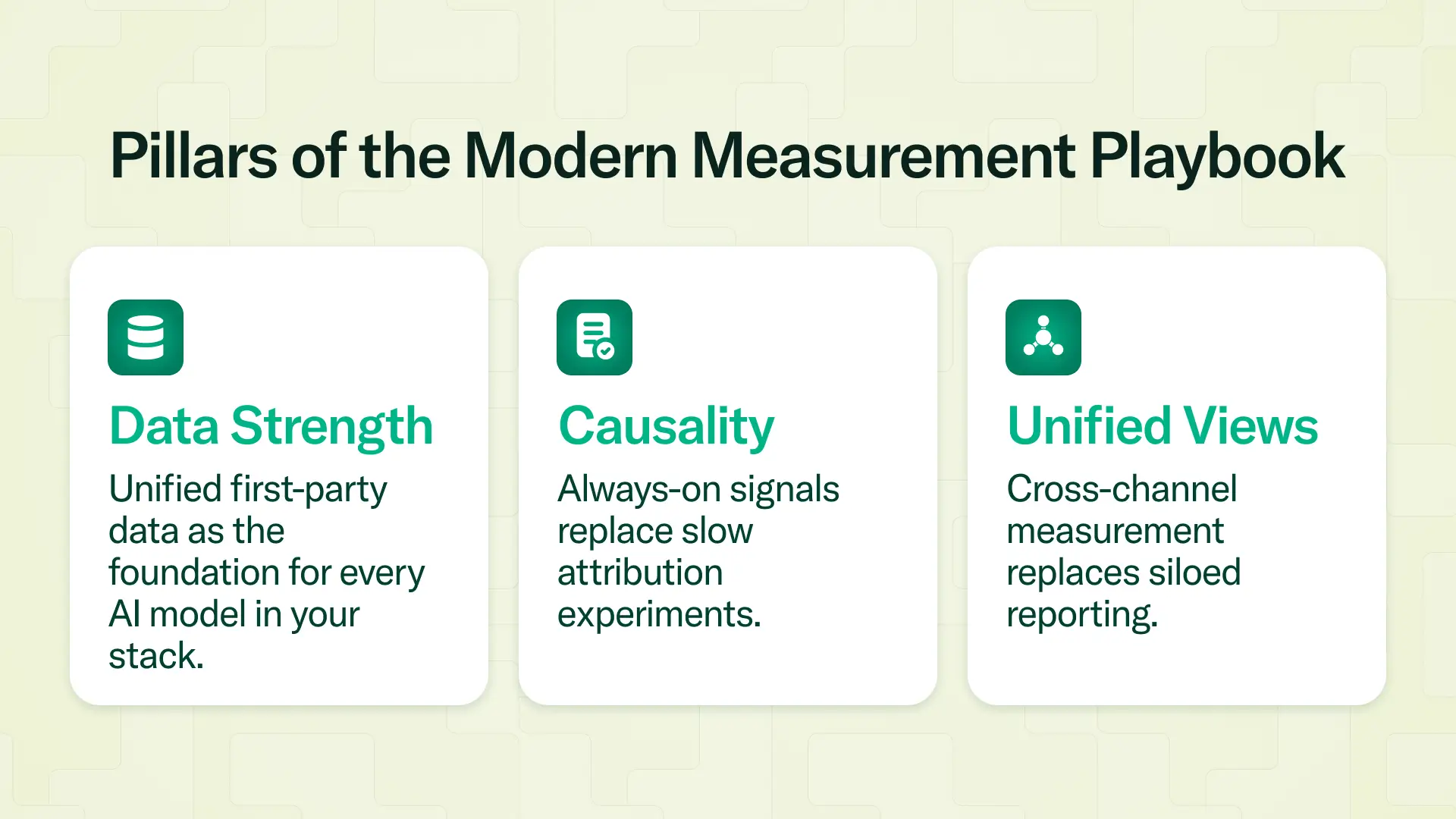
Google's new Modern Measurement Playbook rests on three pillars, and each one points back to the same uncomfortable truth—most marketing organizations aren't measuring what they think they're measuring.
Data Strength
Google calls this your "ground truth," and the math is unambiguous: advertisers who consolidate their first-party data into a unified foundation see an 11% average increase in incremental ROAS. New tools like Data Manager and Google Tag Gateway exist because Google knows the signal quality going into its models determines the value coming out.
Causality
Traditional attribution experiments take weeks. Google's new causality signals — Attributed Branded Searches and Qualified Future Conversions (which predict revenue up to 6 months out) — shift measurement to an always-on model. But these signals only work if you can connect them back to actual business outcomes. That means closing the loop between ad impression, engagement, conversation, and revenue.
Unified Views
This is where most organizations break. Modern buyer journeys can't be measured in silos, and yet most marketing stacks are still organized by channel. The newly introduced Meridian Marketing Mix Model and the reimagined Google Analytics 360 are Google's push toward cross-channel measurement — but the measurement is only as honest as the data feeding it.
The strategic point is that agentic AI fails when fed fragmented data. It will still produce outputs. It will still optimize. It just won't optimize toward the right outcomes, because it doesn't see the full journey.
2. Agentic Commerce: From Discovery to Checkout in Milliseconds
One of the most consequential announcements at GML was the convergence of search and commerce into a single fluid interaction. Buyers no longer search in fragments and then transact separately — they move from curiosity to checkout in a single conversation.
Central to this is the Universal Commerce Protocol (UCP), Google's standardized language for agents and business systems to operate together across consumer surfaces and payment providers. UCP matters because it solves a coordination problem: agents need a common protocol to interact with the dozens of systems involved in a single transaction, without requiring custom connections for every pairing.
The new commerce playbook looks like this:
- Curiosity to checkout in one interface: Agents guide users from vague "brainstorming" intent through to a completed transaction, all without leaving the conversation.
- System interoperability: UCP lets agents move across business databases without the manual integration tax that has historically slowed everything down.
- Frictionless execution: Agents can now monitor price drops, make reservations, and complete purchases autonomously under user direction.
The implication for marketers is significant. If agents are doing the buying, your brand has to be discoverable, citable, and trustworthy to the agent — not just to the human. That requires structured, accessible information and a system that can respond to agentic queries in real time.
3. The Reinvention of Search and Richer Intent Signals
Google introduced the most significant update to the search box in 25 years: it's now a multimodal portal. Search is no longer typing keywords; it's a "brain dump" of complex needs using text, images, and live video.
This has changed search behavior fundamentally. "AI Mode" searches are now three times as long as traditional searches. "Brainstorming searches" — queries like "ideas for" or "where should I" — are growing 30% faster than standard AI searches. Buyers are revealing more of their intent than ever before.

The strategic challenge: these richer signals are useless if you can't process them in real time and connect them to what happens next. A buyer who spends three minutes brainstorming with an AI before clicking through to your site is arriving with vastly more context than a keyword searcher. If your stack treats them like any other visitor, you've wasted the most valuable signal you'll ever receive.
4. The Foundation: Why First-Party Data Is the New Competitive Edge
For agentic technology to work — whether it's Gemini Spark, Agentic Commerce, or whatever Google announces next — it needs high-quality ingredients. John Nicoletti, VP of Google Customer Solutions, made the point directly: marketers need to break the habit of micro-managing creative variations and shift their focus to the quality of their inputs.
AI is a forced multiplier of the data you give it. Feed it fragmented signals from disconnected point solutions and you'll get fragmented optimization. Feed it a unified view of the buyer — across digital behavior, conversations, and transactions — and the same AI will produce dramatically better outcomes.
This is the strategic divergence happening right now between organizations:
- Disconnected stacks treat each channel as its own optimization problem. The AI inside each tool gets smarter, but the overall picture stays fragmented. Performance plateaus.
- Connected systems treat the buyer as a single entity moving across channels. The AI operates on a shared context layer. Performance compounds.
The companies that win the next decade will be the ones that solved the data plumbing before the AI race got serious.
5. Revenue Execution and ROI in the Agentic Era
In 2026, ROI is driven by an integrated system where data, creative, and models work together. The speed of that system is governed by Gemini 3.5 Flash, which is four times faster than other frontier models. That speed enables real-time outcome-based marketing where media "talks back" to measurement in milliseconds.
Google's AI Max for Search is already leveraging this, driving 27% more conversions than manually managed campaigns. But achieving that performance requires more than Google's models — it requires an engineering velocity that matches the pace of the market. Platforms like Antigravity, the AI-powered agent-first development platform, are accelerating product rollouts from quarters to months.
The three pillars of 2026 ROI:
- Real-time outcome-based marketing: Use the 4x speed of Gemini 3.5 Flash to optimize while the journey is still in motion, not after it's over.
- Autonomous optimization: Deploy agents that turn real-time feedback into code and campaign updates — closing the loop without human intervention on every change.
- Unified measurement: Connect YouTube — the world's most powerful demand engine — with offline conversation and transaction data to prove actual revenue impact.
Remember, none of this works without a system that can carry signals across the entire buyer journey. Speed without connectivity just means making the wrong decisions faster.
Connected AI Systems Will Power Winning Organizations
The innovations revealed at GML 2026 — from the Universal Commerce Protocol to Gemini 3.5 Flash — demand a new kind of infrastructure. Success in the agentic era requires moving away from disconnected tools and toward a unified system of revenue execution.
This is exactly the gap Invoca was built to close. The Invoca Platform combines first-party digital, conversation, and transaction data into a shared context layer purpose-built for the agentic era. Through its Context Engine and AI Operating System, Invoca turns fragmented signals into a live understanding of the buyer. And through its integrations and the Model Context Protocol (MCP), that intelligence flows seamlessly to the rest of your stack — so agentic actions move between your marketing systems, your CRM, and the channels where revenue actually happens.
The marketers who thrive in 2026 will have mastered the first-party data inputs that fuel the next generation of AI agents — and built the connected systems that enable those agents to act.
.svg)
.svg)