.svg)


In a digital-first business environment, the importance of phone calls is often overlooked. However, these interactions play a critical role in the customer journey — they’re often the first point of human contact consumers have with your brand. In addition, research shows that callers convert faster, spend more, and stay loyal longer than online shoppers.
Our analysis of over 70 million calls revealed a statistic that business leaders need to pay attention to: 56% of callers to businesses speak to a human. If your answer rate falls below this benchmark, it’s likely that many potential customers will never reach someone who could help them. Invoca’s 2026 Lead Conversion Benchmarks Report also found that 38% of answered calls turn into qualified leads, and 42% of those leads convert on the call—proof that how your business handles calls will make or break your revenue growth goals and your brand’s reputation.
Low answer rates rarely exist in isolation. They often signal deeper operational issues like understaffing, confusing IVR systems, inefficient call routing, or fundamental misalignment between marketing and contact center operations. Contact center and sales leaders who can identify and correct these issues will increase customer satisfaction and drive more revenue.
In this post, we’ll break down call answer rate benchmarks across industries to see how you stack up against your competitors. We’ll also explore five proven strategies to improve your call answer rate and recapture lost revenue opportunities in your contact center.
Answer Rate Benchmarks by Industry
Our research shows that, on average, 56% of business calls are answered by a live person across all industries. Brands that fall below this benchmark will face problems as customers expect seamless experiences — if you don’t quickly connect them to a human agent, you’re creating a hurdle for customers before they even begin the purchasing process.
Below is a breakdown of average call answer rates by industry:
If your answer rate falls below the industry benchmarks, it’s a clear sign of operational gaps — whether due to staffing challenges or inefficient processes at your contact center or business locations.
The caveat to this stat is that, for some calls, human assistance isn’t necessary — customers can easily cancel appointments or look up information via an automated IVR, for example. The trick is knowing when you can automate experiences and when the human touch is essential.
6 Strategies to Fix Your Call Answer Rate and Stop Losing Revenue
1. Monitor How Your Business Answers Calls
You can't improve what you don't measure, and many businesses lack visibility into their true call answering performance. The first step toward improvement is implementing call monitoring across all of your contact centers and locations.
Start with location-specific analysis
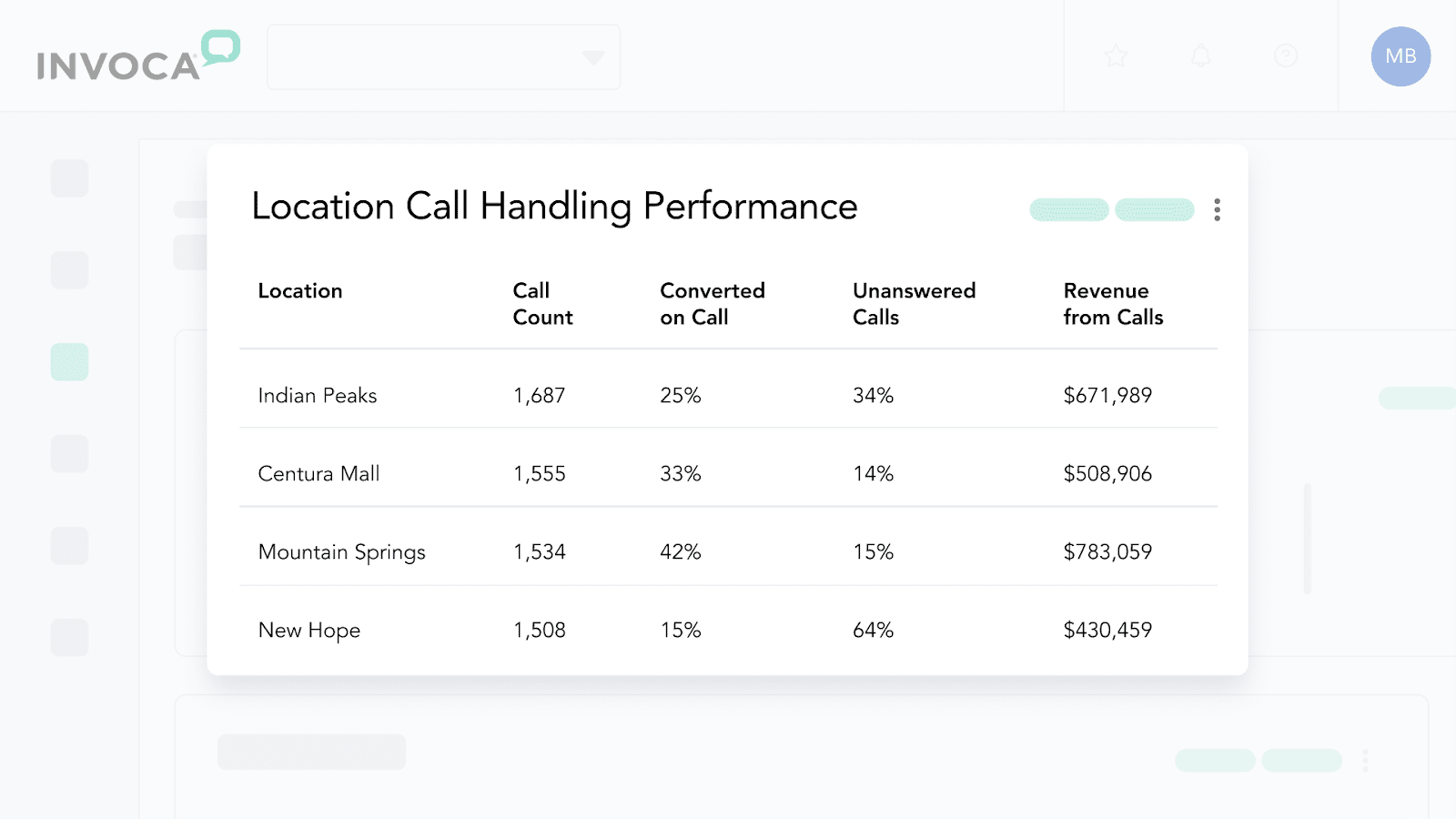
Different locations or contact center teams often have dramatically different answer rates. Platforms like Invoca provide a comprehensive view of how each location handles and converts calls, enabling you to identify areas for improvement. Below is a sample report of Invoca’s multi-location call reporting in action:
Implement time-based analysis
Call answer rates typically vary throughout the day and week. Detailed time-based analysis helps pinpoint specific problem periods:
- Hour-by-hour analysis to identify daily patterns
- Day-of-week trends to spot consistent problem days
- Seasonal variations that might require temporary staffing adjustments
Many businesses discover that their answer rates drop significantly during lunch hours, shift changes, or toward the end of the business day. Once you understand these patterns, you can adjust staffing accordingly to fill gaps.
Connect marketing activities to call volume
Your marketing team's activities directly impact call volume, yet many businesses fail to coordinate these efforts with contact center operations. Implement a system to share marketing campaign calendars with contact center leadership, allowing for proactive staffing adjustments before campaigns launch.
2. Use Missed Call Data to Optimize Staffing
Once you've identified when calls are being missed, you can make data-driven staffing decisions to address these gaps.
Correlate call volume with staffing levels
Creating visual overlays of call volume against staffing schedules allows you to spot misalignments. For example, you may have peak hours with too few agents or slow periods where you're overstaffed and wasting resources. From there, you can make the right adjustments to optimize your staffing levels. In addition to reducing missed calls, this will help you cut down hold times, improve agent morale, and reallocate labor more efficiently.
Consider flexible staffing models
Traditional rigid shift schedules often contribute to answer rate problems. Consider implementing:
- Split shifts to cover peak periods
- Part-time positions focused on high-volume times of the year
- Floating agents who can be deployed when volume spikes occur
- Remote work options to expand your talent pool and increase scheduling flexibility
Use forecasting to predict staffing needs
Historical call data can help predict future volume patterns with remarkable accuracy. Advanced analytics can identify correlations between external factors (marketing campaigns, weather events, seasonal patterns) and call volume, enabling proactive staffing adjustments.
3. Pause Paid Media Ads During Closed Hours
Marketing teams are often evaluated solely on lead volume, creating incentives to drive calls regardless of whether those calls can be properly handled. This misalignment causes significant waste and customer frustration.
Implement dayparting in all paid media campaigns
Dayparting — the strategy of running ads only during specific hours — is essential for any business with limited call-handling capacity. Aligning your ad schedule with your operating hours ensures you’re not paying to drive phone calls your team isn’t available to answer.
Create after-hours alternatives
In addition to turning off ads after hours, you should also consider setting up alternative conversion paths. Some callers will still reach out to you after your locations close, and you need to ensure their needs are met. You can accommodate them by implementing automated IVRs or AI virtual agents they can use to self-serve. You can also consider creating after-hours landing pages that offer appointment scheduling for the next business day and email contact forms that set proper response expectations.
4. Simplify Your IVR Experience
Complex IVR systems are often major contributors to abandoned calls. While they're designed to route calls efficiently, many systems have grown unwieldy over time, creating frustration rather than solutions.
Conduct an IVR audit
Many businesses haven't critically evaluated their IVR experience in years. Below are some easy first steps you can take to audit your IVR:
- Time how long it takes to reach a human through various paths
- Count the number of options and decision points
- Identify outdated or rarely used options
- Analyze abandonment rates at each step of the IVR journey
Looking to revamp your IVR system? Invoca offers easy-to-configure IVRs that you can set up with just a few clicks — no developer assistance required! This allows you to iterate and make adjustments to your IVR paths on the fly. In addition, Invoca captures analytics about how often each keypress is used, helping you identify underutilized paths and change menus accordingly. Invoca’s IVRs also recognize speech, making them accessible for all audiences.

Consider IVR bypass for high-value calls
Not all callers have equal revenue potential. For calls generated from marketing campaigns or web pages that indicate high intent, e.g., the shopping cart, consider bypassing the IVR with intelligent call routing. These callers typically have purchasing intent already established through their interaction with your marketing, making IVRs unnecessary and potentially counterproductive.
5. Implement Ring Group Call Routing
Even with optimal staffing and streamlined IVRs, calls can still go unanswered if they're routed to a single destination. Ring group routing provides multiple answering options for each call, significantly reducing the chance of missed connections.
Sequential routing
Sequential routing tries multiple destinations in a predetermined order, ensuring calls don't go unanswered if the primary destination is unavailable. This approach works well for businesses with clear hierarchies of preferred answering destinations.
Below is a sample sequential routing configuration created in the Invoca platform:

Simultaneous routing
Simultaneous routing sends calls to multiple destinations at once, with the first to answer taking the call. This option maximizes the chance of quick answers but can be disruptive if overused.
Round-robin distribution
Round-robin routing distributes calls evenly across a group of potential answering destinations. This system is ideal for businesses that want to allocate the workload — and the potential for sales commission — evenly across all of their contact centers and locations.
6. Deploy AI Voice and SMS Agents to Answer and Qualify Every Lead
Staffing, dayparting, and routing all help you answer more of the calls a human can realistically handle. But there's a ceiling on how many callers your team can reach, no matter how well you staff and schedule. For many businesses, AI voice and SMS agents can be the most effective lever for improving answer rates, precisely because they remove that ceiling. An AI agent can pick up every call or text the moment it comes in, at any hour, at any volume, without waiting for a hire or a schedule change.
Let an AI Voice Agent answer every call, not just the overflow
Invoca’s AI Voice Agent engages every caller the moment they dial. It understands the caller’s intent, determines whether they can be helped, and answers common questions on its own. This allows every caller to receive assistance, even during a slammed shift at a short-staffed location. When a caller is a high-value lead, the agent routes them to the right human agent and hands off the caller’s intent, qualification details, and conversation history, so your team has the right context to close the deal. It’s trained on your own highest-performing calls, so it qualifies and converses the way your best agents already do.
Qualify and convert leads over SMS, not just the phone
Not every lead wants to talk—some would rather text. Invoca’s AI Messaging Agent starts an SMS conversation the instant a lead calls, submits a form, requests a quote, or abandons a form partway through, using the context of what they clicked or viewed to guide the conversation. It asks the qualifying questions your sales team would ask, answers routine ones itself, and books the appointment or callback directly—all while intent is at its highest. For regulated industries, this comes with SOC 2, HIPAA, and GDPR compliance built in, plus automated consent capture, opt-out management, and sensitive data redaction, so conversational SMS can be deployed without adding compliance risk.
Take the Next Step with Invoca
Improving your call answer rate requires visibility, analysis, and coordinated action across marketing and contact center operations. The potential revenue impact makes this a high-priority initiative for businesses in any industry where phone calls are a significant part of the customer journey.
The most successful organizations approach this challenge holistically, implementing a revenue execution platform like Invoca. With Invoca, you can get visibility across the entire call journey — from the marketing source that drove the call through the conversation and ultimate conversion outcome. You can also improve the phone call experience with its robust feature set, which includes intelligent call routing, easy-to-configure IVRs, multi-location call handling reporting, and much more.
Download the Full Report to See Industry-Specific Data
Want to see how you stack up against the competition? Download the 2026 Lead Conversion Benchmarks Report for a full breakdown across all 10 industries, plus an interactive calculator that models how much revenue you could recover by closing the gap to your industry benchmark.
.svg)
.svg)