.svg)

Home services marketers have a lead conversion problem that needs to be fixed. Say you're spending $100k a month on paid search and social ads. If you’re like the average home services company, about half of the phone calls these ads drive go unanswered.
Of course, many of your potential leads will fill out a form on your website rather than call. Our research shows that only 41% of those leads get a response within an hour. That's a lot of leads you already paid for getting left in the lurch. You might as well bury half of your ad budget in a termite mound.
Or, instead of turning your ad budget into a pile of termite frass, you can use AI agents to instantly engage, qualify, and help you convert every lead that gets in touch with your business.
Here's how you can use AI voice and SMS agents to convert more leads, whether they call or fill out a form on your website.
How Slow Speed-to-Lead Is Killing Your Revenue
A homeowner with water coming through the kitchen ceiling isn't shopping. They're picking, and probably panicking, too. Same with the person whose AC died during the first 95-degree week of the summer, or who just found mouse poop behind the pantry. By the time they call you or fill out your form, they've already read the reviews, compared a few companies, and built a short list. What happens in the next few minutes decides whether the job is yours.
Speed-to-lead is usually filed under operations metrics, something a dispatch manager watches. It belongs on the marketing dashboard. Nearly 80% of leads buy from the first company that responds, and after an hour, the odds of converting drop by roughly 80%. Your budget evaporates every minute between "I need someone out here today," and your first real response back to that potential customer.
Calls are where the funnel leaks first. Invoca data shows 41% of calls to home services businesses are never answered by a person. Peak season makes it worse still. The days your phones ring the most are the days your CSRs can't keep up, which means your highest-demand hours are also your highest-leakage hours.
And consumers won't wait for you. Invoca's B2C Buyer Experience Report found that 50% of consumers have hung up after being placed on hold, and 66% say one bad experience is enough to make them stop doing business with a brand.
Forms leak differently but just as badly. A lead submits an HVAC service request at 7:40 pm. It lands in a queue. Someone sees it at 8:15 the next morning and sends an email. By then, the homeowner has already called two competitors and booked one. Even fast follow-up doesn't help much if the first touch is an autoresponder confirming you got the message. The lead has to start over when a human finally calls.
Underlying both problems is the same structural issue: the systems that generate demand and the systems that convert it don't communicate. Marketing knows the lead clicked on an emergency plumbing ad. The CSR who eventually calls back knows none of that. So the homeowner explains the burst pipe again, and momentum, along with the job, drains away.
How AI Agents Work for Home Services Businesses
AI agents close that gap by delivering the first response instantly, every time, with the context the customer provided, that same context your team usually lacks.
Meet Nico, Invoca's AI revenue conversion agent. Its job is to engage, qualify, and convert leads into revenue, and it works across both of the channels where home services leads actually show up.
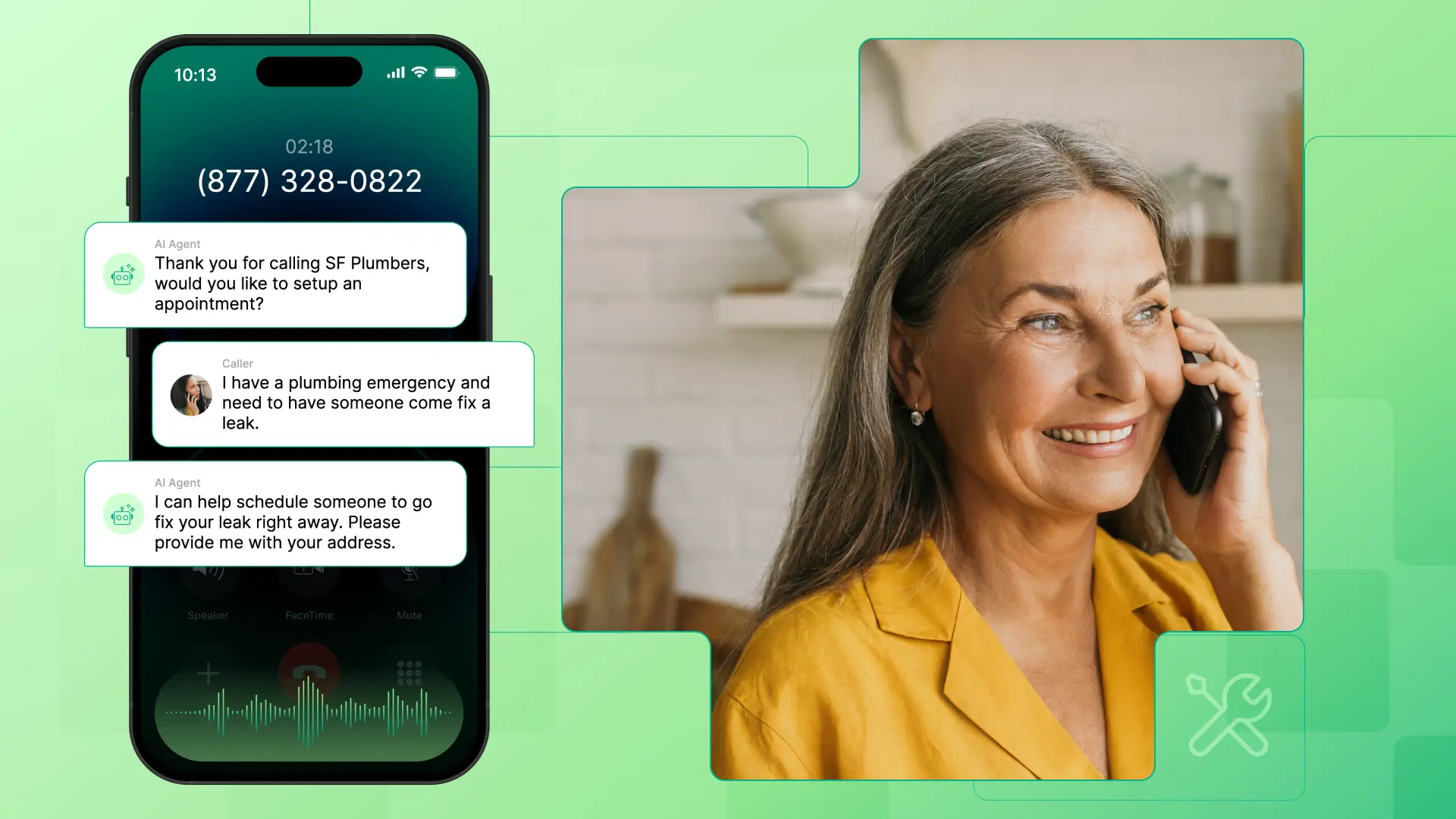
As an AI Voice Agent, Nico engages leads the moment they come in, whether that's because every CSR is on another line, it's 2 am, or it's the third week of a heat wave. Nico figures out what the caller needs, answers questions, confirms you provide service to their address, and routes high-intent leads to the right person.
As an AI Messaging Agent, Nico does similar work over SMS, engaging leads from form fills within seconds and picking up conversations with callers who couldn't get through or didn’t want to wait on hold.
Two things make Nico behave less like an IVR and more like your best CSR.
The first is training. Nico is an extension of your brand, having learned from your existing call recordings, so it already knows how your top performers qualify leads, what your service areas are, and how you talk about pricing. As Jody Farmer, CMO at U.S. Gold Bureau, put it, since Invoca already had its conversation data, the agent was trained and ready almost immediately.
The second is context. Nico knows the lead's digital journey before it says a word, including the ad they clicked and the pages they viewed. Someone arriving from an "emergency AC repair near me" search gets treated differently than someone who spent ten minutes on your gutter installation page.
That context also travels. When Nico hands a lead to a human, the intent, qualification details, and conversation history go with it, so your CSR opens the call already knowing the furnace make and the earliest window when the homeowner can be home.
Everything Nico handles gets tied back to the campaign that produced it. That's the part that turns an AI agent from a coverage tool into a marketing measurement tool.
Configure Your AI Agents for Conversions, Not Just After-Hours Coverage
The mistake many home services operators make is only using AI agents for after-hours coverage. It works, but it leaves most of the value on the table.
Nico will qualify calls during business hours too, handling routine conversations so dispatchers and CSRs stay on the jobs that need human judgment. On the messaging side, it engages form fills within seconds, before the lead has a chance to browse competitors.
Here's how that configuration looks by call and lead type.
Emergency calls
Burst pipes, dead furnaces, active infestations. These callers will book if you answer. Provide a frictionless experience and let the AI agent route them to a live agent immediately or trigger a callback within minutes. The qualification step can be shortened to determining if they live within your service area, because urgency has been established.
Standard service requests
The agent qualifies job type, location, and urgency, then either books the appointment or sets a callback window and passes the context to dispatch. This is where most of your volume lives, so a clean handoff here has the biggest aggregate impact on booked jobs.
Estimate and quote requests
The agent captures job details, confirms availability windows, and books the estimate. It removes the phone tag that kills conversion on lower-urgency requests, which are the ones most likely to go cold while someone waits for a callback.
Marketplace and LSA lead calls
The agent validates lead quality before routing to a sales agent. That protects your top performers' time and cuts down the junk-call handling that burns out CSRs.
Web form submissions
The moment a lead submits a form, whether it's an HVAC service request, a plumbing estimate, or a restoration intake, Nico can text them. It answers their questions, qualifies them, and moves toward a booked appointment or callback. No waiting for a rep to log in, and no one-way email drip that shows up after the lead has already called three competitors.
Use These Metrics to Track Conversions, Not Just Engagement
Answer rate is a basic coverage metric. Booked job rate is a revenue metric. If your reporting stops at "calls handled" or "SMS sessions initiated," you're not looking at what actually pays the bills.
Here's what's worth tracking instead.
Booked-on-call rate by call type
Break it out by emergency, standard service, and estimate. If your agent is qualifying and routing correctly, these numbers should diverge meaningfully. If they don't, your routing logic probably isn't doing anything.
After-hours capture rate
Calls and form fills handled outside business hours that ended in a scheduled callback or confirmed appointment. This number tells you what revenue you were losing before that the AI agent is now converting.
Form-to-SMS engagement rate
Of the form submissions that triggered a messaging session, what percentage of leads responded? A low rate usually indicates a timing or messaging issue.
Agent handoff conversion rate
When the AI agent qualifies a lead and passes it to a person, does that person close it, does it get transferred, or disqualified? This is how you find out whether the handoff is actually working or whether context is getting dropped on the way. Invoca Signal AI and Quality Management help you dig deeper into the human agent side of the equation to discover what converts customers and what doesn’t.
Campaign-level booked job attribution
Which paid search keyword, which LSA, which marketplace drove the calls that became booked jobs? This is the number that defends your ad spend in the budget meeting.
Invoca ties every Nico interaction back to the originating campaign, call, or form fill, so "booked jobs from emergency HVAC paid search" is a reportable number rather than an estimate. That's the difference between scaling spend with confidence and scaling it on CPL intuition.
Get your AI agent reporting in place before your next seasonal peak. Summer and winter HVAC surges are the highest-stakes test of this, and the highest-return opportunity.
Ready to see how Nico works for home services? Request a demo or download the 2026 Home Services Lead Conversion Benchmarks Report to benchmark your current conversion performance.
.svg)
.svg)