.svg)


You added SMS to deflect simple calls and protect agent capacity. But if those text threads aren't connected to the campaigns that drove them or the calls that close revenue, you can't measure deflection or justify the investment. SMS becomes a reporting blind spot. Conversations happen, but you can't tie them to spend or conversion.
To run SMS as a real channel, your software needs to plug into your contact centre and CRM. Escalation paths, compliance controls, and attribution must link every thread to its campaign source and call outcome. This article covers the features, integration requirements, and deployment steps you need to make that happen.
Main Takeaways
- An SMS call centre runs texting as a managed channel. Routing, agent assignments, and reporting are all tied to voice operations.
- Text messaging costs less than voice and lets agents handle multiple threads at once. That frees capacity for high-value calls.
- SMS-to-call escalation must pass full conversation context to the receiving agent. Without it, attribution and customer experience both break.
- Your platform needs bi-directional CRM sync covering customer profile, ticket ID, transcript, disposition tags, and agent assignment.
- A2P 10DLC registration and automated opt-out keyword handling are required before you send business texts from local numbers.
What an SMS Call Centre Is (and What It Isn't)
An SMS call centre runs two-way texting as a managed contact centre channel. That means shared inboxes, routing rules, agent assignments, conversation history, and reporting. All of it ties into the same platforms that power voice. Nobody texts from a personal phone. Call centre text messaging follows the same SLAs, quality standards, and data rules as any other production channel.
One common mix-up: an SMS call centre has nothing to do with an SMSC (Short Message Service Centre). An SMSC is carrier-level network infrastructure that routes messages between devices. An SMS call centre is an operational tool inside your contact centre, with agents, routing rules, and integrations.
Why SMS Changes Contact Centre Economics
Text messaging handles low-complexity tasks without tying up the phone queue. Think appointment confirmations, status checks, and basic qualification. The average inbound call costs $7.16, according to ContactBabel. That's 18% more than email and 42% more than web chat. Resolving simple inquiries via SMS instead of voice frees agent time for conversations that close revenue.
Voice also locks an agent into one conversation at a time. SMS lets agents work multiple threads at once. How many depends on inquiry complexity, template access, and inbox automation. Measure threads-per-agent and response time during a pilot instead of assuming a fixed ratio.
The channel itself isn't a question mark. Americans exchanged nearly 2.2 trillion texts in 2024, up 42 billion year-over-year, per the CTIA Annual Survey. For contact centres, that means customers are already comfortable with text as a service channel. The question is whether your operation runs it with the same rigor you apply to voice.
SMS Call Centre Software: Features and Evaluation Checklist
Running texting as a real contact centre channel means your SMS software must cover six areas: agent workflow, routing and automation, integrations, analytics and QA, compliance and consent, and scalability. Most vendor feature lists flatten these into one checklist. Organising by category exposes gaps before procurement, not after launch.
| Category | Must-Have | Nice-to-Have |
|---|---|---|
| Agent Workflow | Shared inbox, conversation history, internal notes, role-based access | MMS / rich media support |
| Routing & Automation | Intent-based routing, automated responses, template library, queue management | AI-powered triage |
| Integrations | CRM sync (bi-directional), help desk / ticketing, contact center platform, marketing attribution | CDP and ad platform connectors |
| Analytics & QA | Response time tracking, disposition / outcome tagging, conversation-level reporting, exportable data | AI scoring and sentiment |
| Compliance & Consent | Opt-in capture / storage, automated opt-out keyword handling, audit trails, A2P 10DLC registration support; HIPAA BAA and PCI DSS posture (regulated industries) | — |
| Scalability | Multi-number support, concurrent agent capacity, API / webhook access | — |
Pay close attention to what your platform syncs and in which direction. You need bi-directional data flow for five objects: customer profile, case or ticket ID, full transcript, disposition and outcome tags, and agent assignment. Without that sync, you lose the single record of truth. Customers repeat themselves and reporting fragments across systems.
Escalation to voice also deserves its own line in your requirements. If your SMS software can't hand a conversation to a phone call with full context, including intent, history, and campaign source, you've built a dead-end channel. Think customer interaction management software that passes intent, history, and campaign source into the receiving agent's screen before they say hello. Evaluating by category instead of a flat feature list turns procurement into a gap analysis. Broken data sync, missing compliance controls, and dead-end workflows surface before launch, not after.
Explore our AI Messaging Agent to learn more.
SMS as a Revenue Channel: Escalation, Attribution, and Compliance
Text messaging becomes a revenue channel when three things connect. Escalation paths must carry context into phone calls. Compliance controls must protect deliverability. Attribution must tie every thread to its campaign source and downstream outcome.
SMS-to-Call Escalation: Step-by-Step Workflow
Here's how a well-built SMS-to-call escalation works:
- Capture on arrival. An inbound text hits the system. The platform records the originating campaign, keyword, and landing page alongside the customer's identity.
- Classify intent. AI or rule-based triage sorts the inquiry. Simple requests go one way. High-value or complex ones go another.
- Resolve in-channel. For straightforward requests like status updates, appointment confirmations, or basic qualification, the agent or AI handles it via SMS.
- Trigger escalation. When the conversation needs voice, such as a complex product question, a purchase decision, or a regulatory constraint, the system starts a callback or click-to-call.
- Hand off context. The receiving agent sees the full SMS transcript, customer profile, reason for contact, and campaign source. The customer doesn't start over.
- Tag the outcome. After the call, the disposition, whether a sale, appointment, or no-sale, gets logged against both the SMS thread and the call record. That closes the attribution loop.
Skipping step five breaks everything downstream. The customer restarts from scratch. The agent has no intent data. The outcome can't be tied to the SMS interaction or the campaign behind it.
Solutions built for this workflow, like Invoca, keep the connection intact from digital journey through SMS thread and into the call. Attribution stays intact end to end.
Compliance Controls You Must Operationalise
Three compliance areas require attention before you go live with SMS. Each one has direct consequences for deliverability, legal exposure, or both.
- Consent and TCPA. Since April 11, 2025, senders must honor a standard set of opt-out keywords: "stop," "quit," "end," "revoke," "opt out," "cancel," and "unsubscribe." Revocations must be processed within 10 business days, as detailed by Kelley Drye. Your platform must automate keyword detection and suppression. Every consent record needs a timestamp for audit.
- A2P 10DLC registration. Sending business texts from local 10-digit numbers requires brand and campaign registration. Current fees run $4 for brand registration, $15 for standard campaign review, and $1.50 to $10 monthly per campaign, per Bandwidth. Skip registration and carriers will filter or block your traffic. Toll-free numbers follow a separate verification process. Unverified toll-free messaging has been fully blocked since January 31, 2024.
- Regulated industries. If you operate in healthcare or financial services, your SMS platform must provide HIPAA BAA support and PCI DSS compliance documentation. Without those, you can't run SMS in those verticals. Confirm your vendor's posture against the standards required for HIPAA-compliant call tracking and financial services call tracking.
SMS Call Centre Deployment Checklist
Plan for four phases across three to five weeks. The blockers that stall most launches are A2P registration timelines, integration setup, and agent readiness. These need to be sequenced, not run in parallel.
- Week 1: Numbers and registration. Provision SMS-enabled numbers, whether local 10DLC, toll-free, or short code, based on your volume and use case. Submit A2P 10DLC brand and campaign registration. If you're using toll-free numbers, start verification now. Owner: IT + compliance.
- Week 2: Integrations and routing. Set up bi-directional sync between your SMS platform, CRM, and help desk. Cover customer profiles, ticket creation, and transcript logging. Build routing rules for intent-based triage and define escalation triggers. Automated opt-in confirmation and opt-out keyword handling go live here. Owner: marketing ops + contact centre ops.
- Week 3: Agent training and QA setup. Walk agents through the shared inbox workflow and template use. Cover escalation protocols and compliance guardrails. Make clear what content should never appear in an SMS. Configure QA scoring criteria and reporting dashboards. Owner: contact centre ops.
- Weeks 4 to 5: Pilot and measurement. Launch a controlled deflection pilot targeting two or three low-complexity intent categories. Track concurrent threads per agent, response time, deflection rate, and escalation-to-call volume. Confirm that attribution connects each SMS thread to its campaign source and downstream call outcome. Refine routing and templates based on what the data shows. Owner: RevOps + marketing.
Registration delays, incomplete integrations, and undertrained agents erode stakeholder confidence before the channel proves its value. Sequencing these phases prevents that.
Build Your SMS Call Centre with Invoca's AI Messaging Agent
You now have a feature checklist, integration requirements, and a phased deployment plan. With these in hand, you can select platforms that connect text conversations to campaign attribution, enforce compliance at scale, and pass full context into phone calls without breaking the revenue trail.
Invoca's AI Messaging Agent keeps attribution intact across the entire buyer journey, from the digital campaign through the SMS thread and into the closing call. Every text conversation stays tied to its source and downstream call outcome. That means you can measure real deflection and justify the channel with complete revenue data.
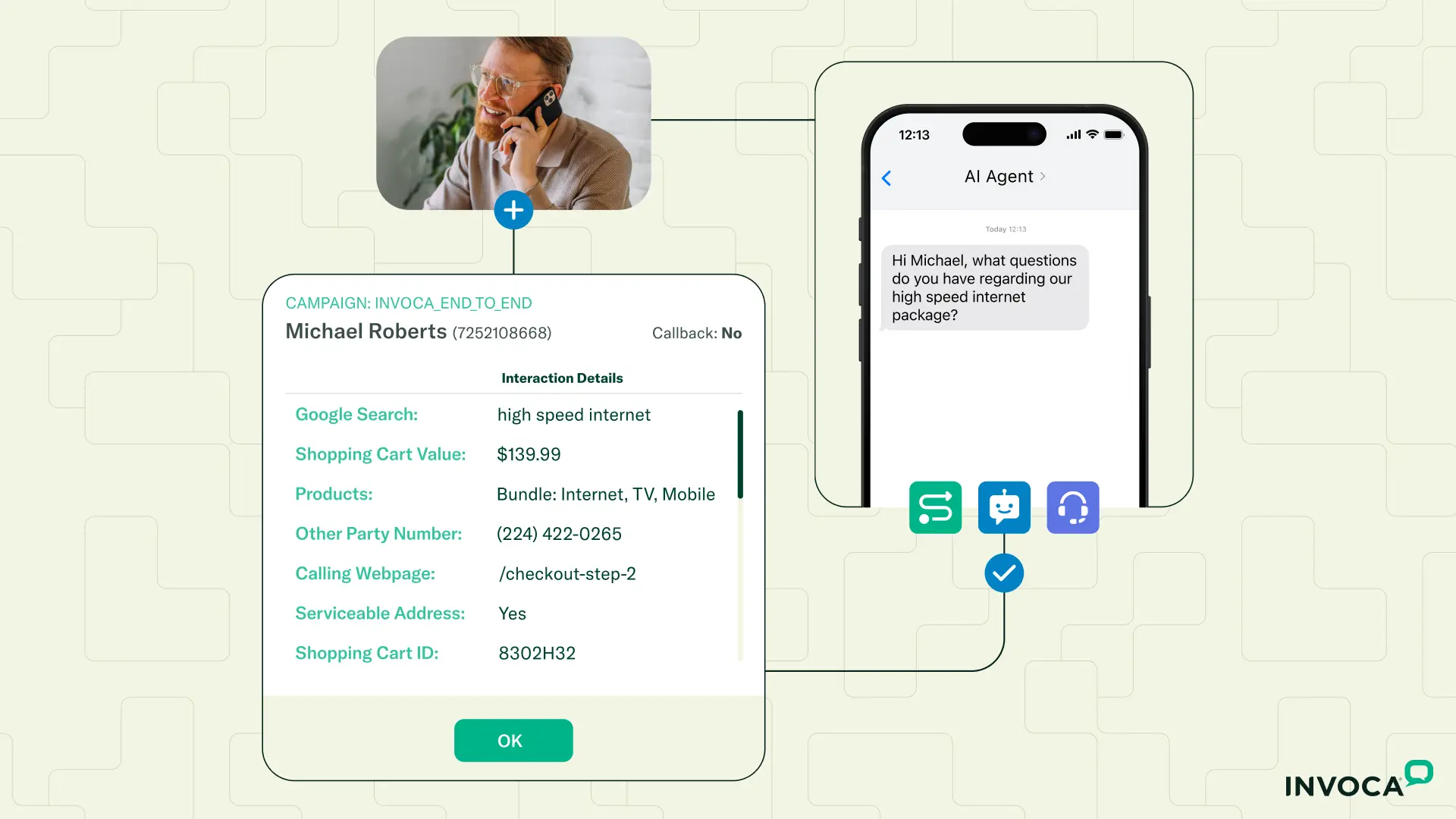
The AI agent is pre-trained on top-performing sales conversations and launches with industry-specific templates. It qualifies leads and handles conversations around the clock while meeting the compliance and context handoff standards needed to run SMS as a real contact centre channel.
Want to see Invoca's AI Messaging Agent in action? Request your demo today.

FAQs About SMS Call Centre Software and Deployment
What happens if I don't complete A2P 10DLC registration before sending business texts?
Carriers filter or block unregistered 10DLC traffic, so your messages won't reach customers. Registration exists to curb spam, and skipping it kills deliverability. Fees include $4 for brand verification and $15 for campaign review, with monthly costs per campaign, per Bandwidth.
How do I measure whether SMS is actually deflecting calls or just adding channel noise?
Start with two or three low-complexity intent categories like appointment confirmations and status checks. Track call volume for those categories before and after SMS launch. Monitor escalation-to-call volume and downstream conversion rates to confirm you're deflecting simple calls, not blocking revenue ones.
Do I need separate compliance posture for SMS in healthcare or financial services?
Yes. Healthcare and financial services require HIPAA BAA support and PCI DSS compliance from your SMS platform. If your vendor can't provide that documentation, you can't run SMS in those verticals. Confirm your vendor's posture before signing any contract.
Can I use toll-free numbers for SMS, or do I need local 10DLC numbers?
Toll-free numbers work for SMS, but they require separate verification through your carrier. This process is distinct from 10DLC registration. Unverified toll-free messaging has been fully blocked since January 31, 2024, per Twilio. Launch with unverified numbers and your messages won't deliver.
What opt-out keywords must my SMS platform recognise, and how fast do I need to process them?
As of April 11, 2025, your platform must recognise: "stop," "quit," "end," "revoke," "opt out," "cancel," and "unsubscribe." Revocations must be processed within 10 business days, per Kelley Drye. Automate keyword detection and suppression. Store consent records with timestamps for audit.
.svg)
.svg)