.svg)


Adding agentic AI to your business can feel a lot like starting a new workout routine. You set out with high hopes, buying a membership to a fancy new gym with a sauna and cryotherapy chamber. But after a couple of weeks with no signs of a six-pack, enthusiasm wanes. If you’re not careful, you can find yourself back on the couch with a bag of Funions. When your agentic AI pilot doesn’t immediately generate results, it’s tempting to let it suffer the same fate.
Like the promise of shredded biceps, the promise of agentic AI is hard to ignore. These autonomous agents can reason, act, and adapt in real time, handling complex workflows, surfacing insights, and driving decisions without needing a human to stitch everything together. The potential productivity gains can make your head spin.
But somewhere between the promise and the payoff, something keeps going wrong. For every organisation seeing measurable returns, there are dozens more stuck in pilot purgatory. They bought a shiny new platform, but when it comes to driving tangible results, their efforts fall short.
In many cases, it’s not the AI that’s the problem. The issue often lies with the strategy, the data, and how it all gets executed in practice. The brands seeing ROI from agentic AI aren't necessarily using better technology—they’ve just built stronger foundations.
The brands falling behind often repeat the same implementation mistakes, and each one chips away at the ROI leadership was expecting. Let's break down exactly what those mistakes look like, and, more importantly, what it takes to avoid them.
Way 1: Starving Your AI Agents of Complete Buyer Journey Data
Here's a question worth sitting with: What does your AI agent actually know about the person it's talking to? If the honest answer is "not much," you've got a problem. Agents that rely on generic FAQs, scraped website content, or surface-level CRM fields can't personalise conversations. They can't progress a buyer who's already done their research and just needs one more nudge. And they definitely can't pick up a conversation where the consumer left off.
As a result, leads get repetitive, irrelevant, or outright frustrating responses, which cause them to leave and seek out a competitor. Agentic AI is only as good as the context it receives. Without journey-level data, it's just a very fast way to give the wrong answer.
Winning teams feed their AI with end-to-end buyer journey data: the marketing source and campaign that drove the initial visit, site-level digital behavior, prior call transcripts, outcomes, and intent signals. That context is what transforms a generic bot into a genuinely helpful conversation. Your AI will be able to anticipate each consumer’s needs, personalise responses, and meet them exactly where they are in the buyer journey. This makes them feel valued and known and drives long-term loyalty.

Way 2: Leaving Gaps Between Data Collection and Action
The promise of agentic AI is that it acts: it doesn't just surface an insight and wait for a human to do something about it. It responds, optimises, and adjusts in motion. But that promise collapses when the underlying data pipeline moves at the speed of a quarterly business review rather than the real-time speed of a customer decision.
Nowhere is this gap more glaring than in call data. According to our study, only 21% of companies can feed call data to their ad platforms in near real time, and just 2% can act on call data within a single day of collecting it. In practice, that means a customer calls in, reveals high purchase intent, or converts, and for the overwhelming majority of companies, that signal sits dormant while AI-powered campaigns keep spending and optimising based on stale data.
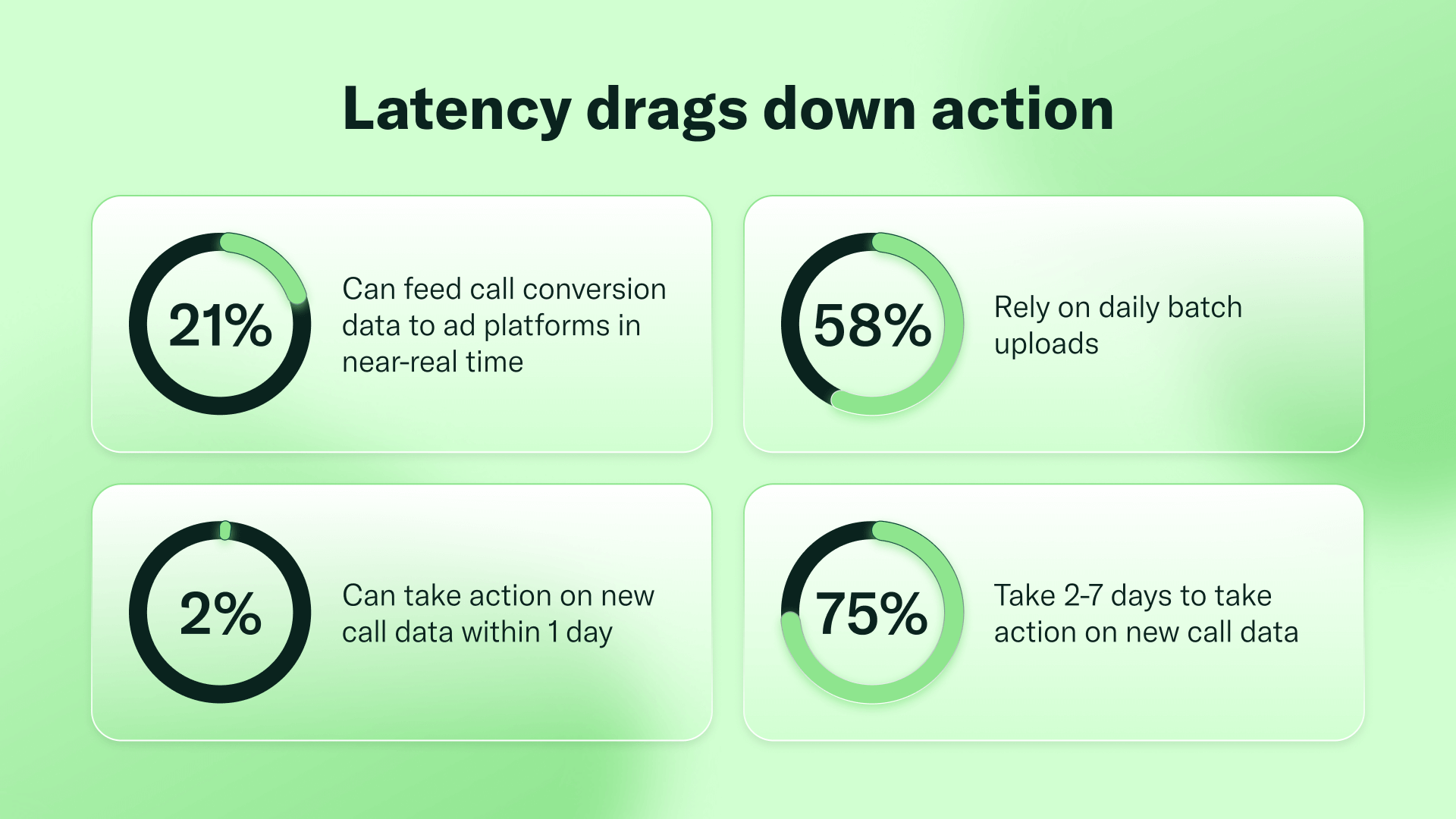
This is what makes the insight-to-action gap such a foundational threat to agentic AI. Agents are designed to close feedback loops, but when data arrives hours or days late, loops stay open. Worse, the confidence with which an agent acts can make latent data problems worse, because errors compound faster than a human would allow them to. Marketing agents may reallocate budget toward channels that only look high-performing. Contact centre messaging agents may fumble interactions by using outdated insights for personalisation.
Companies serious about agentic AI need to treat real-time data integration as a prerequisite, not a nice-to-have. That means auditing every major customer signal source and asking honestly: How long does it take for this insight to reach the systems where decisions are made? If the answer is anything longer than minutes, the agentic layer built on top of it is operating on a cracked foundation.
Way 3: Rushing to Deploy While Ignoring CX Risk
Most marketing leaders are taking a calculated risk with AI by choosing speed over safety. Nearly 60% say they would rather risk harming the customer experience than lose the AI race to competitors. But speed without guardrails is one of the fastest ways to damage the trust you've spent years building with your customers.
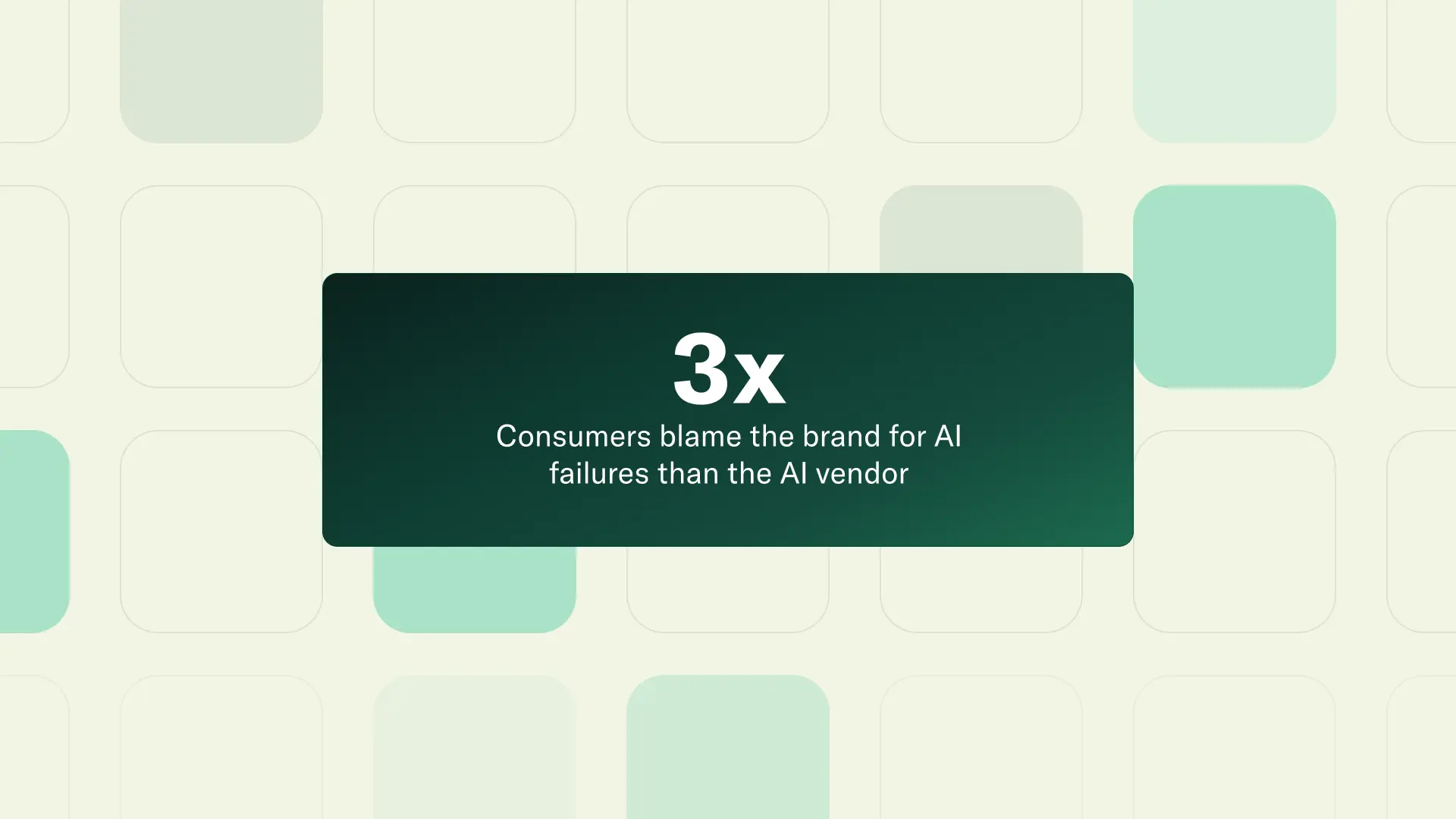
The stakes are higher than many teams realise. Our 2026 Buyer Experience Report shows that when a brand's AI fails, consumers blame the brand over the technology by nearly a 3-to-1 margin. A whopping 38% blame the brand alone, while just 14% blame the AI itself. "The vendor's model hallucinated" is not a defense any customer will hear or accept. They know AI works, and when yours doesn't, that's on you.
When teams rush to deploy, they often end up with undercooked agents: AI that answers questions it shouldn't, fails to recognise when a situation has exceeded its competence, and can't execute a clean handoff to a human when it matters most. These are moments customers remember. A frustrated caller who gets stuck in an AI conversation with no exit ramp doesn't just abandon the interaction; they often abandon the brand.
Leading brands approach this differently. They design AI as a frontline teammate, not a replacement. They define escalation rules, consent handling, and CX guardrails before go-live, not as an afterthought.
Way 4: Underestimating Scaling Costs
What vendors don’t tell you during the demo is that agentic AI can get expensive fast. Every reasoning step, every tool call, and every conversation your agent has consumes tokens. When you're running a pilot with a few hundred interactions a week, the costs are easy to ignore. But when you scale to tens of thousands of conversations across multiple channels and markets, what looked like a lean AI investment can balloon into one of your largest line items. Many organisations don't discover this until they're already committed.
The problem is compounded by how agentic systems work. Unlike simple chatbots that retrieve a canned response, agentic AI reasons through problems. They often make multiple model calls per interaction, pull in context from various data sources, and pass large conversation histories back and forth with each step. The richer the context you feed your agent (and you should be feeding it rich context), the higher the token load per conversation. Organisations that architect for quality without thinking about cost efficiency can find themselves in an impossible trade-off: scale the agent and blow the budget, or cap usage and underdeliver on the promise.
This is why scalability needs to be a design criterion, not an afterthought. Teams that get this right think carefully about context window management, caching strategies, and when a lightweight model call can do the job instead of a heavyweight one. They instrument their token usage early so they can see exactly where costs are accumulating and optimise before scale forces their hand. And they choose AI partners whose pricing models are built for enterprise volume and bill based on outcomes, not ones that look affordable in the pilot stage but become punishing at production scale.
Way 5: Taking a Set It and Forget It Approach to AI
Launching your AI agent is a milestone worth celebrating. But too many teams treat deployment as the conclusion of a project when it's really the beginning of one. The agent is live, the demo looked great, and leadership is happy. And then things start to drift.
Buyer behavior changes, new objections emerge, and product offerings shift. What resonated in Q1 may misfire by Q3. An agent that isn't continuously learning from new conversations, new outcomes, and new signals gradually becomes a liability. It confidently delivers answers that no longer match reality, optimises toward goals that have shifted, and handles objections with expired playbooks. If you’re not actively tuning and optimising your agent, its performance will inevitably regress.
The deeper problem is organisational. Most teams are structured to launch things, not to maintain them. Once an AI agent ships, attention moves to the next initiative. Nobody owns the ongoing feedback loop. Customer preferences drift out of alignment with what the agent is actually doing, and the gap widens in silence until a missed quarter forces a postmortem that could have been a routine tune-up.
Agentic AI must be treated as a living system, not a launched product. This required building feedback loops and continuously training agents based on the latest insights. More importantly, you have to align marketing, contact centre, and operations around continuous optimisation—not just the initial launch. The brands that pull ahead aren't necessarily the ones that deployed fastest. It’s the ones that never stopped improving.
Drive Better Results with Invoca’s Agentic AI
While many AI messaging agents are trained on generic datasets, Invoca's are trained on your best-performing conversations. This ensures your agents are on-brand from day one and equipped to handle calls like your best agents. The result is a messaging agent that sounds like your brand, not a chatbot.
In addition, Invoca's agents are fed a continuous stream of real-time customer signals. That means every interaction is informed by what's happening right now: which campaigns drove the conversation, what the customer has already researched, where they are in the decision process, and what objections or intent signals they've shown along the way. This enhances personalisation and allows your AI agents to meet consumers where they are.
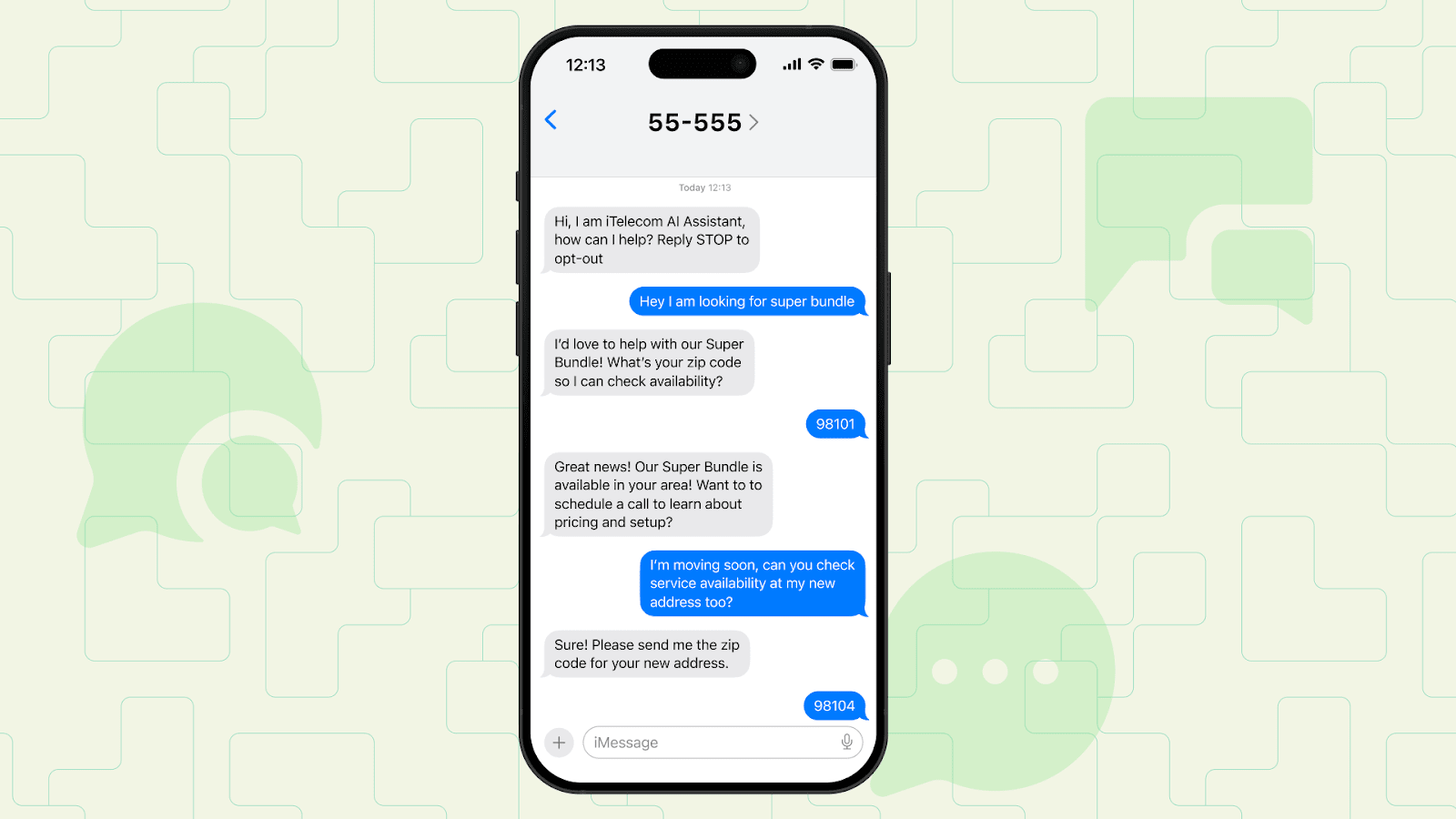
What truly separates Invoca from the field, though, is what happens after the conversation. Most AI tools stop at engagement metrics, like sessions, responses, and containment rates. Invoca ties chat outcomes directly to revenue, closing the loop between what the agent said and what the customer did. That means you can see which conversations drove pipeline, which handoffs converted, and where the experience broke down before a sale was lost. It turns your messaging agent from a cost-containment tool into a measurable growth channel.
Additional Reading
Want to see how Invoca can strengthen your AI strategy? Book a personalised or check out these resources:
- Why First-Party Conversation Data Is Your AI Advantage
- Why Many B2C Brands Overestimate Their AI Maturity
- 5 Ways to use AI Messaging Agents That Consumers Actually Like

.svg)
.svg)