.svg)

In 2026, experimenting with AI isn’t enough. The pressure is on for CMOs and marketing leaders to drive measurable results. Our recent study backs this up: only 15% of marketers say they’re still in “watchful pilot mode” when it comes to AI. The rest have their foot on the gas and are speeding to gain the competitive advantage. The sense of urgency is unmistakable: 81% believe the leader in their category will be determined this year.
But moving fast comes with risks. A staggering 74% of marketers believe that rushing AI deployment can harm the customer experience, and they’re right. We’ve all encountered a chatbot that cycles through the same canned responses, eventually pushing us to abandon the interaction and call customer support instead.
So, as a marketing leader, the question becomes: How can you scale AI across your organisation in a brand-safe, customer-friendly way? It starts with the right data. AI is only as good as the signals you feed it, and more relevant data produces more accurate outputs.
Yet many marketers overlook the richest data source they already own: first-party data from conversations with leads and customers. These interactions offer unmatched visibility into what customers want, what confuses them, what motivates them, and what ultimately moves them to buy.
In this post, we’ll explore why conversation data is your AI advantage, and how to activate it across your organisation in a safe, scalable, and customer-first way.
Why General-Purpose Data Fails Your Customers
Most marketing teams assume that more data automatically means better AI. But in reality, the wrong data produces the wrong outcomes, and nowhere is this more obvious than when AI is trained on scraped web content or massive third-party datasets.
General-purpose data is built for breadth, not accuracy. It’s a patchwork of outdated articles, public forums, and inconsistent language patterns scraped from across the internet. While it can help AI learn the structure of language, it can’t teach it the nuance of your brand, your customers, or your buying journey.
When you rely on generic data, your AI starts to sound generic too—often drifting off-brand and outside your guidelines. Instead of confidently guiding customers, it defaults to vague statements and canned responses that flatten your brand voice into something unrecognisable. Even worse, it may deliver incorrect answers with absolute certainty, eroding trust and damaging the very experience you’re trying to improve.
The hard truth is that your AI is only as good as the data feeding it. If your inputs aren’t grounded in real customer conversations, real objections, and real intent signals, your outputs won’t reflect the reality of your customer experience. They’ll reflect the internet’s version of it, and that’s not a standard any modern brand can afford.
If you want AI that’s truly helpful, trustworthy, and aligned with your brand voice, you need data drawn from real customer experiences—not the noise of the open web. Conversations deliver exactly that, giving your AI a direct line to the authentic voice of your customers.
Three Key Forms of First-Party Data from Conversations
It can feel overwhelming to start mining your organisation’s phone conversations for insights. The data is unstructured and hard to wrangle at scale. Below, we’ll cover key data points you can capture with tools like Invoca to turn complex conversations into clear, actionable signals.
1. Digital journey data
Conversations don’t exist in a vacuum. There is a rich trail of digital context leading up to every call or text that can give you far deeper insights into a customer’s intent and purpose. For example, you can capture:
- The ad or keyword that drove the visit
- The referral source (organic search, partner site, affiliate, etc.)
- Pages viewed and time spent on each
- Abandoned carts or checkout steps
- Information typed into partially completed forms
- Rage clicks or signs of digital frustration
- Previous interactions with your brand (return visitor, past customer, loyalty member)
2. Conversation data
Once the call is connected, you can capture numerous signals from the conversation to train your AI and enhance the experience. If the caller chooses to engage with you via SMS, you can mine insights from those conversations as well. Below are some of the most common examples:
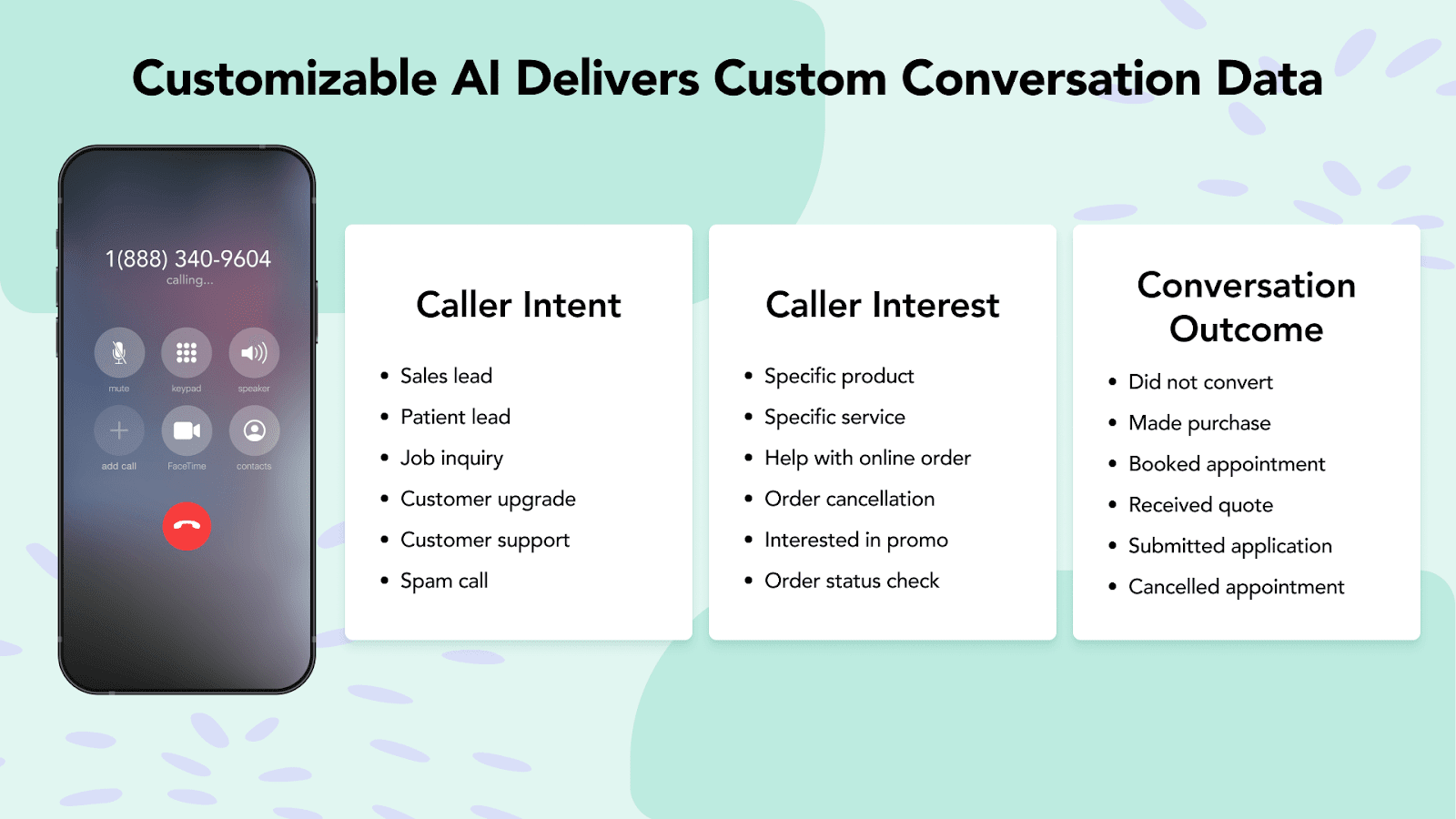
- Caller Intent: Detect if the caller is a sales lead, current customer, new or existing patient, or job seeker
- Caller Interest: Determine the specific product or service the caller is interested in, if they are looking for help with an online order, or need support with a product issue
- Call Events: Discover important events like if the caller asked to be called back or to speak to a supervisor
- Voice of the Customer (VoC) Insights: Detect if the caller asked about pricing or a specific product feature, discussed a competitor, or lodged a complaint
3. Transaction data
Every phone call ends with a resolution: an appointment, a purchase, a quote, or a missed opportunity. Understanding that outcome is essential because it closes the loop on whether your marketing and customer experience efforts actually drove revenue. Knowing whether a caller booked an appointment, completed a purchase, requested a quote, or took any other high-value action allows you to distinguish true conversions from low-intent interactions. This outcome data not only helps you measure ROI accurately—it also powers smarter AI models.
How Conversation Data Improves the Customer Experience
Having these three types of conversation data at your disposal is valuable; having them connected is transformative. When digital journey data, conversation insights, and transaction outcomes are combined into a single unified view, you can finally see the complete story of how customers progress through the buying journey. As a result, you can optimise every step of that process with precision.
Here's what that looks like in practice: a potential customer clicks your Google ad for "furnace replacement," views three different products, then starts filling out an appointment scheduling form but stops partway through. Ten minutes later, they call your contact centre. Without connected data, your agent starts from scratch: "Thanks for calling, how can I help you today?"
Invoca PreSense fixes this all-too-common issue. The solution unifies the entire online-to-offline customer journey, so the agent sees exactly what pages the caller viewed, where they got stuck, and what question likely prompted them to reach out. They receive this data before the call is connected, so they can personalise the conversation and speed up resolution times. In this example, they could greet the caller by name and ask them if they had any questions about furnace models or the installation process.
See how PreSense works in the short video below:
How Conversation Data Increases Marketing ROAS
Conversation data not only improves the customer experience, but it can also multiply your marketing results. Let’s go back to the furnace replacement example from the last section: after the caller is connected, Invoca’s AI can capture rich insights from the conversation, including what products the caller was interested in, if they expressed price sensitivity, if they ultimately scheduled an appointment, and more. These data points can fuel smarter marketing optimisations and higher ROAS.
For example, you can push the appointment conversion data directly into Google Ads. This gives its AI insight into which keywords and ad variations drive conversions—not just online, but also over the phone. As a result, the algorithm gains a more complete picture of your ROI, and can make smarter bids on your behalf.
You can also use conversation insights to improve ad targeting. For instance, if the caller didn’t schedule an appointment due to price sensitivity, you could remarket them with an email offering a 15% discount for new customers. If they scheduled an appointment and mentioned interest in an air conditioning unit as well, you could serve them ads offering a bundling discount.
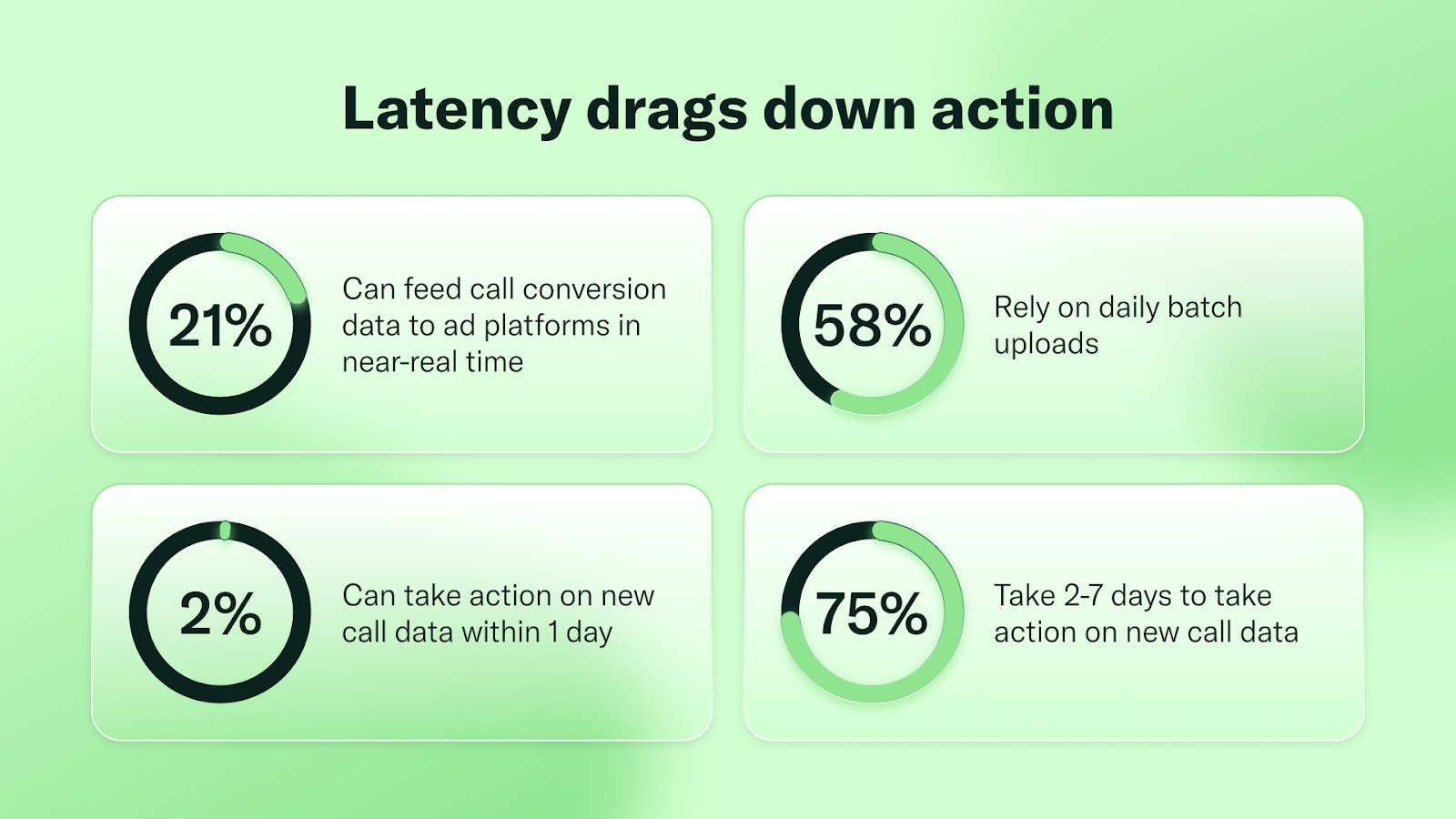
Though these optimisations are undeniably powerful, only a fraction of marketers can take advantage of them. Many organisations suffer from latency issues that prevent them from acting on their data in a timely manner. Our AI Impact Report reveals just how widespread this problem is: only 2% of marketers can act on insights from unstructured data within one day, while 75% take between two and seven days to use that data to implement changes. Organisations that can eliminate these latency issues will gain a clear advantage over their slower-moving competitors.
How Conversation Data Improves AI Model Performance
Conversation data can also improve your AI strategy on a fundamental level—it contains the rich insights you need to train your models. Unlike scraped web content, third-party marketing data, or synthetic training data, calls capture real, high-stakes interactions where customers are explicit about their needs, objections, and intent. People pick up the phone when something matters: they’re ready to buy, confused, frustrated, comparing options, or seeking reassurance. In those moments, they reveal how they actually talk about your product, what language resonates with them, and what information moves them forward.
Just as importantly, calls capture how your best agents respond—the phrasing they use, the empathy they show, and the ways they guide customers toward resolution. That’s gold for training AI that needs to sound human, helpful, and on-brand.
Yet this data is often overlooked because it has historically been difficult to analyse at scale. Phone conversations are unstructured, messy, and packed with nuance, which made them hard to activate before modern AI and conversation analytics. As a result, many teams train AI on generic datasets that miss the lived reality of their customers and agents.
Invoca solves this all-too-common issue by turning phone conversations into structured, usable training data. As a result, you can fine-tune your AI models to reflect true customer intent, brand voice, and high-performing agent behaviors.

AI Success Starts with Data CMOs Can Trust
When CMOs and business leaders insist their AI is trained on first-party conversation data, they gain a durable competitive advantage that compounds over time. First-party conversation data reduces deployment risk because your AI is grounded in real customer conversations, not generic data scraped from the web. It improves customer experience because interactions feel relevant and human. And it accelerates time to value because you're not spending months teaching generic AI how your business works—it already knows.
The brands that win won't be the ones that race to deploy AI everywhere first. They'll be the ones who took the time to feed it the right fuel: complete, connected, first-party data that reflects how their customers actually buy and how their best people actually sell. Speed matters, but in an era where one bad AI experience can tank brand trust, feeding your AI the best possible data matters more.
Additional Reading
Want to learn more about how Invoca’s data can help you create better AI experiences? Check out these resources:
- AI Has Made Conversations the Future of Revenue Growth. Are You Ready?
- 3 Ways to Convert More Leads with AI SMS Messaging Agents
- 5 Ways to Make Customers Hate Your AI

.svg)
.svg)