.svg)


There's no shortage of opinions about AI in customer experience. Vendors say it's transforming service delivery, skeptics say it's impersonal and frustrating, and somewhere in the middle are the actual customers interacting with it. We figured the best way to settle the debate was to ask them directly.
For Invoca's 2026 B2C Buyer Experience Report, we went straight to the source: 700 US consumers who had recently navigated a high-stakes purchase in industries like insurance, automotive, healthcare, and telecom. What they told us paints a nuanced picture of where AI is actually working, where it's still falling short, and what marketers and contact center leaders need to do about it.
Keep reading to learn what the data says.
What Is AI in Customer Experience?
AI in customer experience (CX) refers to the use of artificial intelligence to assist, automate, or personalize interactions throughout the buying journey. This includes conversational AI to assist buyers (think AI messaging agents and AI voice agents), sentiment analysis, real-time agent coaching, predictive website experiences, and much more.
At its best, AI in CX means faster responses, more relevant service, and a purchasing process that feels seamless across channels. Leading brands use AI to connect interactions that happen on a website, via text message or chat, and over the phone.
The risk, however, is deployment quality. AI that isn't properly implemented doesn't just fail to help—it actively damages the customer relationship. And according to our data, consumers are far more likely to blame the brand for a bad AI experience than the technology behind it.
Does AI Improve the Customer Experience?
The short answer: it depends on how well you deploy it.
The share of consumers who said AI made their buying experience worse dropped from 29% in 2025 to just 18% in 2026—an 11-point improvement in a single year. That's a significant shift, and it reflects real progress in AI quality. Voice and text agents are faster, more conversational, and better at staying on topic than they were even 12 months ago.
In addition, the share who said AI improved their experience ticked up modestly (42% to 46%). This shift was especially pronounced for the Baby Boomers, who were slower to adopt the technology but are now open to it.
Can People Tell When They're Talking to AI?
Here's one of the most striking findings in the entire report: 63% of US consumers either have never realized they were talking to AI or weren't sure.
A year ago, AI interactions were often identifiable by their scripted responses, narrow topic ranges, and inability to deviate from a preset flow. That experience is clearly improving. Today's AI agents are polished enough that most consumers can't reliably distinguish them from human agents.
For marketing and contact center leaders, this has two implications. First, AI quality has crossed a meaningful threshold. The technology can now genuinely engage customers without alienating them. Second, the risk of a bad interaction is higher now because customers don't realize they're talking to an AI until something goes wrong.
Should AI Identify Itself as AI?
Yes, and consumers are emphatic about it.
Eighty-three percent of US consumers say it matters that a brand's AI clearly identifies itself as AI. More than half (57%) say it matters a great deal. This isn't a "nice to have" from a consumer trust perspective. It's a demand.
The good news is that this is also the lowest-cost, highest-trust move a brand can make right now. Disclosure is simple, and consumers reward it. One survey respondent put it plainly: "I feel they should let you know before throwing you to AI. It feels like a lie." That sentiment is widely shared.
Brands that skip AI disclosure aren't just risking a bad interaction, but their entire relationship with the customer.
Who Gets Blamed When AI Fails?
When an AI interaction goes badly, consumers blame the brand by nearly 3 to 1 over the AI itself. Thirty-eight percent say they blame the brand alone, while another 30% blame both the brand and the technology equally. Only 14% place primary responsibility on the AI.
Add that up, and roughly two-thirds of consumers will tie a bad AI experience back to the company that chose to deploy it. The vendor takes none of the heat. The customer's relationship is with your brand, and so is their disappointment when your AI lets them down.
This changes the calculus of AI investment considerably. Deploying AI isn't just a technology decision. It's a brand equity decision. The question isn't just whether you can use AI for a given interaction, but whether your AI is good enough to represent your brand at that moment.
When Do Consumers Actually Prefer AI Over a Human Agent?
AI performs best when the task is simple and the customer is in a hurry. According to our data:
- 49% of consumers prefer AI for simple tasks
- 43% prefer AI when they need fast answers
- 35% prefer AI specifically to avoid hold queues
- 19% say they never prefer AI
That "avoid hold queues" number is the one that should drive investment decisions. More than one in three consumers will actively choose AI to skip the wait, meaning brands without a capable AI frontline are losing good leads at the exact moment they're most motivated to convert.
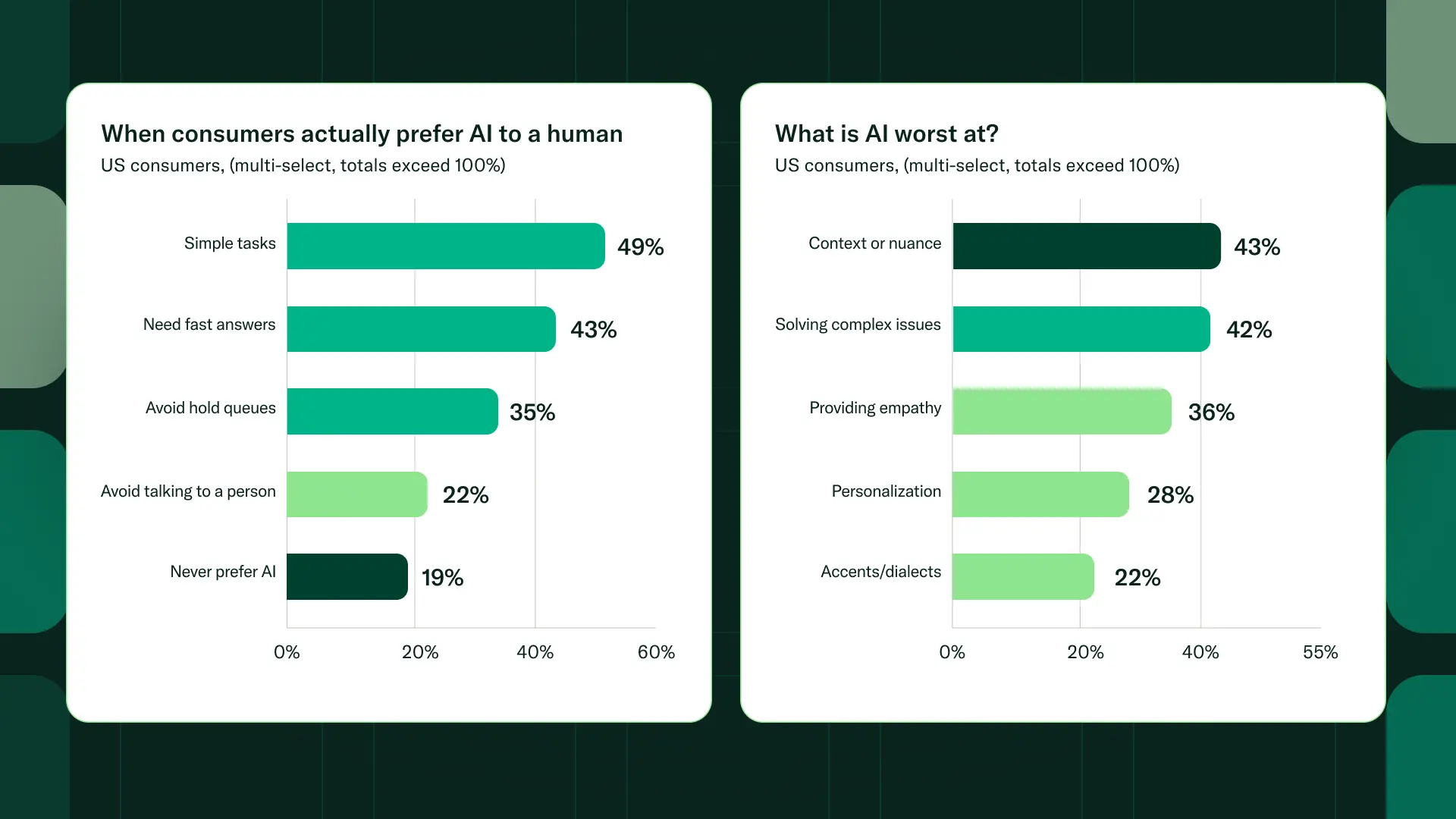
What is AI worst at, according to consumers? Context and nuance (43%), solving complex issues (42%), and providing empathy (36%). These are the moments where human agents still win, and where a smart handoff from AI to a person makes all the difference.
Where Do Consumers Still Want a Human?
For all the progress AI has made, the desire for human connection hasn't budged. Ninety-six percent of US consumers say human connection is important during a high-stakes purchase. And when both options are equally available, 59% prefer a human representative over an AI assistant.
Calling is still the number one support channel across every generation, from Gen Z (30%) to Boomers (52%). It's held the top spot in our research for three straight years, rising from 32% in 2022 to 44% in 2025 and staying strong at 41% in 2026. When consumers have a real problem and a meaningful purchase on the line, they pick up the phone.
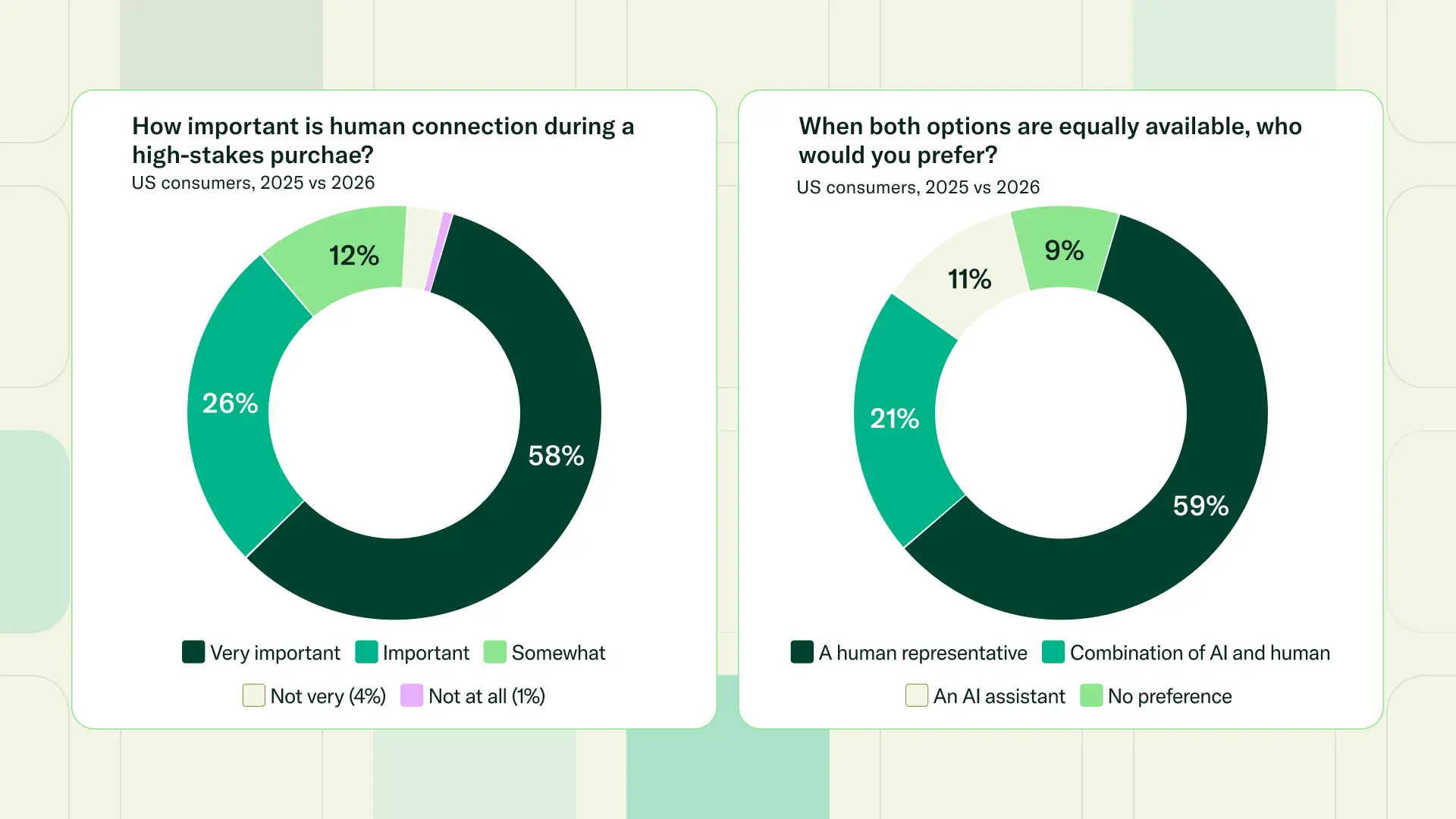
This is where contact center leaders need to pay close attention. AI is welcome upstream for research, quick answers, and routing. But at the moment of conversion, humans are often still needed to close the deal. The brands that understand this aren't choosing between AI and people. They're using AI to make sure the right human gets the right call at the right moment, with the right context already loaded.
Speed-to-Lead Has Never Been More Important
One data point from the report deserves its own spotlight. There's a 20-percentage-point gap between what consumers expect and what they actually get in terms of response speed after submitting a lead form.
Fifty-six percent of consumers expect a response within one hour, but only 36% actually get one. And 79% say they'll switch to a faster competitor if they don't hear back quickly enough. The cost of a slow response isn't a delayed conversion. It's a lost one.
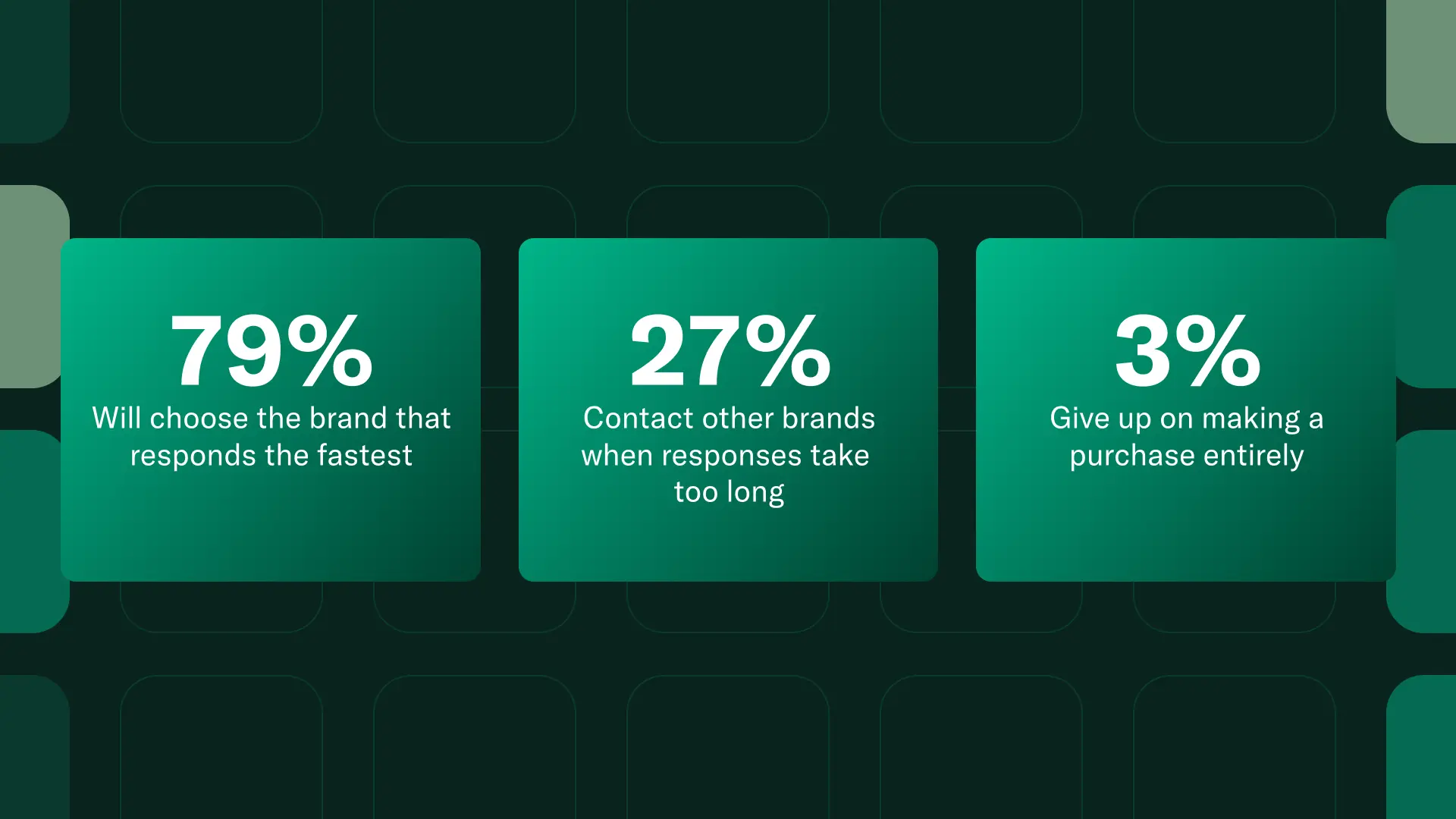
This is the gap that AI is built to close. AI messaging agents can engage leads within seconds of a form submission, qualify intent, answer questions, and route hot leads to the right agent before they even think about contacting your competitors. For marketing teams managing paid media spend, this is where AI pays for itself.
What Does This Mean for Marketers and Contact Center Leaders?
The 2026 data tells a consistent story: AI has earned its place in the buying journey, but it can't replace the human moments that drive the final decision.
Here's how to think about the opportunity:
- For marketers: The buying journey is increasingly AI-assisted from the start. Fifty-eight percent of consumers used generative AI to research a high-stakes purchase in 2026, up from 41% just a year ago. Your media spend needs to be connected to the actual outcomes those buyers produce, not just clicks and form fills. That means closing the loop between your campaigns, your conversations, and your conversions.
- For contact center leaders: Consumers will not wait on hold. Seventy-five percent hung up after being placed on hold for too long in 2026, up from 50% the year before. AI messaging and voice agents can handle the volume, answer simple questions, and route complex ones to the right human agent. The goal isn't to replace your agent, but to give them more time to do the work that only they can do.
- For both: The handoff between AI and human is where experience is made or broken. Consumers are more forgiving of bad experiences than they used to be (the share who'd stop doing business after one bad experience dropped 26 points to 40%), but they still won't wait to be heard. The brand that responds quickly—with AI or a human—earns the right to make a mistake. The brand that leaves them on hold never gets the chance to make a first impression.
How Invoca Helps Brands Balance AI and the Human Touch
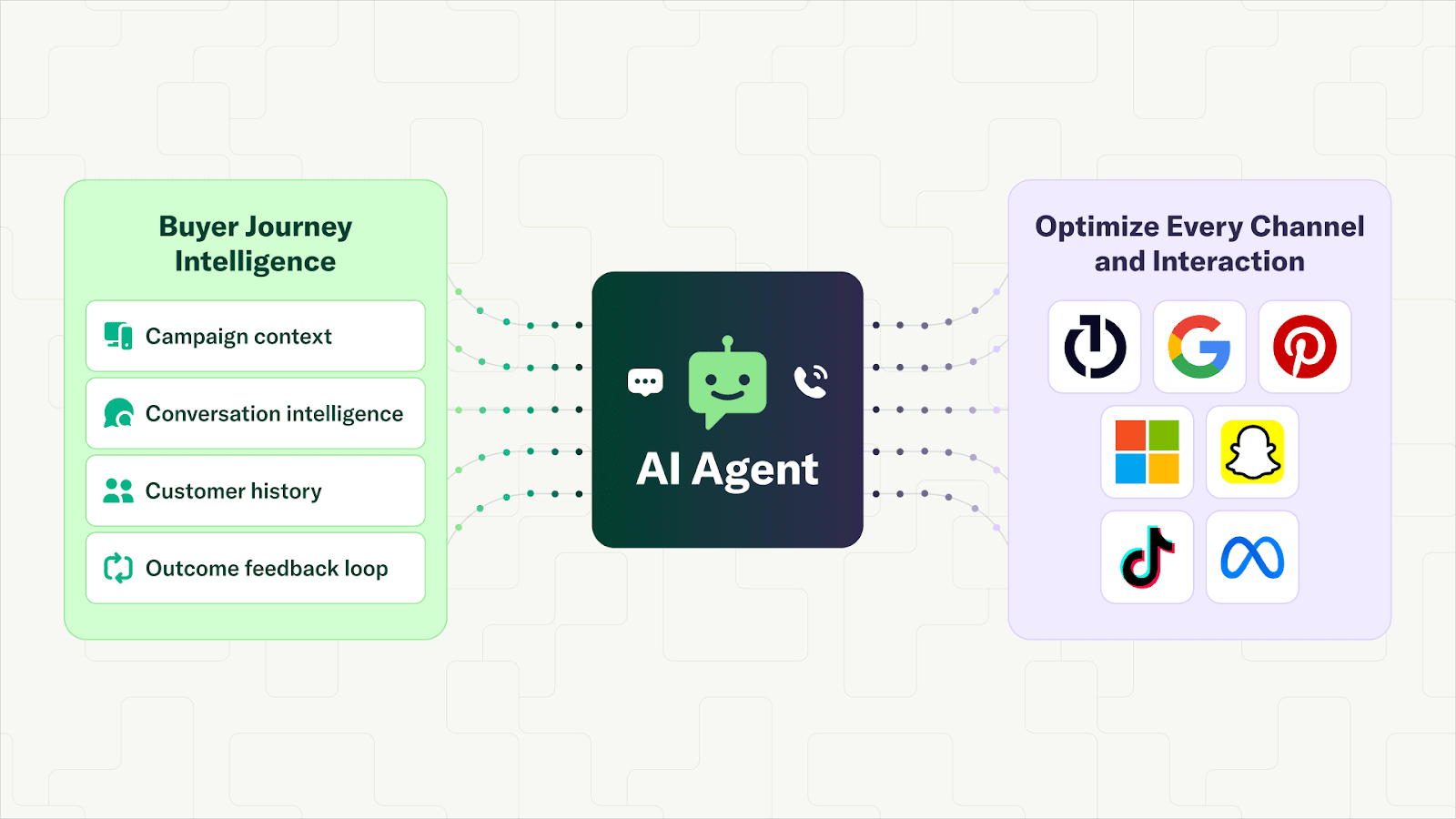
Invoca is an AI-powered platform that connects marketing, contact center, and CX teams across the full buyer journey, including phone conversations and AI agent conversations.
With Invoca, marketers can see which campaigns drive conversions, not just clicks. Contact center teams get real-time intent data before a call even connects, so agents can deliver seamless, personalized experiences. And our AI Messaging Agents can engage leads instantly, so no inquiry falls through the cracks while your team is handling other calls.
Want to see more of the data? Check out the full 2026 B2C Buyer Experience Report.
Want to see how Invoca helps marketing and contact center teams connect the full buying journey? Request a demo.
.svg)
.svg)