.svg)

At Google’s recent Rethink ROI event in New York City, marketing executives, agency leaders, and Google product specialists gathered to discuss the latest trends in customer acquisition. There was one consistent through-line across every session: AI has rewritten how consumers discover, evaluate, and choose brands.
The event wasn’t just about recognizing that shift, but also providing solutions. From new Google products and capabilities to customer panels, the sessions explored how brands can connect buying journeys, reach consumers in AI-powered environments, and make measurement more durable as the path to purchase becomes increasingly fragmented.
Whether you missed the event or just want a refresher, we’ve got you covered. We compiled our top 5 takeaways for you in this blog post. Keep reading to learn about the latest consumer behavior shifts, measurement frameworks, and Google’s product roadmap.
1. The “Super-Empowered Consumer” Is Doing More Research, Not Less
For as long as anyone has tracked the path to purchase, buyers have traded confidence for convenience. You could do the work yourself—40 browser tabs and a spreadsheet comparing 15 providers—or you could trust that you’d phrased your search well enough and get on with your day. Google’s framing is that AI removes that trade-off and empowers the buyer like never before.
You may think AI shortens the buying journey by serving the consumer a single answer rather than providing a list of blue links to explore. However, Google’s research actually shows the opposite. People who use AI to research a purchase have 3 times as many touchpoints as those who use traditional search. That’s because AI searchers are often brainstorming, asking follow-up questions, and diving deep into product specifics. Plus, AI can surface sources they never would have found on their own: creator videos, community threads, side-by-side comparisons, and reviews buried five pages deep.
Brands need to rethink the funnel in order to accommodate AI searchers. Search, YouTube, and AI answers aren't sequential stages anymore; the same person moves across all three in one sitting. Running them as separate channels with separate owners can create a disjointed experience.
2. Your First-Party Data Is Your Competitive Advantage
Google was blunt about the division of labor. Their side of the deal is reach and intent: billions of queries, audience signals, and bidding models that can find people who are in-market right now. Your side is telling them what a good lead looks like. Skip that step, and the algorithm optimizes toward whatever it can see, which is usually form fills and clicks that never become revenue. Google can find more people like your best customers, but only once you've defined who your best customers are.
The case for doing that work is measurable. Google shared that it drives 15-30% more conversions for advertisers that invest in proper data foundations. That means collecting the right first-party data, using durable identifiers, and pushing offline conversion outcomes back into the platform.
A common issue for brands is that they’re ignoring one of the richest sources of first-party data available to them: phone and text conversations. In considered purchase industries, calls are often where the deal is won or lost, which means the most telling signal in the whole journey never makes it into Google. As more buyers communicate—and convert—with brands over text message, it’s become a critical conversion data source as well. Sending call and text outcomes back as conversions closes that gap and gives the bidding models the data point they've been guessing at.
3. Traditional Search and YouTube Are Still Where Decisions Get Confirmed
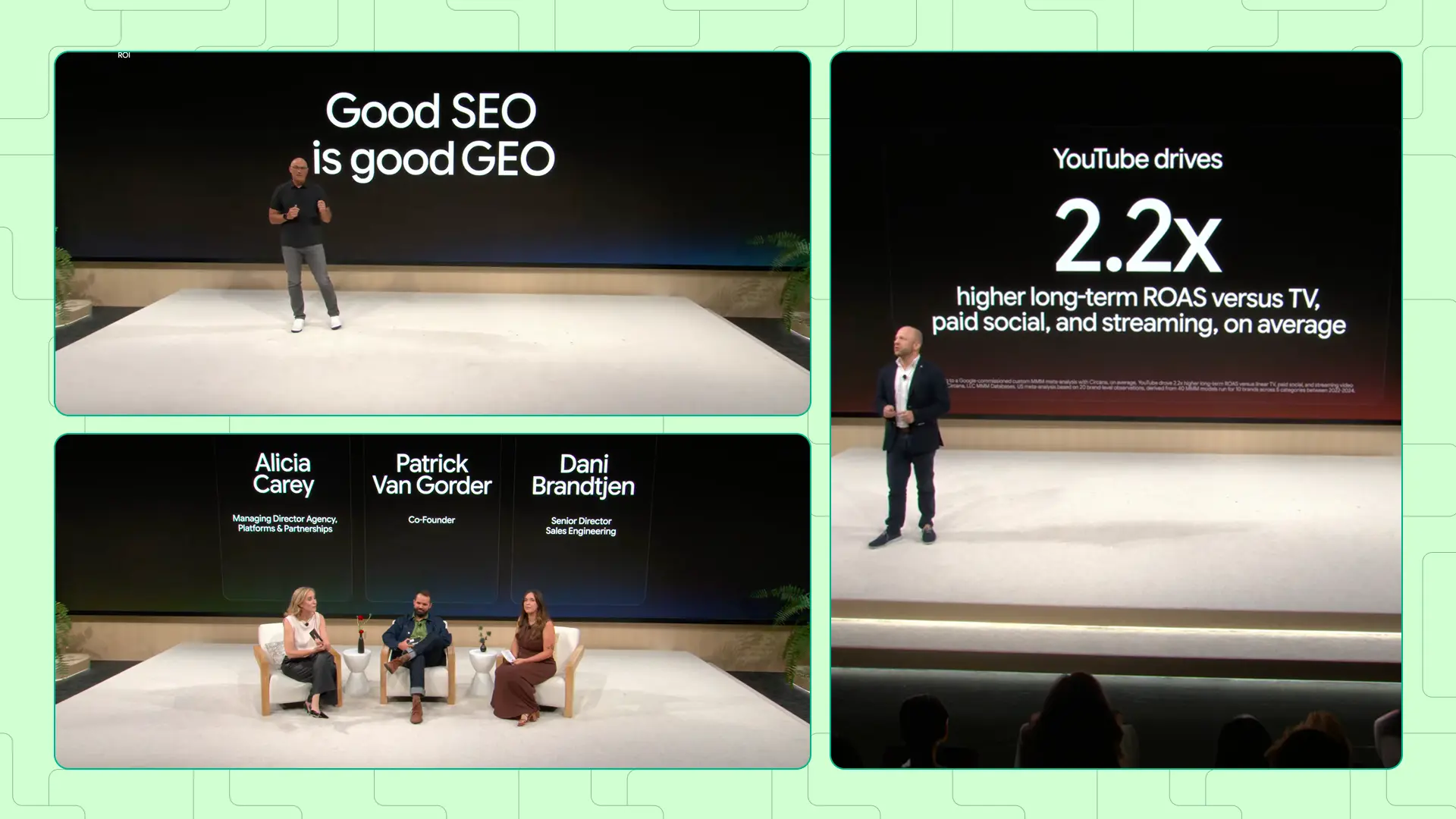
While consumers are turning to AI more than ever to research purchases, they still use traditional search to confirm their decision-making. In fact, when people use ChatGPT to research a purchase, 99% still consult Google before committing, and 71% said they won’t buy without checking Google first. Additionally, when consumers discover a product or service on social media, 84% go to Google to validate it, and two out of three times they end up buying a different brand than the one they found.
YouTube is the other place consumers go looking for proof. Already the top streaming platform in the US, it's now one of the places AI search sends people when they want a real look at a product—reviews, demos, or comparisons from someone who actually used the thing. And watching leads to doing. 89% of lead gen customers said they clicked a link, visited a site or app, or ran a search after watching a related video.
Whatever route a buyer takes through AI, all roads lead to Google and YouTube to confirm the decision. These are your proof points, and you should treat them as a single cohesive strategy. Google reported 37% higher ROAS for businesses that ran the two channels together.
4. Good SEO Is Good GEO
With all of the new acronyms popping up—AEO, GEO, and AIO, to name a few—it's easy to assume a whole new discipline has arrived. Google spent a solid chunk of the session arguing the opposite. AI Mode and AI Overviews aren't a separate channel with separate rules. They're a presentation layer on top of the same crawling, indexing, and ranking that has always powered search. Nothing about the underlying work changed, so the advice didn't either. Teams already doing SEO work are showing up in AI answers.
Google urged brands to stop building for bots, publishing generic content at volume, and chasing brand mentions in community forums. Going forward, its algorithm will favor sites that share a genuine point of view, publish first-hand experience, and offer unique industry expertise.
5. Google Has Plenty of New Lead Gen Products on the Roadmap
No Google event would be complete without a round of product announcements. Below are four new or upcoming products they previewed:
- Business agent for leads (coming soon): A search ad format with an embedded agent that answers prospect questions and pre-qualifies them in conversation. People can chat or submit details directly in the ad, with customer information prefilled.
- Lead journey mapping (now available): Gives visibility into how different customers move from the first ad interaction through your pipeline to the final sale, so you can find where to optimize.
- Journey-aware bidding (in pilot): Uses those journey insights to redirect budget toward the people most likely to convert, learning from the full journey rather than a single event.
- Lead intent scoring (in pilot): Cross-references inbound lead signals with your historical CRM conversion data and Google’s ecosystem signals, then tags every new lead as high, medium, or low intent. Google says it can predict whether a lead will convert with 90% accuracy.
Not everything Google previewed is still in a pilot. Text customization in AI Max is live now, and Google brought a customer on stage to speak on it: Infinity Sales Group (ISG), a longtime Invoca partner.
ISG sells on behalf of major telecom and connected-home brands, so every ad has to clear strict partner requirements and stay inside defined service areas. That's exactly the kind of scenario that makes marketers reluctant to hand creative to an algorithm. Text customization let ISG set text guardrails so the team kept control of what the ads could say while AI Max broadened the set of search terms they competed for. The compliant, dynamic copy plus wider query coverage drove an impressive 40% increase in revenue.
Convert More of the Demand You Drive from Google with Invoca
Despite all the disruption in the digital marketing ecosystem, Google’s role hasn’t changed: it helps brands to generate demand. Its search, YouTube, and AI-powered campaigns put you in front of the super-empowered consumer while they're researching a purchase. But the demand Google creates doesn't convert on its own.
For considered purchases, a phone call or text is often the next step in the journey after a search. However, many brands aren't there to answer it. Calls and texts come in after hours, during lunch, on Saturday morning, or in a rush that overflows the queue. A buyer who just spent an hour researching won't wait for a response or try again later. They call the next brand on the list.
This is where Invoca's AI voice and SMS agents come in. They convert leads to sales and appointments while your staff is tied up. When a conversion occurs, they pass the outcome data back into Google Ads, so you can optimize your campaigns accordingly.
Want to learn more about how Invoca’s AI agents can help you convert more of the demand you drive from Google search? Request your demo today.
.svg)
.svg)