.svg)


We recently surveyed 700 consumers to learn about their attitudes toward AI, and the findings surprised us—especially among Baby Boomers. When you picture this age cohort, it’s easy to fall into stereotypes of digital laggards who call their grandkids every time they need to reset the router. But our research shows the Boomers are more technologically savvy than most give them credit for.
In the past year, Boomers have gone from AI skeptics to adopters. Their use of generative AI to research high-stakes purchases jumped 23 percentage points in a single year, up from 11% in 2025 to 34% in 2026. That's the largest generational shift in the entire dataset of our 2026 B2C Buyer Experience Report.
If your AI strategy is still built on the idea that older buyers are digital holdouts, the data says it's time to update that assumption.
However, there’s a bit of nuance brands need to understand. Boomers embracing AI for research isn’t the same thing as Boomers wanting AI to close the deal. If your company misses that distinction, you’re going to lose sales.
Let’s dig deeper into the findings below!
Boomers Are Closing the Generational AI Gap
The 2026 generative AI research numbers, broken out by generation, tell a clear story about where growth is happening:
Gen Z and Millennials are already near saturation, and there isn't much headroom left to grow. The real movement in 2026 happened in the middle and older cohorts. Gen X climbed significantly, and Boomers, starting from a tiny base of 11%, nearly tripled their adoption rate.
The 2026 story isn't digital about natives discovering AI tools. It's about the older holdouts starting to catch up. And why wouldn't they? Generative AI tools are genuinely easy to use for the kind of research tasks that older buyers care about most. Understanding the fine print on a financial product, comparing different mattress brands before heading to a showroom, or figuring out whether a home repair estimate is reasonable before committing—these are the kinds of tasks where a well-prompted AI assistant saves real time.
What Boomers Are Actually Doing with AI
When asked how they used generative AI in their purchase research, US consumers pointed to three main use cases: getting a quick summary of their options (32%), comparing companies or brands (25%), and understanding complex topics (22%). These findings hold true for Boomers too, who tracked closely with the overall trends.
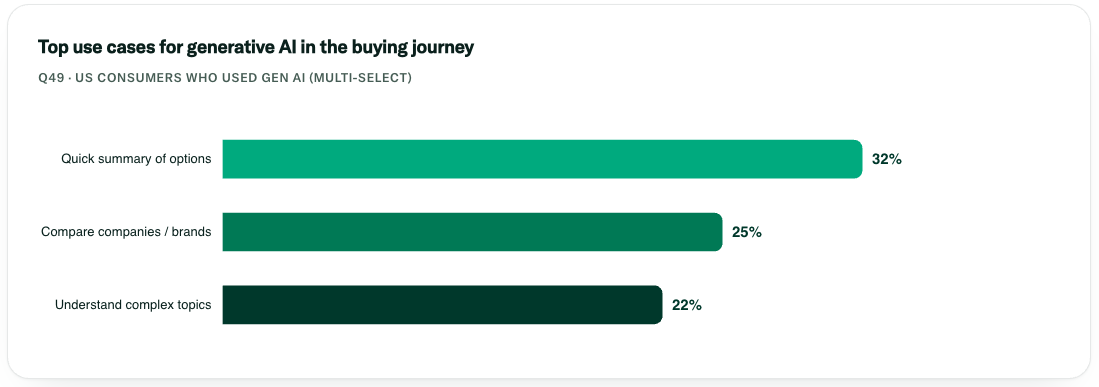
Notice anything about that list? Every single use case is upstream of the actual purchase decision. Boomers—and consumers more broadly—are using AI to educate themselves before engaging with brands. They're doing their homework with AI, then showing up to the conversation ready to ask better questions.
This is a fundamentally different behavior from using AI to make a purchase. It's the research equivalent of walking into a car dealership after reading every review and comparison article.
Boomers Still Want Humans at the Close
Even as Boomers are embracing AI as a research tool, they haven't softened their preference for human help when it’s time to make a decision. Our research found that 85% of US Boomers still prefer a human representative when both options are equally available. And 92% say human connection during a high-stakes purchase is important.
These aren't numbers from the AI-resistant crowd. They're from consumers who are actively using AI to research those same purchases. The same Boomer who asked ChatGPT to compare Medicare Advantage plans also wants to speak with a real person before enrolling.
The preference for human connection at the point of purchase isn't limited to any one generation, but it does intensify as consumers get older. The breakdown across generations looks like this:
That's a nearly 40-point spread from youngest to oldest. If your brand serves older buyers, you're looking at an audience where roughly 8 in 10 want a human involved when they're ready to commit.
What This Means for How You Deploy AI
If there's a single strategic takeaway from this year's data, it's this: the old framing of "AI for younger buyers, human touch for older buyers" is outdated. Boomers want AI too. They're using it to research, compare, and prepare for major purchases. But it’s a human handoff that ultimately secures the sale.
That means your AI investment should be doing the early work of qualifying leads, answering the informational questions buyers now arrive with thanks to their own AI research, and creating a fast, frictionless experience that makes it easy to continue the conversation. The 2026 data shows that 79% of US consumers will switch to a competitor that responds faster. For Boomers sitting at the top of the funnel doing their research, speed still matters.
But when those same buyers are ready to move forward and finalize their purchase, a human needs to be there. Not only that, but they need to be easy to reach, not buried behind multiple menus. For brands with older-skewing audiences, this is non-negotiable.
Balance AI and the Human Touch with Invoca
How can your brand achieve the right balance of AI and human assistance? It starts with having a tool like Invoca's AI Messaging Agent. When a buyer submits a web form or sends a text inquiry, the AI Messaging Agent responds immediately, answering qualifying questions, providing information, and keeping the conversation moving at the speed buyers now expect. It handles the research-stage work: the comparisons, the FAQs, and the "what's included in this plan" questions that busy contact center agents shouldn't have to field 200 times a day.
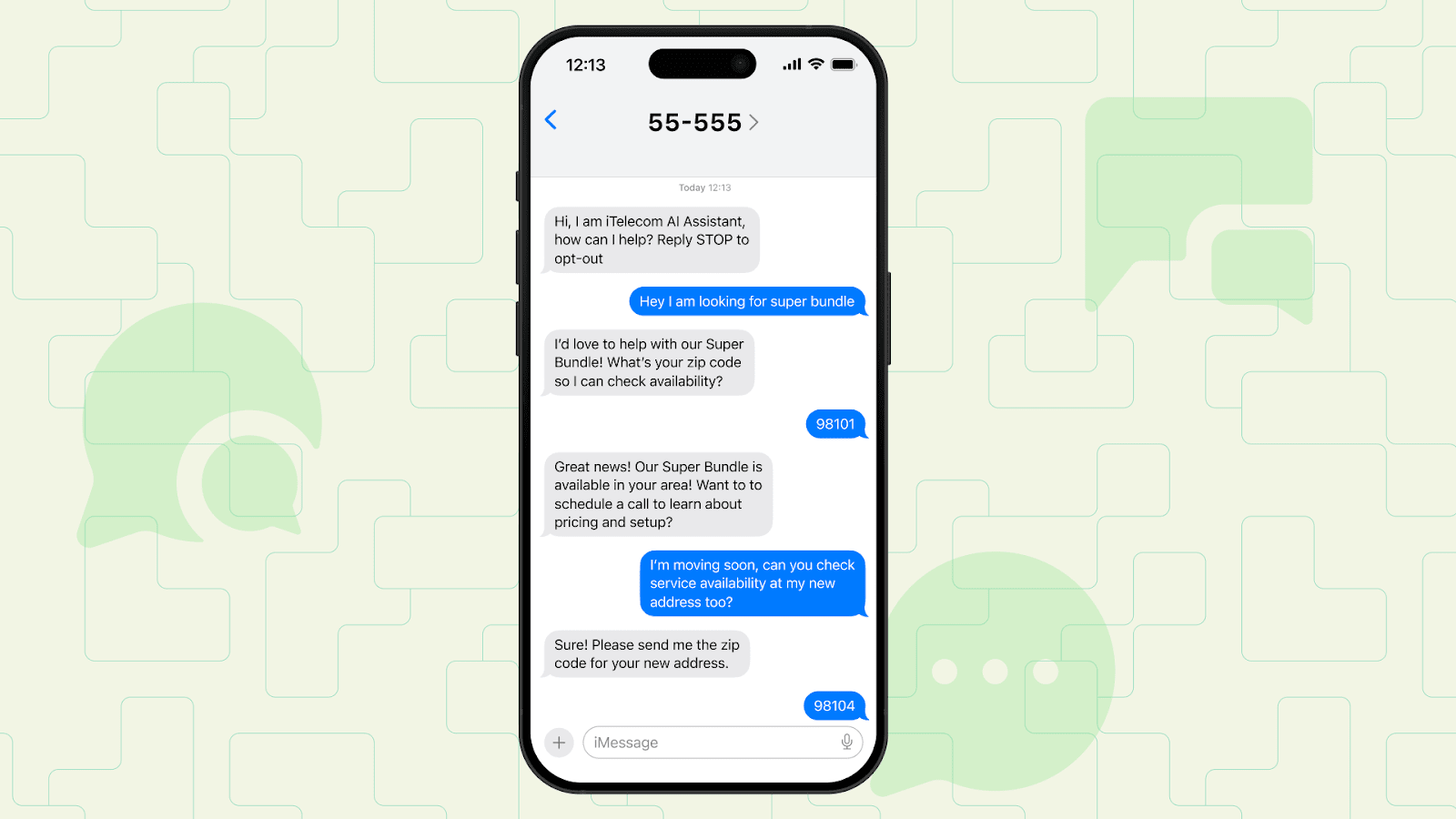
And when the buyer signals they're ready to commit, the AI agent hands them off cleanly. It schedules a callback, books an appointment, or routes to the right agent with context already in hand. These are the kinds of seamless experiences that keep buyers coming back again and again, regardless of their age cohort.
Additional Reading
Want to learn more? Download the Invoca 2026 B2C Buyer Experience Report here.
.svg)
.svg)