.svg)


It's 9:40 p.m. on a Tuesday, and a prospective patient who just finished researching knee pain online picks up her phone and texts the number from a practice's ad. Within seconds, she's in a conversation: a few questions about her symptoms and insurance, a callback window she prefers, and a confirmation that someone will follow up first thing tomorrow. There’s no human on the other end—an AI agent handled the entire exchange.
This kind of patient journey is becoming more common as leading healthcare providers scale AI across their organizations. The goal isn’t to replace human interaction, but to supplement it, providing instant answers and faster access to care.
This guide is for the operations leaders, patient access directors, and marketing teams evaluating AI voice and SMS agents. It covers what these agents can do, where the line between administrative help and clinical risk sits, how to evaluate a vendor demo without getting distracted by the razzle-dazzle, and how to continually improve your deployment after go-live.
What Are AI Voice and SMS Agents?
"AI agent" has become a loose label in healthcare technology. It gets applied to everything from a simple appointment-reminder bot to a fully conversational system that can hold a real exchange with a patient. For the purposes of this guide, here are two working definitions:
An AI voice agent is a conversational system that understands spoken natural language over the phone, draws on context about who's calling and why (the number they dialed, the ad they clicked, the form they started), asks qualifying questions, takes action like booking an appointment or a callback, and hands off to a human with full context when it needs to. It doesn't route callers through a phone-tree menu of pre-recorded prompts. It holds an actual conversation.
An AI SMS agent does the same job over text. It understands typed natural language, pulls in the same kind of context (what the patient texted in about, what they clicked or filled out beforehand), asks clarifying questions in a real back-and-forth, and can take action—scheduling, rescheduling, collecting information—or hand off to a human with the full thread when the conversation calls for it. It doesn't just push out a canned reminder or wait for a rigid keyword reply. It carries a conversation across multiple texts.
Why Medical Practices Are Under Pressure to Automate Calls and Texts Right Now
Practices are under growing pressure to bring in more new patients, even as they deal with staffing and resourcing issues and the operational costs that come with them. Margins are tight, and intake teams are often understaffed, left struggling just to keep up with scheduling calls. On top of that, they're fielding all the other clutter that pours into their queues: billing questions, pharmacy requests, directions to locations, you name it.
Here are a few factors leading practices to turn to AI agents:
Missed calls are a persistent, measurable leak
Invoca’s analysis of 70 million phone calls found that 54% of callers to healthcare practices don’t speak to a person. Solo providers and small practices may run higher due to thinner front-desk staffing. Whatever the precise number at a given practice, the pattern is the same: a meaningful share of every day's call volume never reaches a person, and that causes issues for patient acquisition.
Speed to lead has an outsized effect on conversion, and healthcare is slow
According to Invoca research, 53% of healthcare leads expect a response within 1 hour, but only 32% get one. Every minute a lead sits in an inbox waiting for a callback is an opportunity for a competitor to win that patient instead.
Burnout: Front desk and medical assistant roles are the hardest to staff and the first to turn over
MGMA Stat polling from 2025 found that nearly half of practice leaders name medical assistants as their hardest role to recruit—roughly three times the difficulty reported for nursing roles—and that front-office and MA positions consistently exhibit the highest turnover.
Put together, these three trends point to the same operational reality: practices aren't losing new patients because demand is soft. They're losing them because response speed and coverage can't keep pace, and staff turnover is often high.
What AI Voice and SMS Agents Automate: A Use Case Breakdown
The most useful way to think about these agents isn't as a flat list of features. Instead, visualize a set of checkpoints along the patient acquisition and access journey, from first contact through handoff to staff.
Instant Engagement for New Patient Inquiries (Speed to Lead)
This is why most healthcare practices start looking at this category of tools in the first place. Most agents can engage patients the moment they reach out via an inbound call, a missed call that triggers a callback text, a web form submission, or a click on a paid ad. But only the best agents can use context like which ad was clicked, which page was viewed, or which service was searched to shape the conversation from the very first message.
Instead of a form sitting in an inbox or a call going to voicemail, the conversation starts immediately and is personalized to the patient’s needs.
Qualifying and routing patients
Once engaged, the agent asks the qualifying questions a front-desk staffer would normally ask first: what insurance the patient has, what service or specialty they need, location preference, and whether they're a new or returning patient. It can also answer the administrative questions that make up a large share of call volume—hours, locations, services offered, general pricing—so that by the time a human gets involved, they're talking to someone who's already qualified and ready to move forward.
Scheduling, confirmations, and callback booking
Beyond qualifying, the agent can book directly: scheduling an appointment, confirming the details, or arranging a callback window when a live conversation is genuinely needed. This matters most during the gaps in coverage—after hours, over lunch, during a call surge—when interest would otherwise sit unanswered until someone is free. Capturing that interest at its highest point, rather than losing it to a voicemail or an unanswered lead form, is where most of the measurable ROI in this category comes from.
Handing off to staff with full context
Even well-designed AI agents often need to hand conversations off to a human. Patients often have complex or clinical questions that fall outside an AI agent’s capabilities. The quality of that handoff is one of the most underrated differentiators between platforms. A good handoff passes along the caller's intent, the qualification details already gathered, and the full conversation history, so the staff member picking it up doesn't have to ask the patient to repeat everything they just said.
What AI Voice and SMS Agents Should (and Shouldn't) Handle
AI agents belong in the administrative domain of scheduling, hours, insurance questions, reminders, and intake logistics. That's the territory these tools are built for, and where they hold up well. The moment a conversation touches symptoms, medical advice, or a health or safety emergency, it's crossed into clinical/crisis territory. That shift needs to trigger an immediate, hard-coded handoff to a human.
This has to be designed into the system as a firm rule, so the handoff happens the same way every time, regardless of how the rest of the conversation is configured.
In addition, adhering to legal guidelines is critical. Texting a patient carries its own set of obligations that voice doesn't. SMS falls under TCPA consent requirements, though treatment-related messages like appointment confirmations, wellness checkups, and similar messages get a narrower consent standard than marketing texts do. On top of that, 10DLC carrier registration has become a practical necessity: without it, messages risk getting blocked by carriers outright, regardless of whether the content itself is compliant.
Voice has its own wrinkle, as roughly a dozen states require all-party consent before a call can be recorded. Hence, a vendor needs to handle that disclosure by default rather than as something a practice has to remember to configure. None of this is legal advice, and the specifics shift often enough that it's worth confirming current requirements with counsel before finalizing any configuration.
How to Evaluate a Vendor: 7 Considerations for Demos
Most vendor demos are built to show off what the agent can do on a good call. The questions below are built to surface what happens on a bad one and to expose the parts of a platform that are easy to gloss over in a sales conversation.
1. Conversation quality and training data
Ask to hear (or read) unedited examples of the agent handling an ambiguous request, an interruption, or a caller who changes the subject mid-conversation—not just the clean, scripted demo flow. Also inquire about the agent's ability to identify and handle crisis, emergency, or potential self-harm. You’ll want to see if the voice agent can understand different dialects and accents as well.
In addition, ask how the agent is trained. For example, does the vendor train it on generic web data or real first-party data from your best patient conversations?
2. Context awareness
Ask what information the agent actually has access to at the start of a conversation—the ad clicked, the page viewed, the phone number's call history with the practice—and how much of that is used to shape the interaction.
Also, if a patient leaves and returns, does the agent have to start at the beginning? Or can it pick up where the conversation left off?
3. Compliance and consent handling
Ask directly how the platform handles TCPA consent capture, 10DLC registration, and call recording disclosure by state, and ask to see documentation rather than taking a verbal assurance. Ask who's responsible for compliance if something goes wrong, and get that answer in writing. Also, ask if the solution is HIPAA compliant, and if the vendor is willing to sign your BAA.
4. Escalation and the clinical/crisis boundary
Ask for the specific list of triggers that force a handoff to a human, and what an audit trail of escalations looks like. A vendor that can't answer this precisely hasn't built it precisely or at all.
5. Pricing transparency
Ask for the full pricing structure, including what happens during a call volume spike, what counts as a "conversation" for billing purposes, and what's included versus billed separately.
6. Integration and handoff quality
Ask how the agent hands a conversation to staff: does the person picking up the call or text see a summary of what's already happened, or are they starting cold? Ask how the platform integrates with the practice's existing phone system, scheduling software, or EHR, and what breaks if one of those systems changes.
7. Conversation quality monitoring
When evaluating AI voice and SMS agents, don’t stop at “How many conversations did the agent handle?” You need reporting that shows whether those conversations actually delivered business results. Vendors should provide clear visibility into containment and escalation rates, conversion rates, human handoffs, and conversation outcomes across both voice and SMS.
In addition, ask whether the agent supports marketing attribution. The best agents can trace each AI-booked appointment back to the specific webpage or marketing channel that drove it. This gives marketing teams a clear line of sight into which campaigns are actually converting, so they can allocate their budgets accordingly.
After Go-Live: How to Continually Optimize Your AI Agent
Launching an AI agent is just the beginning. The real value comes from measuring performance and continuously optimizing it.
Start by defining success metrics before go-live. Track containment rate, appointment booking or callback conversion rate, escalation accuracy, and patient satisfaction. Just as importantly, measure conversion attribution—which conversations, campaigns, and AI interactions actually lead to booked appointments and revenue. With solutions like Invoca, organizations can connect AI-driven voice and messaging interactions to downstream conversions, giving marketing and operations teams clear visibility into ROI.
Don't rely on aggregate metrics alone. Regularly review a sample of conversations to identify missed opportunities, incorrect responses, or booking errors that dashboards can miss. A weekly spot check combined with a more comprehensive monthly audit is often enough to catch issues early.
Finally, watch for signs of performance drift, such as rising escalation rates, declining booking conversions, longer conversations, or the AI handling requests outside its intended scope. These are signals that your AI agent needs refinement.
Why Leading Healthcare Organizations Use Invoca’s AI Agents
Invoca's AI agents are HIPAA-compliant with BAA support, so practices can deploy voice and SMS agents without treating compliance as a bolt-on afterthought. In addition, our agents redact sensitive information the moment it’s provided, so it's never stored.
The agents also start with a real advantage most competitors can't offer: they're trained on your highest-converting calls, so instead of a generic script, the agent learns how your staff actually qualify leads, answer questions, and guide callers to a booked appointment. This means it performs at the level of a top scheduler from day one rather than requiring months of tuning.
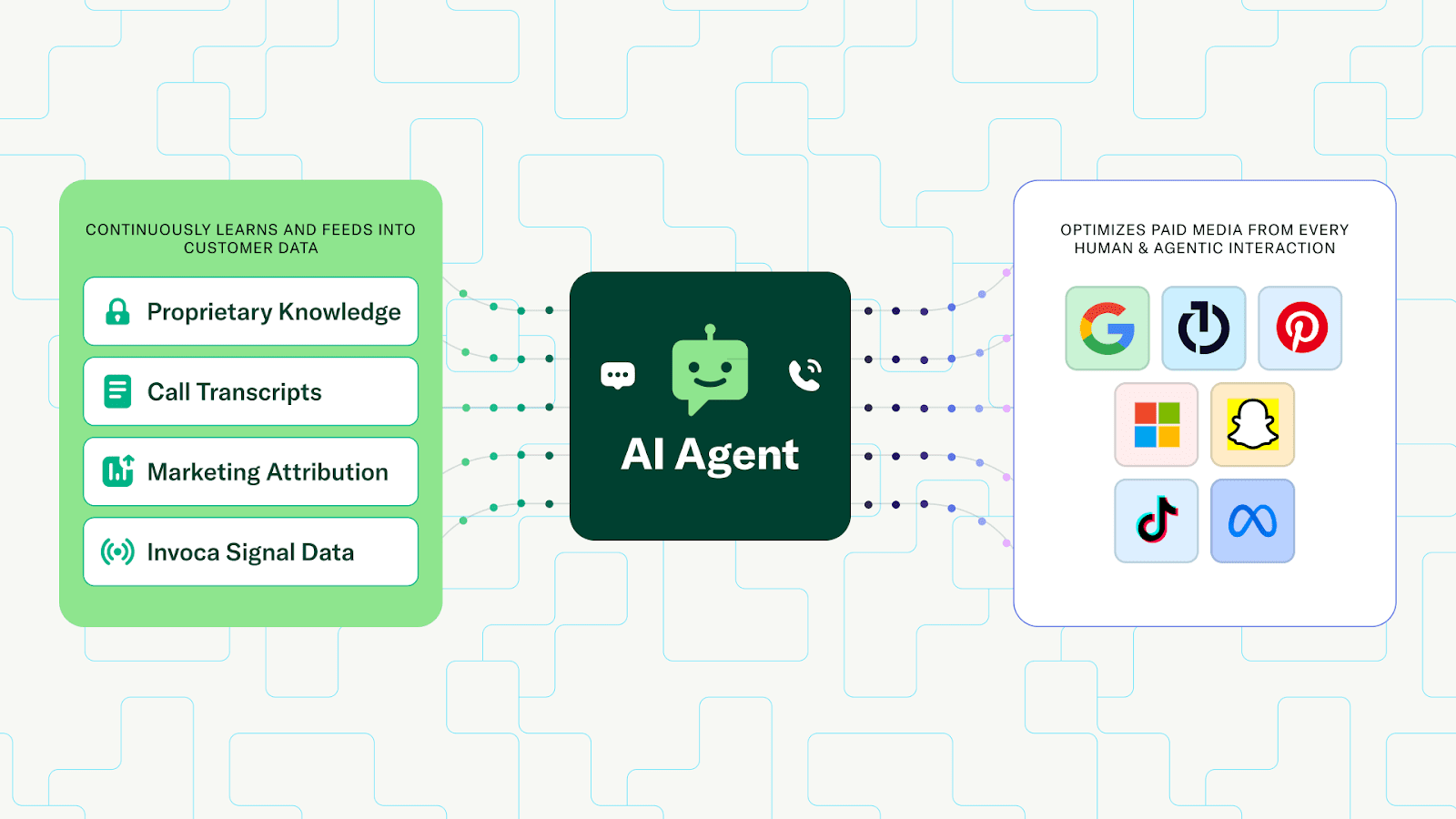
In addition, Invoca AI agents use digital journey data—like ad clicks, web activity, and content viewed—to tailor conversations from the very first interaction. By meeting patients with relevant context and personalized messaging, agents can create better experiences that drive more bookings.
Finally, because conversion tracking is native to the platform, every booking, callback, or escalation the agent handles ties back to the marketing campaign, ad, or keyword that drove it, giving practices the same closed-loop visibility into AI-handled conversations that they'd expect from any other part of their funnel.
Additional Reading
Want to learn more about Invoca’s AI agents for healthcare? Check out these resources:
.svg)
.svg)