

.svg)
The Consumer Services
Lead Conversion Benchmarks Report
How consumer services businesses drive demand, handle calls, and convert phone leads into revenue.
Compare your performance to consumer services peers using anonymized insights captured by Invoca's AI across funeral services, legal, storage, tutoring & child care, vet services, and waste treatment. Whether you're a CMO maximizing digital marketing ROI, an operations leader working to convert more callers, or a CX professional focused on the customer experience, these benchmarks give you a baseline to measure against.
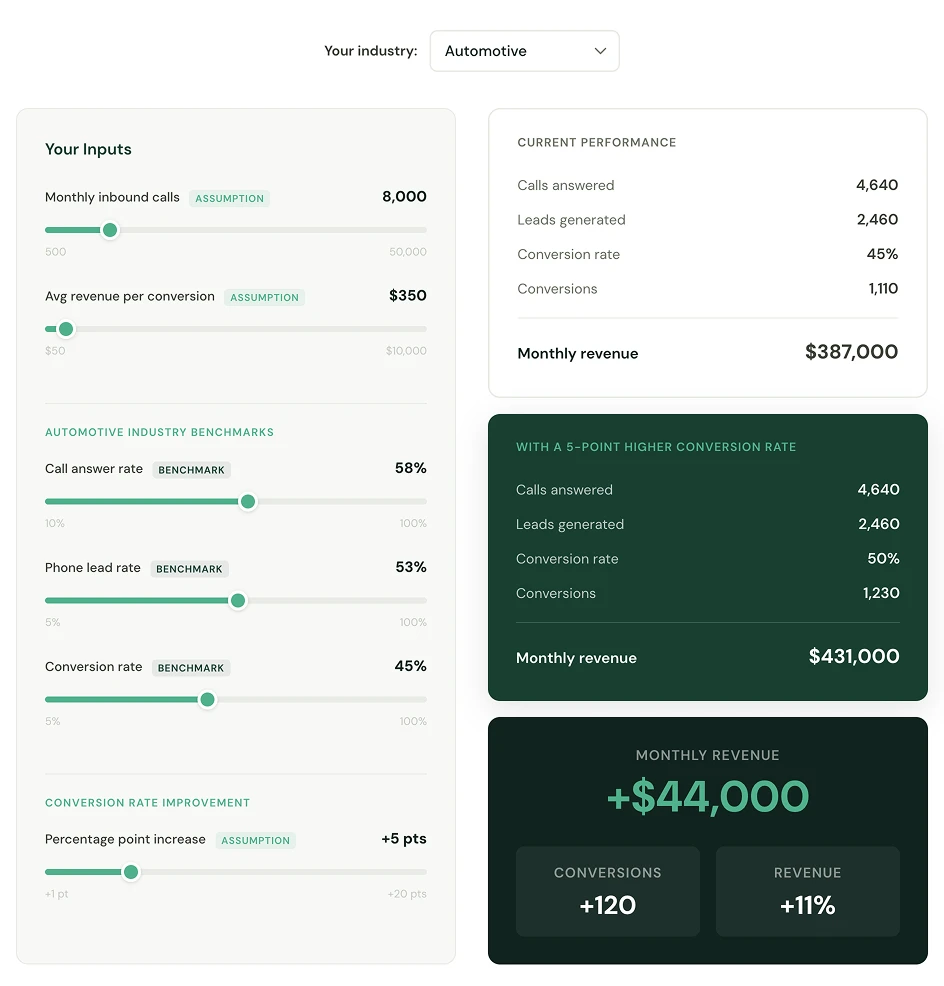
Be sure to try the interactive calculator ↓ at the end of this report to see how even small increases in your call conversion performance can move revenue.
Research Highlights
Here's a snapshot of the consumer services benchmarks. See anything that surprises you? Keep reading to see how the numbers break down across sub-industries and channels.
Call Answer Rates
A consumer who's been comparing providers finally calls to move forward and book a vet visit, reserve a storage unit, set up a tutoring consultation. The marketing did its job and got the phone to ring. If that call goes unanswered, the budget that drove it is wasted, and the caller reaches out to the next business on their list.
Across consumer services, 60% of calls are answered by a person. For calls lasting longer than 15 seconds — which filters out misdials and quick hangups — the answer rate is 70%. For calls over 30 seconds, it's 76%. Those thresholds provide a clearer picture of how well businesses connect with callers who are genuinely trying to reach them.
Answer rates vary across consumer services sub-industries, ranging from 42% to 73%. Review the benchmark for your segment below. If your answer rates fall significantly below it, that gap points to revenue slipping away through routing, process, or staffing issues with the teams fielding the calls.
Call answer rates by sub-industry
Tactics to Improve Call Answer Rates
If your answer rates trail the benchmark for your segment, these four moves help close the gap.
- 1Deploy AI agents to engage callers 24/7
Consumers reach out across time zones, after hours, and on weekends — often the moment they decide to act. AI-powered voice and SMS agents can engage callers around the clock, so a ready-to-book caller doesn't go elsewhere when the business is closed or the phones are busy. When a caller can't reach a person, an AI agent can answer common questions, capture intent, schedule a callback, or book an appointment by text. This is the single biggest lever for improving answer rates and speed-to-lead.
- 2Use missed-call data to inform staffing
Pinpoint the days and times when missed calls spike, then compare those windows against call volume to find where you're understaffed. Adjust schedules so people are available when callers need them.
- 3Pause ads when you're closed
If you can't help callers during off-hours, consider pausing the paid campaigns driving high call volume into those windows, unless an AI agent is handling them. There's little reason to pay for calls no one can answer.
- 4Fix site issues causing unnecessary calls
Some calls happen only because the website didn't answer a basic question like hours, pricing, service area, or what to bring. When callers repeatedly ask what the site should already tell them, fix the content or booking experience. Fewer low-value calls means your team can focus on the callers ready to book.
Phone Lead and Conversion Rates
Knowing which calls are real opportunities is how you connect marketing spend to revenue. Across consumer services, 34% of calls answered by a person are leads, and 40% of those leads convert on the call.
For marketing leaders, this is the foundation for calculating true campaign performance and return on ad spend. For operations and CX leaders, it sets the baseline for how effectively your team turns phone leads into booked business and where coaching pays off.
Phone lead and conversion rates by sub-industry
Phone lead and conversion rates by marketing channel
Looking at lead and conversion rates by channel shows where your spend is actually producing booked business, and whether a channel is better at driving top-of-funnel leads or bottom-of-funnel conversions.
A note on volume: percentages alone don't tell the full story
Paid search drives the highest volume of calls, leads, and conversions of any paid channel. For multi-location and local businesses, Google Business Profiles plays the same role on the organic side. Channel efficiency matters, but so does scale.
What the data shows about ChatGPT and generative AI search
This is the first year there was enough data to measure calls driven by generative AI search, and the consumer services lead rate stands out. ChatGPT-referred calls show one of the highest phone lead rates at 41%, on par with Google Business Profiles and about six points above the next channel, Paid Social (35%). That tracks: someone who uses an AI assistant to research a provider or service, then picks up the phone, is usually well into the decision-making process.
Conversion sits right around the consumer services average at 40%, while conversion across channels runs as high as 46% (Display). The qualified intent shows up more in the lead rate than in the close.
Here's the important context: the total volume of calls attributable to generative AI is still very low, with no measurable volume from LLMs other than ChatGPT. This is a signal worth watching closely, not a channel to redirect significant budget toward yet. For now, the bulk of your phone leads and conversions still come from proven, high-volume channels like paid search and Google Business Profiles.
Phone lead performance by sub-industry and channel
Percentage of answered calls that are leads.
Phone conversion performance by sub-industry and channel
Percentage of leads that convert on the call.
Tactics to Improve Phone Lead and Conversion Rates
If your lead rates trail the benchmark, your paid media may not be driving the right calls. If conversion rates trail, your team may not be saying the right things to move callers toward a booking. Here are four ways to close those gaps.
- 1Shift ad budget to what's really working
Use phone lead and conversion data to see which channels, campaigns, and keywords actually produce booked business — not just calls. Reallocate budget from the underperformers to the investments driving revenue.
- 2Pass call data to ad platforms for better auto-bidding
Feed phone lead and conversion outcomes back into your ad platforms so automated bidding and audience targeting optimize against real business results instead of raw call counts.
- 3Use call data to improve targeting
Retarget leads who didn't convert on the call, and suppress callers who already booked or called for reasons unrelated to a sale. Build lookalike audiences from your highest-value callers. And mine what callers actually say — the questions, needs, and hesitations they raise — to sharpen ad copy and landing pages.
- 4Use AI agents to convert more leads
AI-powered voice and SMS agents can convert leads after hours, during peak times, and with callers who'd rather text than wait on hold. They qualify intent, book and confirm appointments, schedule callbacks, and speed high-intent callers to the right person.
Google Ads Paid Search Performance
Google Ads remains the most important digital advertising channel for driving phone-based conversions in consumer services. Even small improvements to your phone lead and conversion rates from search ads can move business results more than any other paid channel.
Google Ads paid search performance by sub-industry
Tactics to Improve Phone Lead Rates and ROAS from Google Ads
If your Google Ads paid search results lag others in your segment, consider these strategies to improve efficiency and increase ROAS.
- 1Shift spend to the keywords driving the most valuable calls
Identify the keywords generating qualified phone leads and booked business, then move budget off underperforming terms and onto the ones producing revenue.
- 2Feed call data into Smart Bidding and Performance Max
Pass call outcomes into Google's automated bidding so it optimizes for calls that actually become booked business.
- 3Retarget phone leads that didn't convert
Build audience segments from callers who were leads but didn't book. These in-market callers are often your most valuable prospects.
- 4Suppress non-lead and converted calls
Stop paying to show ads to people who have already booked or called for reasons unrelated to a sale. This alone can cut a meaningful chunk of wasted spend.
- 5Add your most valuable calls to lookalike campaigns
Build lookalike audiences from your highest-value callers to find more prospects with similar behavior and intent.
Call Handling Performance
Answering the call is step one. Whether a lead becomes booked business comes down to how your staff engages the caller, understands what they need, and guides them toward a decision.
Our analysis evaluated how often consumer services businesses correctly handle phone leads across six key call handling metrics.
Tactics to Improve Call Handling Performance
If your metrics trail the benchmark or you don't have this level of insight into how calls are handled, here's where to start.
- 1Use AI to score call handling performance
AI-powered call scoring gives you objective analytics on 100% of calls, so you can measure performance against the metrics that matter and catch patterns you'd otherwise miss across a busy phone line.
- 2Qualify and route leads with an AI voice agent
An AI voice agent can qualify callers and route them before a person picks up, so callers ready to book reach the right person fast, and your team spends less time on calls that aren't real opportunities.
- 3Pass caller context to staff before they say hello
Arm your team with the caller's digital journey data, like the ad they clicked, the pages they viewed, and what they searched for. When staff know why someone's calling, the conversation is sharper, and booking rates climb.
- 4Refine talk tracks based on what works
Use call scoring data to connect specific behaviors to outcomes. Find what your top performers do differently, update your talk tracks, and coach to it with real call examples.
Turning These Insights Into Action
This benchmark data shows how consumer services businesses are performing at answering calls, converting leads, and handling conversations. It's a useful starting point for figuring out where you stand and where to focus.
But benchmarking only works if you have the data to compare against, and that's where most businesses hit a wall. Without visibility into which calls are leads, which channels drive them, how well your team converts them, and what's actually happening in the conversations, you're optimizing in the dark.
The businesses that connect their digital, conversation, and transaction data have a real advantage. They can see the full journey from ad click to phone call to booked business, and use that picture to make better decisions across marketing, operations, and the front line.
The good news: small improvements compound fast. If your results align with the benchmarks here, lifting your answer rate, lead rate, and conversion rate by just five percentage points each would drive roughly 40% more conversions from the same call volume.
Want to see what that looks like for your business? Try the calculator below.
What Would Converting More Calls Mean for Your Revenue?
You're already driving the demand. Use this calculator to see how much additional revenue you could capture by converting more of the leads you're getting today.
Model your own improvement
Plug in your current call volume, answer rate, lead rate, and conversion rate to see the revenue impact of closing the gap to your segment's benchmark.
How this report was built
This report focuses on the consumer services industry, drawing on anonymized data from phone calls tracked and analyzed by the Invoca platform across funeral services, legal, storage, tutoring & child care, vet services, and waste treatment, within a broader dataset of over 70 million calls and 600 million minutes of conversation spanning 10 industries and 7 marketing channels. All figures are averages across the Invoca customer base.