.svg)


Healthcare marketers are feeling the squeeze from tightening budgets, leadership pressure to prove marketing ROI, and tightening regulations on how you can use your data.
To help you navigate this landscape, we partnered with our friends at Freshpaint to create a new original research report. We surveyed 200 healthcare marketing leaders across hospitals, health systems, DSOs, and payers to learn how they’re adapting to these challenges. The State of Healthcare Marketing 2026 provides a comprehensive look at how teams measure performance, where they’re falling short, and what sets the leaders apart.
What we found is clear: the gap between perceived performance and actual performance is wider than most teams realize.
Below are our biggest takeaways from the report, and what they mean for your strategy.
Takeaway 1: Most Healthcare Marketers Face a Measurement Gap
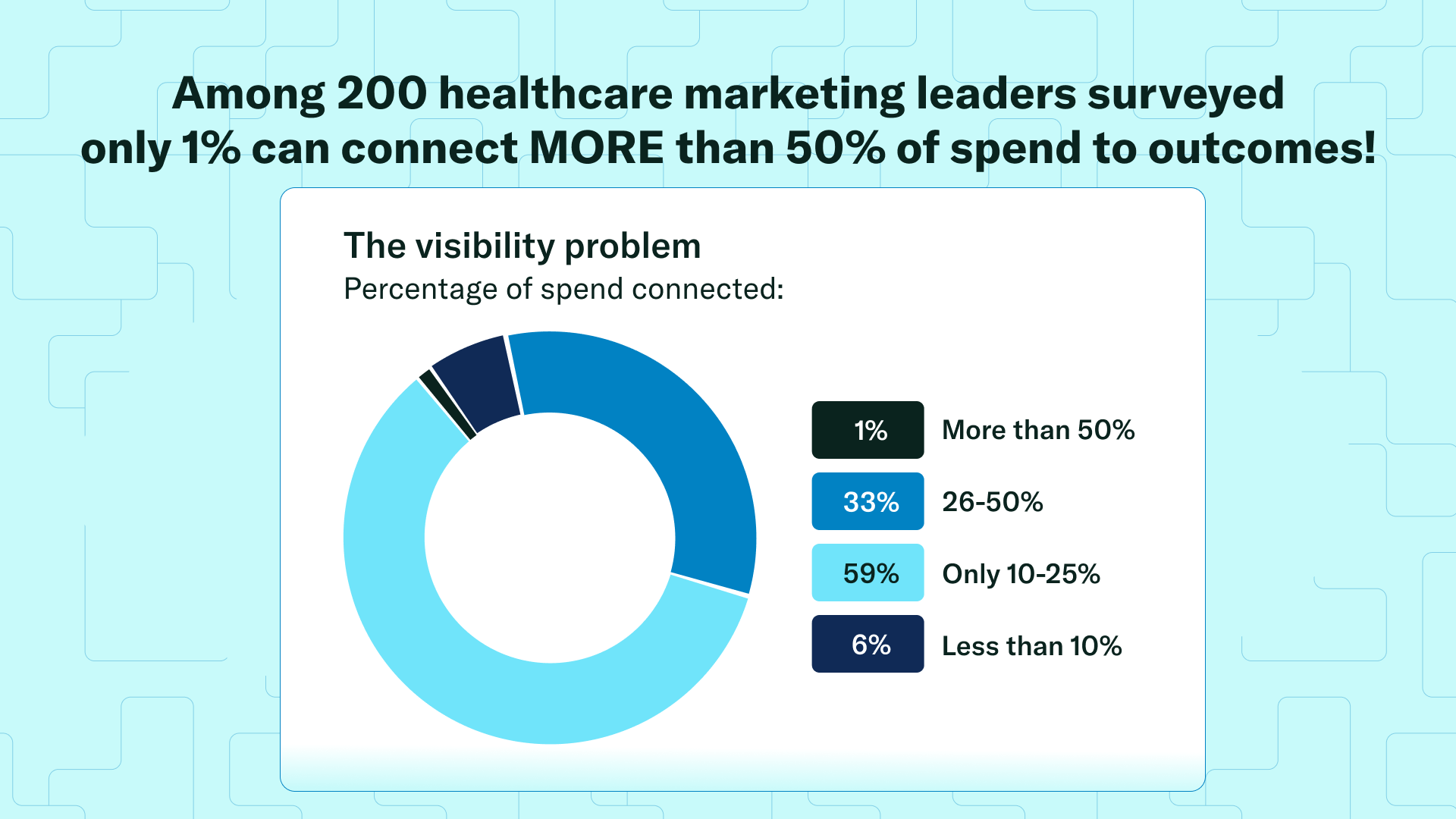
Healthcare marketers are investing in the right channels, tracking the right metrics, and making reasonable decisions with the information they have. The problem is what they can't see. Marketers are facing a measurement gap: just 1% can connect more than half of their spend to patient outcomes. And this is impacting their optimization decisions, as 51% of marketers are unable to consistently improve ROI at the appointment level.
The gap is mainly due to the toolkits these teams use. Most measurement systems were never designed to handle healthcare's unique challenges: phone calls and appointments that occur offline, patient journeys spanning weeks and dozens of digital touchpoints, and privacy regulations that constrain what you can track in the first place. As a result, healthcare marketers find themselves optimizing based on incomplete attribution models like last-click or first-touch, rather than unifying the entire patient journey.
Takeaway 2: Google Gets Too Much Credit (and It’s Costing You)
Search advertising dominates healthcare marketing budgets, with 64% percent of healthcare organizations ranking Google Ads as their top-performing channel. Our research found that teams may be allocating too much spend to this channel.
The problem isn't Google, but how marketers are measuring it. Most healthcare organizations still rely on last-touch attribution, which gives Google full credit for every conversion it closes, regardless of what brought the patient there in the first place. That creates a self-reinforcing cycle that's hard to break. Google appears to outperform every other channel, budgets shift toward search, investment in awareness channels shrinks, and Google ends up capturing even more conversions at the bottom of the funnel. Rinse and repeat.
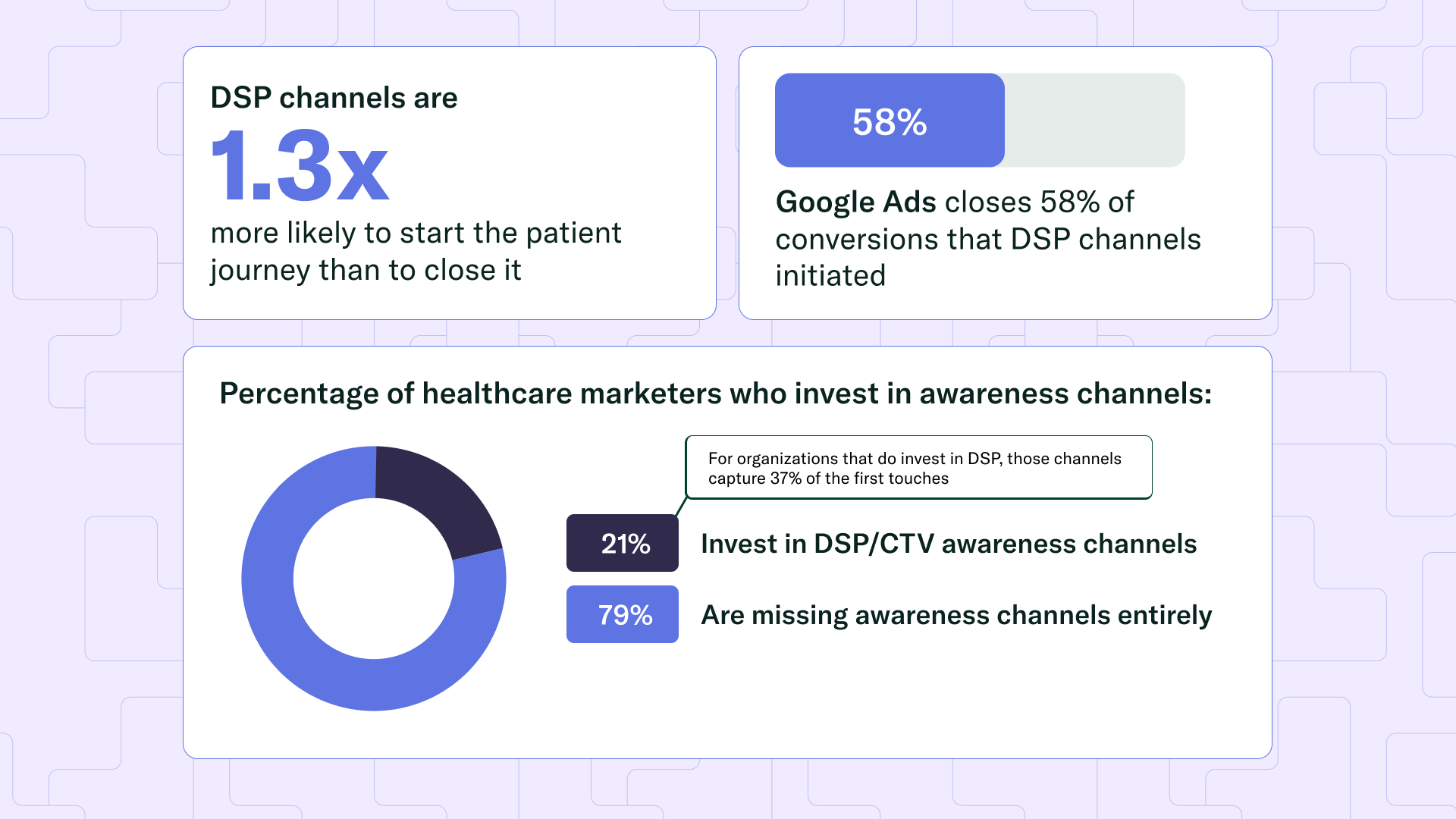
What gets lost in that cycle are the channels doing the earlier work to build brand awareness. Top-of-funnel channels like CTV and programmatic advertising drive 37% of first touches in the patient journey, introducing your brand to patients long before a Google search occurs. But because last-touch attribution can't see that contribution, those channels are chronically underfunded and undercredited. The budget follows the data, and the data is incomplete.
Takeaway 3: Healthcare Marketers Are Data-Driven, but the Data Is Incomplete
A whopping 91% of healthcare marketers say they're capable of making data-driven decisions, which is a remarkably high level of confidence for any industry. But dig a little deeper, and a more complicated picture emerges.
Only 62% of healthcare marketing teams have web analytics fully integrated into their measurement stack, and just 9% have call data integrated. That second number is the one that should give every healthcare marketer pause. Because while digital channels get carefully tracked and analyzed, phone conversations remain largely invisible to most teams.
Phone calls are one of the most critical touchpoints in the entire patient journey. Industry data consistently shows that roughly 80% of healthcare appointments are still booked over the phone. When your team cannot properly track this channel, you have no way to understand patient intent before a call, assess the quality of the leads your campaigns are generating, or confirm whether a phone interaction actually resulted in a booked appointment. This data gap can result in poor optimization decisions and misallocated budget.
Takeaway 4: High-Performing Teams Treat Privacy as a Foundation, Not a Barrier
Eighty-two percent of healthcare marketers say compliance is their single biggest barrier to effective measurement, and it’s not hard to understand why. Third-party cookie deprecation, HIPAA guidelines, state privacy laws like CCPA, and tightening platform policies have created a compliance environment where nearly every measurement tool carries some level of risk.
Organizations that are winning on measurement have made one critical shift: they've stopped treating privacy as a roadblock and started treating it as the foundation for how they operate. Rather than letting legal and compliance teams serve as gatekeepers who slow things down, they've brought them into the process as collaborators, working alongside marketing to build infrastructure that makes more data accessible.
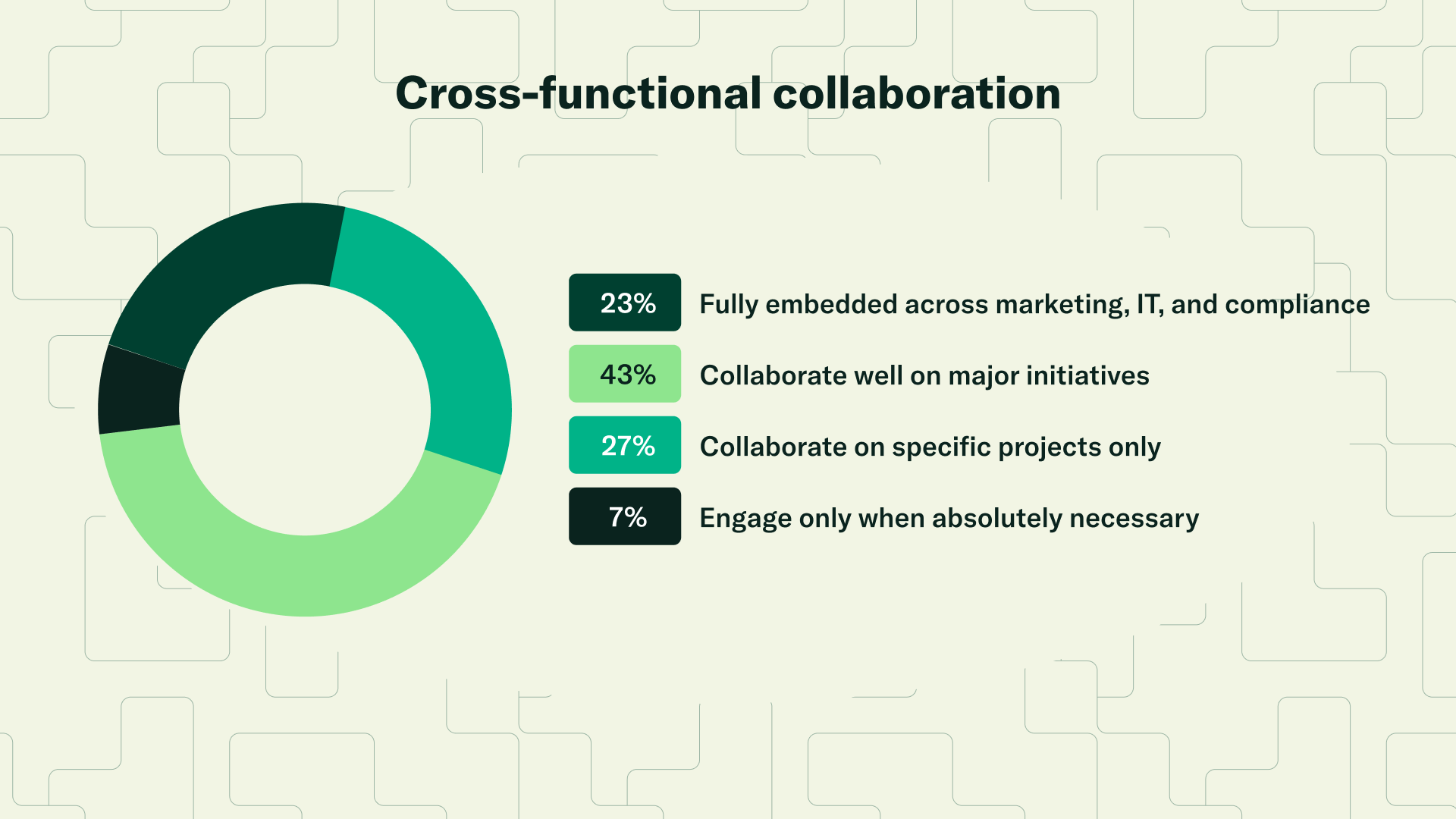
The contrast with the status quo is stark. Only 23% of healthcare marketing teams report strong collaboration among marketing, IT, and compliance, meaning the vast majority are still operating in silos, with privacy constraints limiting what data is collected and how it is used.
What This Means for Healthcare Marketers
What strikes me most about this report is how clearly it illustrates that the patient journey no longer fits neatly into a funnel. A patient might discover a provider through a CTV ad, research them via a generative AI tool, and make their decision during a phone call or a conversation with an AI agent at 10 pm on a Tuesday.
If your measurement stops at the click, you're missing the moment that matters most: the conversation where intent becomes an appointment. That's why Invoca partnered with Freshpaint on this report. Freshpaint brings the privacy-first data foundation. Invoca sits at the point where a prospective patient picks up the phone, engages with an agent, and takes the next step toward care. Together, you can finally connect what drove the demand to what happened as a result.
The full report goes much deeper, delving into maturity benchmarks, channel-mix analysis, and a practical framework for 2026 planning. If you're a healthcare marketer trying to move from "we think it's working" to "we can prove it," this is a good place to start.
Download The State of Healthcare Marketing 2026 to see more data.
Want to learn how Invoca and Freshpaint can help improve your healthcare marketing measurement? Request your demo today.
.svg)
.svg)