.svg)


Every consumer who calls your contact centre already has an opinion about how that interaction is going to go, and it's usually not optimistic. They expect long hold times, they dread repeating themselves, and they've learned to brace for the robotic “I'm sorry, I didn't understand that” of a chatbot that ran out of script.
Generative AI is changing those expectations, and fast. By bringing large language models into the contact centre, brands can deliver multi-turn, context-aware conversations that actually resolve issues. They also improve agent productivity, so they your team can spend more time on high-value inquiries.
What Is Generative AI in a Contact Centre?
Generative AI applies large language models (LLMs) to data already flowing through your operation. When you integrate it into your contact centre, you can reap many efficiency benefits—for example, you can generate summaries of each call, automatically update CRM profiles, and assist consumers via SMS agents trained on your best conversations.
A simple rules-based chatbot fails the moment a caller goes off-script. Generative AI, on the other hand, draws on trusted knowledge sources to build relevant, context-aware answers. For any AI contact centre deployment, the operational shift is the same. Your team spends less time maintaining rigid scripts and more time governing data quality.
Generative AI vs. Traditional Contact Centre Automation
Most contact centres already use automation tools like IVR trees, scripted chatbots, and keyword-based QA sampling. Generative AI doesn't replace all of those tools. Instead, it changes what's possible across interaction handling, quality coverage, and data infrastructure.
Use the comparison below when evaluating generative AI contact centre software.
According to Gartner, 91% of customer service leaders are under pressure to implement AI in 2026. More than 80% of organisations also plan to expand human agent responsibilities as AI takes on more routine tasks. The operational focus is shifting from writing scripts to managing AI outputs and keeping knowledge current. Many teams underestimate that transition. If your knowledge foundation isn't sound, GenAI amplifies the problem instead of solving it.
Generative AI Call Centre Use Cases
These applications represent the highest-impact opportunities for generative AI inside contact centres today. Each one maps to specific workflows, measurable KPIs, and risk controls you'll need before going live.
AI Messaging Agents for Self-Service
AI messaging agents sit at the front line of self-service. They handle:
- Appointment scheduling
- Order status checks
- Account lookups
Generative AI-powered agents carry multi-turn conversations. They pull answers from approved knowledge sources, such as previous phone conversations, without rigid scripts. They’re also empowered by data from the customer’s digital journey, so they can meet them where they are and understand context.
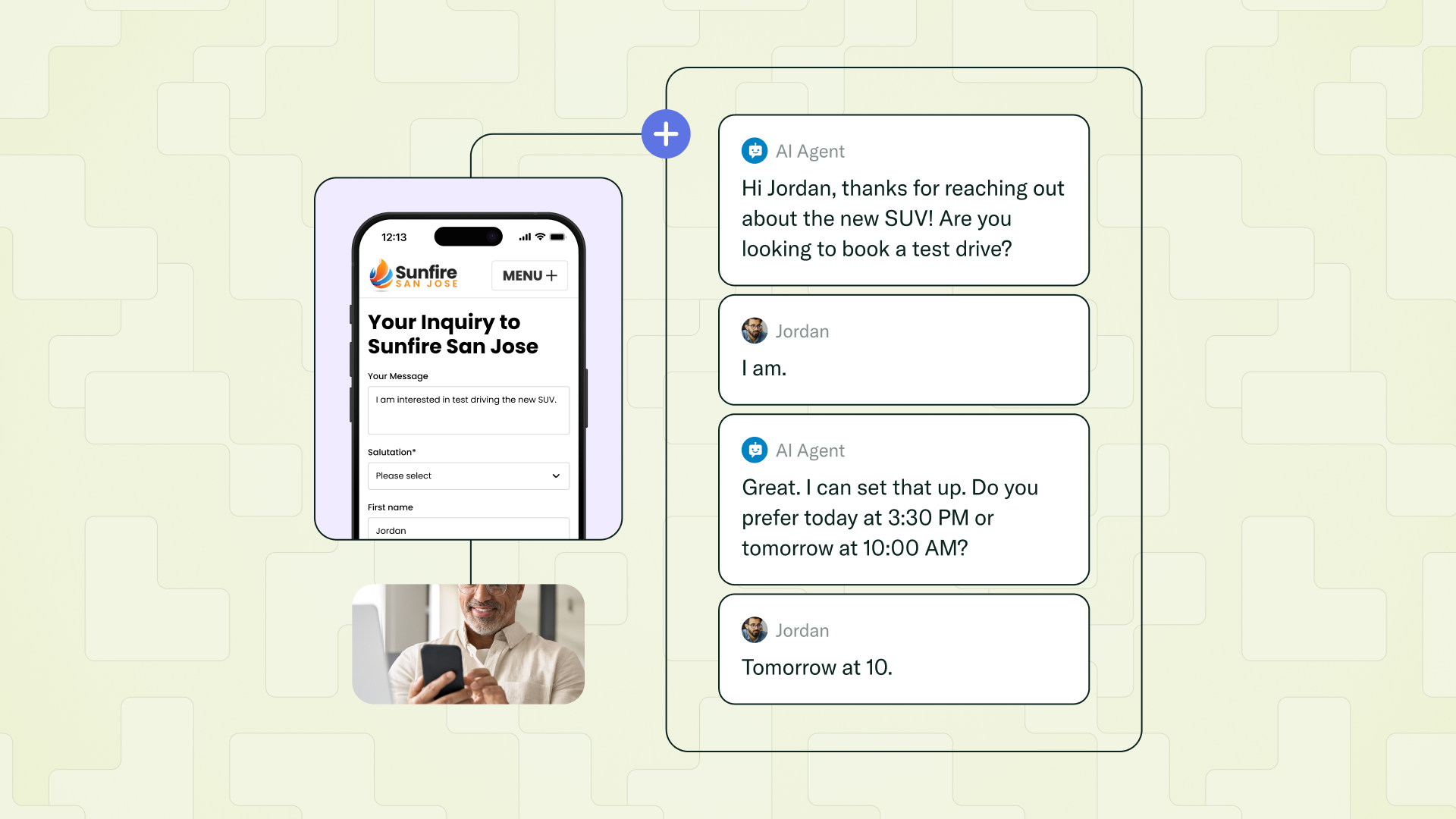
When the agents can't resolve a request, they can escalate to a live agent with full conversation context.
Key KPIs include:
- Containment rate
- Call deflection
- CSAT
- Cost-to-serve
Real-Time Agent Assist
During live calls, agents need the right knowledge at the right moment:
- Product specs
- Policy language
- Objection-handling guidance
- Compliance disclosures
Real-time agent assist uses generative AI to monitor the conversation and surface contextual tips as the call unfolds. The agent stays in control of what to use and when.
This use case moves AHT, first-call resolution, conversion rate, and compliance adherence. Every recommendation must pull from verified sources, and human review loops catch model drift over time.
Tip: Agent assist carries the lowest risk profile of any generative AI application in the contact centre. That makes it the strongest candidate for a Phase 1 pilot.
Automated Summarisation and CRM Updates
After-call work eats agent time on every interaction. Generative AI captures conversation details as the call happens and produces structured summaries. CRM disposition fields auto-populate. The agent reviews, edits where needed, and submits.
This directly reduces ACW time and total AHT while improving CRM data accuracy. Until you've confirmed summary quality at scale, keep human review in the loop.
Tip: Make sure your CRM integration supports structured field mapping, not just free-text note dumps.
Knowledge Base Optimisation
Generative AI surfaces knowledge gaps by analysing conversation patterns. It drafts new content and flags stale material for review. This tackles the governance bottleneck that slows every other GenAI use case.
The result? Better first-call resolution, faster agent ramp time, and improved IVA containment accuracy. All generated content requires human approval and a formal review cadence before publishing.
Tip: Knowledge quality affects the accuracy of every other GenAI output. Treat it as ongoing infrastructure, not a one-time setup task.
How Generative AI Improves Contact Centre Performance
Generative AI gives contact centre leaders broader visibility into conversations, agent performance, and compliance risk without relying on manual reviews alone. It:
- Surfaces coaching opportunities faster with automated scoring and summaries
- Reduces after-call work with AI-generated summaries and structured CRM updates
- Recoups lost opportunities with AI SMS messaging agents that can book appointments and make sales
- Gives managers faster feedback loops across the full conversation dataset
As adoption grows, governance becomes just as important as automation, because:
- Payment-focused contact centres need to meet PCI DSS requirements.
- Healthcare organisations need HIPAA-compliant platforms.
- Teams need redaction, escalation paths, and human review policies in place.
Industry leaders choose Invoca’s conversation analytics solution, since it is backed by industry-leading compliance.
Generative AI Call Centre Readiness Checklist
Before deploying generative AI in your contact centre, assess readiness across three areas:
- Data
- Integrations
- Governance
Data
- Call recordings and transcripts covering representative interactions across channels, intents, seasons, and products
- Chat logs and disposition codes
- QA scorecards and evaluation forms
- Knowledge base content
- Clear definitions for what counts as a conversion, appointment, policy, or booking
- Enough labeled interactions to train or confirm models
Integrations
- Telephony or contact centre platform with API access
- CRM with bidirectional sync for dispositions and outcomes
- Ad and analytics platforms for closed-loop attribution
- Knowledge base system
- SSO for governance and access control
- APIs and webhooks to move conversation analytics data across the stack. Platforms like Invoca integrations show the depth required.
Governance
- Brand voice guardrails defining tone, approved language, and escalation triggers
- Compliance redaction for PCI, HIPAA, and PII
- Human-in-the-loop review policies for all GenAI outputs during initial deployment
- Escalation policies for when AI should hand off to a human
- Alignment to NIST AI 600-1 for a formal risk management structure
Scale Generative AI in Your Contact Centre with Invoca
The contact centres that will win the next five years aren't the ones that simply added a chatbot and called it a day. They're the ones that built a foundation: clean data, smart integrations, and AI that actually understands why customers call and what it takes to convert them. That's exactly what Invoca delivers. With AI messaging agents trained on your best conversations and automatic call summaries that eliminate after-call work, Invoca gives your team the tools to handle more volume, convert more leads, and stop losing revenue to operational friction.
But what sets Invoca apart isn't just the features, it's the data underneath them. Every AI messaging agent interaction, every call summary, every CRM profile update is powered by first-party data that spans the complete buyer journey, from the ad that drove the call to the revenue outcome on the other end. That means your contact centre isn't operating in a vacuum anymore. It's connected to marketing and continuously improving based on real outcomes. This turns your contact centre into a bona fide revenue engine.
See how Invoca connects contact centre AI to revenue outcomes and agent performance across the full customer journey. Book a demo.

FAQs about Generative AI Contact Centres
How do I know if my contact centre is ready for generative AI?
Perfect data isn't required, but you need enough volume and structure to train and confirm models. Minimum requirements include:
- Transcripts covering channels, intents, and seasons
- Labeled outcomes like conversions, appointments, or service issues
- Existing QA scorecards
- A telephony platform with API access
- CRM with bidirectional sync
- Workflow automation hooks through APIs and webhooks
Can generative AI improve marketing ROAS, or is it only a contact centre efficiency tool?
Without generative AI, marketing-generated calls go unanswered, there is no mechanism for efficient followups. Hot leads will often go to competitors as a result.
However, generative AI can fill this gap by following up automatically via SMS. AI-powered agents can instantly engage missed calls to recoup lost opportunities and book appointments.
.svg)
.svg)