.svg)


There’s no denying AI is transforming the marketing world. Teams that continue to ignore this technology look as primitive as cavemen rubbing sticks together or modern-day humans still printing out MapQuest directions.
From generative copy to automated bidding and predictive analytics, brands are pouring billions into AI-powered tools. Yet, for many organisations, the promised "efficiency revolution" hasn't arrived. Instead of seeing a hockey-stick growth in ROI, many marketers are seeing inconsistent results and can’t prove their impact on revenue.
If you’re experiencing these issues, your AI tool of choice probably isn’t the culprit. The issue likely lies with the data you’re using to power it. Think of AI as an engine and data as the fuel. Giving your AI tools subpar data is like filling a Maserati with cheap unleaded gasoline. Not only will the engine run poorly, but it may eventually break down, leaving you stranded on the side of the road while your competitors whiz past you.
The AI winners won’t be the teams with the most expensive AI tools—they’ll be the ones feeding them the best data. In this post, we’ll cover why fragmented data fails and how top performers connect the full customer journey to power better results.
The Promise vs. The Reality of AI for Marketers
In a perfect world, AI-powered marketing optimises your spend automatically, personalises experiences at scale, and predicts buyer behavior before the customer even knows what they want.
However, in reality, most AI systems are flying blind. Because they lack visibility into the full customer journey, they optimise toward proxy metrics—clicks, opens, and form fills—rather than actual revenue. Your programs might look effective according to your dashboard, but if those clicks don't turn into customers, your AI is simply helping you burn marketing dollars faster.
True AI optimisation requires visibility into lead quality and revenue outcomes. This means tracking customers through the entire funnel and closing the loop between marketing engagement and real business results. That can’t be achieved if your data is fragmented across disconnected systems and your journey isn’t connected.
When digital behavior, conversations, and conversions live in separate silos, AI is forced to make decisions with an incomplete picture of demand. High-intent signals—like a phone call where a prospect asks detailed pricing questions or requests an appointment—never make it back into your optimisation engines. Instead, algorithms keep chasing the easiest signals to find, not the signals that actually drive growth.
Are You Feeding Your AI Fragmented Data?
You may think you’re feeding your AI tools the right data—after all, you’re pulling from a wide variety of sources. However, if you’re like most teams, you still lack visibility into how customers actually progress through the funnel.
And even teams that have access to full-funnel data still can’t act on it in a timely manner—our recent study found that only 21% of organisations feed offline conversions back to their ad platforms in near real time. When we asked marketers how quickly they can turn a new insight from unstructured data into a live campaign change, only 2% said they can act the same day.
This is because critical customer insights are scattered across disconnected systems:
- Digital journey data lives in ad platforms and Google Analytics
- Conversation data lives in contact centres and recorded calls
- Conversion outcome data lives in CRMs and ERPs
Individually, each dataset looks useful. But when these systems don’t talk to each other, high-intent moments—like a phone call where a customer expresses interest in a specific product line—become invisible to your marketing AI. You’re forced to instead optimise toward shallow proxy metrics like clicks, form fills, and session volume because those are the only signals your platforms can reliably see.
The consequences compound quickly. Media platforms bid aggressively for traffic that looks promising on the surface but never converts. Personalisation engines serve generic experiences because they lack context about what customers actually said or needed. And marketing leaders are left defending performance metrics that don’t fully tie to revenue.
Until the full customer journey is unified, your AI isn’t truly intelligent. It’s simply making fast decisions based on incomplete information.
How Fragmented Data Breaks Your AI Performance
1. AI optimises for the wrong goals
Without revenue and outcome data, AI naturally gravitates toward the signals it can see most easily: engagement. If your AI detects that a certain ad’s “call now” button is generating thousands of clicks, it will confidently shift more budget in that direction. On the surface, performance appears to improve.
But engagement isn’t the same as value. What if those callers are dialing in to complain about a broken link? What if they’re existing customers contesting a recent bill? Without visibility into what actually happens during the conversation and whether it leads to revenue, your AI has no way to tell the difference.
As a result, budgets flow toward campaigns that generate the most activity, not the most qualified pipeline, wasting ad spend.
2. Personalisation falls flat
The right personalisation makes customers feel recognised, understood, and valued. When it works, it creates confidence that your brand is paying attention and ready to help.
But if your AI doesn’t know why a buyer reached out, what they viewed online, or what they discussed with an agent over the phone, the next “personalised” message will miss the mark. Instead of feeling helpful, it can feel disconnected or tone-deaf. A prospect who just called about pricing doesn’t want a generic awareness email. A customer who already made a purchase doesn’t want to be retargeted as if they’re still shopping.
Over time, these mismatches erode trust. Customers start to feel like your systems aren’t listening, your teams aren’t aligned, and your brand doesn’t really know them at all. Consumers expect top-notch, white-glove experiences, and failing to meet the mark will cost you.
3. High-intent conversations are ignored
Phone calls are among the strongest buying signals a customer can give. People don’t pick up the phone casually—they call when they have urgency, questions, objections, or real purchase intent. Yet in many organisations, this high-value data never makes it into the systems guiding marketing decisions.
Most marketing AI is trained primarily on digital data: clicks, impressions, page views, and form fills. While useful, these signals only tell part of the story. This creates a major intelligence gap. Campaigns may look successful based on surface engagement, while the conversations that reveal true qualification, objections, and conversion drivers go unused. Marketing teams end up optimising for activity instead of intent.
The Business Cost of Fragmented Data
The cost of fueling your AI with fragmented data is far higher than many realise. You may be surprised by just how deeply it can damage your brand. Business consequences can include:
- Wasted ad spend: Bidding on keywords that drive calls but not conversions.
- Lower conversion rates: High-intent prospects slip through the cracks during handoffs.
- Inflated acquisition costs: Budget shifts toward easy clicks rather than qualified pipeline.
- Slower speed to insight: Teams take days (or weeks) to act on signals that should trigger instant optimisation.
- Poor CX: Customers need to repeat their needs every time they switch from a digital channel to a human one.
- Missed personalisation opportunities: Messaging feels generic because systems lack full journey context.
- Revenue attribution gaps: Marketing can’t clearly prove which programs actually drive business outcomes.
- Broken trust: Leadership skepticism regarding AI ROI when engagement is up but revenue is flat.
- Competitive disadvantage: Rivals with connected data train smarter AI and optimise faster.
Why Conversation Data Is the Missing Link
First-party conversation data is incredibly valuable—it comes straight from your customers, often when buying intent is at its peak. Unlike clicks or form fills, it reveals both what the customer wants and what actually happened next. It’s the critical missing link between marketing activity and real revenue outcomes.
However, conversation data is a blind spot for far too many teams. According to our study, only 37% of organisations systematically mine this data to improve AI performance. After consumers leave the digital journey to place a phone call, the trail runs cold.
When you use an AI-powered platform like Invoca, you may be surprised at just how many conversation insights you can gather. Check out the list below:
1. Digital journey data before the call was placed, including:
- Ad or keyword that drove the visit
- Referral source and pages viewed
- Abandoned forms or carts
- Prior brand interactions
2. Insights from the conversation, including:
- Caller intent (lead, customer, patient, job seeker)
- Product or service interest
- If urgency was expressed
- Voice-of-customer themes (pricing questions, complaints, competitors)
3. Conversion and transaction data, including:
- Booked an appointment
- Requested a quote
- Made a purchase
- Didn’t convert
- Cancelled appointment
Gain an AI Advantage with Invoca’s Rich Data
Invoca helps leading brands fuel their AI with smarter data. When you unify digital behavior with customer conversations, your team finally gets the full story. This improves personalisation, so every interaction aligns with the customer’s real intent and recent journey, not guesswork.
Invoca also helps you stop wasting budget on clicks that don’t convert. By feeding call conversion outcomes back into platforms like Google Ads, you can optimise spend based on what actually drives revenue, shifting investment toward high-value leads that grow your business.
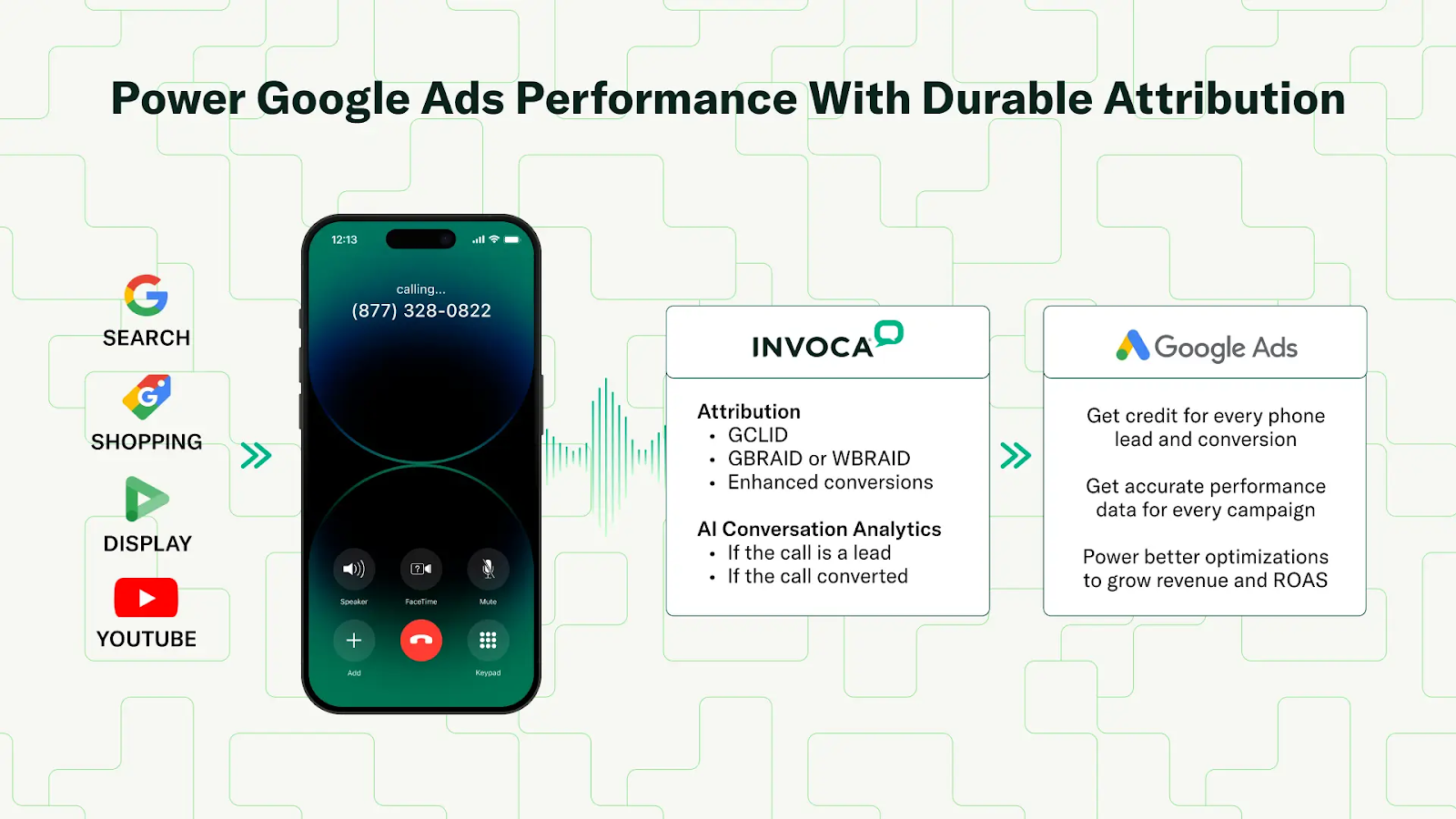
Additionally, you can use Invoca’s conversation data to train your chatbots and SMS agents. Instead of scraping generic web data, your AI will learn from the successful interactions of your top-performing human agents. This ensures that interactions are seamless and brand-safe.
Additional Reading
Want to learn more about how Invoca can help you connect your marketing data and fuel your AI? Check out these resources:
- Why First-Party Conversation Data Is Your AI Advantage
- Why Many B2C Brands Overestimate Their AI Maturity
- How to Reduce Data Latency and Close the Marketing AI to Insight Gap

.svg)
.svg)