.svg)


Telecom customers expect fast support, reliable connectivity, and service that feels personal — even as call volumes, channels, and complexity continue to rise. For many providers, meeting those expectations at scale is challenging. Legacy systems, limited headcount, and constrained investment budgets can make it harder to deliver the kind of responsive, high-quality experiences customers often take for granted.
That’s where artificial intelligence in telecom is making a measurable difference. When applied strategically, AI in telecommunications helps providers move beyond reactive support models toward more proactive, insight-driven engagement. According to McKinsey, telecom organisations that deploy the right AI capabilities could reduce operational costs by up to 30% and improve customer satisfaction by as much as 20% within three years by enabling what the firm describes as a “next-best experience” for customers.
In this article, we’ll explore practical AI use cases in telecom and how AI-driven platforms like Invoca help providers turn customer conversations into real-time intelligence. From understanding caller intent and improving routing to strengthening service quality and uncovering actionable insights, AI in telecom is helping providers create smarter, more connected customer experiences — without sacrificing the human element.
Main Takeaways
- AI in telecom helps providers deliver faster, more personalised customer experiences by automating support, improving call routing, and resolving issues before customers ever need to reach out.
- AI optimises telecom operations by predicting demand, preventing congestion, and reducing downtime. This strengthens reliability and maintains service quality at scale.
- Artificial intelligence in telecom gives leaders deeper business intelligence for forecasting, planning, and revenue growth. AI helps uncover trends, reduce churn, and support more accurate, data-driven decision-making.
- Invoca turns customer conversations into actionable insights that AI alone can’t provide. Telecom providers use Invoca to understand intent, improve routing, reduce transfers, and elevate the customer experience (CX) from the very first interaction.
What Is AI In Telecom?
AI in telecom refers to the use of artificial intelligence technologies across customer engagement, network operations, and business functions to help providers operate more efficiently and serve customers more effectively. In practice, AI in telecommunications enables telcos to improve the customer experience, optimise telephony networks, prevent fraud, and support more predictable, sustainable revenue growth.
Common AI use cases in telecom include agentic customer service, chatbots and virtual assistants, workflow automation, security and fraud detection, and sales and marketing optimisation. Increasingly, AI is also being applied to customer conversations, helping telecom providers understand intent, route interactions more intelligently, and deliver relevant support and offers more immediately.
AI Technologies Used in Telecom
There are five major AI technologies used in telecommunications that are driving innovation across the industry. They are:
- Machine learning (ML): ML helps telecom providers detect patterns and trends in large datasets, predict network demand, and automate decisions based on historical and near real-time data.
- Deep learning (DL): Building on ML, deep learning enables more complex analysis, including anomaly detection, intent analysis, and multilayer network optimisation.
- Generative AI: This technology supports automation across customer-facing and internal workflows, including agent assistance, knowledge retrieval, content creation, and more personalised customer interactions.
- Network digital twins: These virtual network models allow providers to simulate upgrades, forecast performance, and test configurations safely in a sandbox environment before deploying changes in live networks.
- Intelligent automation and robotic process automation (RPA): Automation tools reduce manual effort by streamlining repetitive back-office workflows, such as provisioning, billing support, and ticketing.
9 AI Use Cases in Telecom
Let’s take a closer look at AI use cases in telecom to understand the breadth of impact AI in telecom can have across customer experience, operations, and revenue. While there are many applications, the examples below highlight where artificial intelligence delivers the most immediate and measurable value to telecom providers.
1. Customer Experience
AI improves customer support, reduces wait times, and enhances both self-service and agent-led interactions by automating routine tasks, taking the pressure off live agents and providing key insights into customer needs. This gives customers a far smoother journey and allows agents to resolve issues faster.
Examples:
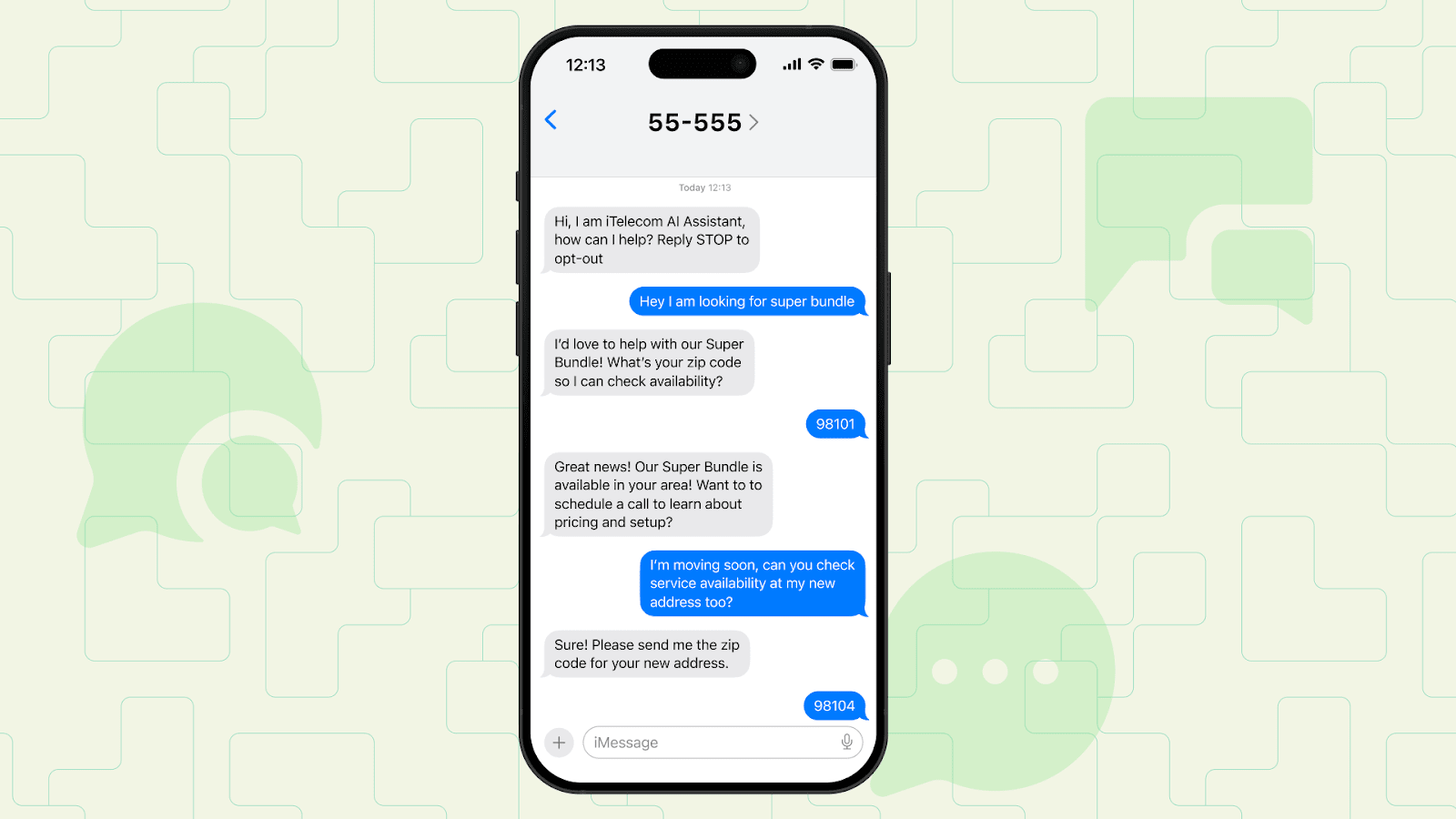
- AI-powered messaging agents: For customers who prefer to send and receive texts, these agents help resolve common service issues instantly without a live agent. They can be trained on high-quality historical conversations to deliver consistent, effective service. Some solutions, such as Invoca’s SMS Messaging Agent, also connect conversation data with a customer’s digital journey — enabling more personalised greetings and faster issue identification.
- Automated troubleshooting flows: Agentic AI solutions help customers troubleshoot simple issues, like resetting a Wi-Fi router, without long wait times on the phone. In more advanced scenarios, AI can interact directly with devices such as modems or phone lines to diagnose issues, verify connectivity, or confirm service status before escalating to a live agent.
- Proactive service alerts: AI can be trained to detect early signs of customer frustration and deliver proactive service messages. So, if Wi-Fi is slow or unresponsive, or an outage occurs, an AI agent can trigger a service alert before a customer calls to report it.
- Omnichannel experiences: Tools like Invoca help telecom providers deliver smoother omnichannel experiences by connecting digital and voice interactions. Invoca can route callers based on their intent to the right agent or queue, and features like PreSense give agents immediate context by surfacing details from the caller’s online journey. This added continuity reduces friction, shortens resolution times, and helps ensure customers don’t have to repeat information as they move between channels.
2. Marketing and Personalisation
Telcos can use AI to analyse customer calls, emails, texts, and other interactions to define customer behavior. They can then use that insight for personalisation, such as delivering relevant offers at an appropriate point in the customer journey or predicting purchase patterns. Over time, this level of precision helps reduce churn across channels and increase customer lifetime value (CLV), a key CX metric.
Examples:
- Personalised plan recommendations: AI analyses usage patterns to identify opportunities for more relevant or cost-effective plans. For example, if a customer frequently makes long-distance calls on a pay-as-you-go (PAYG) plan, AI can flag them as a strong candidate for a discounted long-distance or bundled plan.
- Behavioral segmentation: Marketing teams can use call analytics data — including insights captured by AI-powered tools like Invoca — to segment customers more precisely by device type, location, engagement level, and interaction history.
- Predictive customer value modeling: ML models combine behavioral and engagement data to forecast future revenue potential. This helps identify high-value customers, prioritise retention strategies, and surface at-risk customers who may benefit from proactive outreach.
- Marketing campaign optimisation: AI tools like Invoca connect online and offline touchpoints by tracking how every digital ad ultimately converts to revenue. With clearer attribution, marketing teams can see which campaigns drive high-value conversations and optimise marketing budgets accordingly.
3. Network Optimisation
AI and ML tools can optimise network performance by analysing massive data streams in core telecom systems and cloud-level operations. By pinpointing bottlenecks, identifying latency issues, and predicting demand, they help telcos keep traffic flowing smoothly and maintain consistent service quality.
Examples:
- Traffic forecasting: AI and ML tools predict call traffic congestion before it occurs, allowing telecom operators to better balance network load.
- Dropped-call prevention: AI-driven network performance analysis can reduce interruptions in high-traffic areas and prevent dropped calls.
- Dynamic Spectrum Allocation (DSA): DSA improves wireless communication efficiency and maintains call quality by dynamically assigning radio frequencies and adjusting bandwidth in response to network demand.
- Automated network adjustments: AI-driven automation reduces the need for manual network tuning. This lowers the risk of operator error while maintaining more consistent, reliable service performance.
4. Predictive Maintenance
AI can help telcos reduce network downtime by identifying potential equipment failures before they happen. Predictive analysis of physical infrastructure enables proactive maintenance of cell towers and hardware systems. Telecom teams can address issues early, improve reliability, and keep customers connected without unnecessary disruption.
Examples:
- Equipment failure prediction: AI monitors and flags early signs of degradation in physical infrastructure such as towers, antennas, and fiber lines.
- Anomaly detection: AI can also flag abnormal conditions, including temperature, power, or hardware signal fluctuations, that often precede equipment failures.
- Proactive repairs: AI-driven insights can trigger maintenance protocols before outages occur, preserving network integrity and service reliability.
- Reduced truck rolls: Predictive maintenance reduces the need for in-person repair visits, lowering operational costs and improving response times.
5. Security and Fraud Detection
AI provides stronger network security for telcos by leveraging tools such as behavioral modeling and automated risk scoring to monitor traffic for abnormal behavior, detect fraud attempts, and respond to threats quickly.
Examples:
- Cyberattack monitoring: AI can track, identify, and flag unusual network traffic patterns that may signal DDoS attacks or intrusions.
- Fraud prevention: AI can also detect fraud attempts, such as SIM card swaps, identity theft, or compromised accounts.
- Suspicious call-routing alerts: Irregular routing behavior that may indicate misuse or toll fraud can be detected using AI tools.
- Risk scoring: AI can automatically assign risk scores to transactions or user behaviors that pose elevated security or fraud risk, enabling immediate, proactive action.
6. Business Intelligence
AI’s ability to quickly and accurately analyse large volumes of data enables telecom providers to transform raw information — including the content of customer service phone calls — into actionable intelligence. With AI in telecom, data that once lived in silos can now inform decisions across finance, product development, marketing, and strategy. These insights support better planning, forecasting, and revenue growth while giving businesses a deeper understanding of customer needs and market dynamics.
Examples:
- Trend and churn analysis: AI surfaces patterns in customer behavior and the underlying reasons for churn. Conversation intelligence platforms like Invoca analyse phone calls at scale to reveal sentiment shifts, recurring issues, and opportunities to improve retention.
- Revenue forecasting: Analysis of historical data and consumer behavior can predict subscriber growth, service demand, and financial performance, helping refine forecasts.
- 5G planning support: AI can forecast subscriber demand and evaluate expansion scenarios to guide long-term 5G investment decisions, from infrastructure deployment to regional prioritisation.
- Offer and promotion optimisation: AI analyses customer data at scale to recommend incentives, bundles, or promotions most likely to drive conversion or retention.
- Digital twins: AI-powered digital twins simulate network performance in a virtual environment, allowing operators to test adjustments, model new services, and refine configurations offline — reducing downtime and operational risk.
7. Edge AI (AI at the Network Edge)
Deploying AI at the network edge improves last-mile performance and device-level intelligence by processing data locally rather than relying solely on the cloud. This gives telecom operators faster responsiveness, lower latency, and more immediate decision-making — all essential for high-bandwidth applications, smart homes, and next-generation mobility experiences.
Examples:
- Low-latency routing: Edge AI processes data locally to optimise routing and improve connectivity for high-demand applications such as video streaming, gaming, and real-time communications.
- On-device diagnostics: AI at the edge can identify Wi-Fi or modem issues before customers contact support, enabling remote fixes or proactive alerts to reduce frustration and call volume.
- Local anomaly detection: Edge AI can detect outages, performance degradation, or suspicious activity faster than cloud-only systems. This, in turn, helps telcos improve service reliability and security.
- Internet of Things (IoT) device orchestration: Edge-based AI coordinates smart home or enterprise IoT devices locally to reduce latency, avoid unnecessary cloud dependence, and improve device responsiveness.
8. 5G and IoT Enablement
Telecom network operators looking to the future will use AI to support large-scale device connectivity, advanced mobility, and next-generation network density for rapidly growing 5G and IoT ecosystems.
Examples:
- Mass-device coordination: AI can manage traffic from massive numbers of IoT sensors, wearables, and connected devices across the network, ensuring stable performance as device volumes grow.
- Predictive load balancing: AI can automatically redistribute network load by anticipating spikes during events or peak usage periods, helping maintain consistent service quality.
- 5G coverage modeling: AI predictive models can pinpoint the optimal placement and configuration for network infrastructure, such as antennas, to maximise coverage, performance and capacity.
- Device-level analytics: AI can quickly detect malfunctioning or underperforming IoT devices, even across large, distributed networks, so operators can proactively troubleshoot issues.
9. Operational Automation (Back-Office AI)
AI can automate routine back-office functions across telecom operations — including accounting, finance, service activation, and support workflows — to increase efficiency and reduce costs. By handling repetitive tasks at scale, AI in telecom frees staff to focus on higher-value work, accelerates internal processes, and helps ensure more consistent customer experiences.
Examples:
- Automated ticket classification: AI sorts and prioritises incoming service tickets by issue type and urgency, enabling technicians to respond more quickly and effectively.
- Provisioning automation: AI-powered workflows can activate and configure new services instantly, eliminating the need for customers to speak with an agent or technician during setup.
- Knowledge assistants: Virtual AI assistants can sift through large knowledge bases to deliver on-demand answers, helping live agents resolve issues faster and more accurately.
- Billing anomaly detection: AI can improve the customer experience by identifying anomalies in billing, such as incorrect or unusual charges, so they can be fixed before customers even notice.
Challenges of AI in Telecom
Deploying advanced technology across complex network environments is never simple. To realise the full value of AI in telecom, providers must successfully navigate several challenges that can slow adoption or limit impact if left unaddressed.
- Legacy infrastructure barriers: Many telecom systems run on aging platforms that weren’t designed to support modern AI workloads. This can make upgrades slower, more costly, or disruptive to existing workflows.
- Fragmented or poor-quality data: Telecom data is often spread across billing systems, call centres, digital channels, and network tools. Without unified, high-quality data, AI models struggle to generate accurate predictions or automate processes effectively.
- Security and compliance risks: AI introduces new attack surfaces and data-handling considerations. Telecom providers must ensure customer data, call records, and network analytics are securely stored, governed, and processed in line with regulatory requirements.
- High implementation and operational costs: Deploying AI at scale requires investment in cloud infrastructure, data pipelines, integrations, and ongoing model training and monitoring — costs that can add up quickly without a clear road map.
- Talent and skill shortages: Many telecom organisations lack sufficient access to AI engineers, data scientists, and analytics talent needed to deploy, tune, and maintain high-performing AI systems.
- Customer transparency and trust: As AI plays a larger role in customer interactions, opaque decision-making or unexplained routing outcomes can erode trust and create frustration if not handled carefully.
The challenges can be overcome through strong strategic planning and a firm focus on outcomes. As more telecoms modernise their networks, adopt cloud-native architectures, and unify customer data across channels, implementing AI in telecommunications becomes more practical — and far more impactful.
Power Smarter Customer Connections with AI-Powered Insights from Invoca
More telco providers are realising that AI is an essential advantage for delivering faster, smarter, and more personalised customer experiences. While AI is also transforming network operations, security, and strategic planning, forward-looking telcos don’t need to wait on large-scale infrastructure overhauls to see value. Many of the most compelling AI use cases in telecom already exist within everyday customer interactions.
For example, with an AI-powered platform like Invoca, telecoms can tap into a wealth of data from customer conversations to gain critical insights into customer intent, sentiment, call outcomes, friction points, and more. Invoca’s AI-driven analysis transforms those conversations into actionable intelligence — helping teams improve call routing, reduce unnecessary transfers, and elevate customer experience from the very first interaction.
Telecom marketing teams can also use Invoca to understand how many call conversions their digital ads drive. By showing how phone calls convert from specific ads and where the buying journey breaks down, Invoca enables smarter budget allocation, more effective campaigns, and better end-to-end customer experiences.
Invoca also offers a two-way SMS AI messaging agent that allows telecom providers to engage customers through instant, 24/7 text conversations. From customer support to purchase completion, AI-powered messaging helps resolve issues quickly while keeping experiences convenient and personal. To see how we can help, book a demo with us today.
Additional Reading
To learn more about how Invoca’s AI-driven quality intelligence tools can help your business power smarter customer connections, check out these additional resources:
- AI Has Made Conversations the Future of Revenue Growth. Are You Ready?
- The Role of AI in Marketing and How to Use It
- How to Predict Consumer Behavior with AI in 2026

.svg)
.svg)